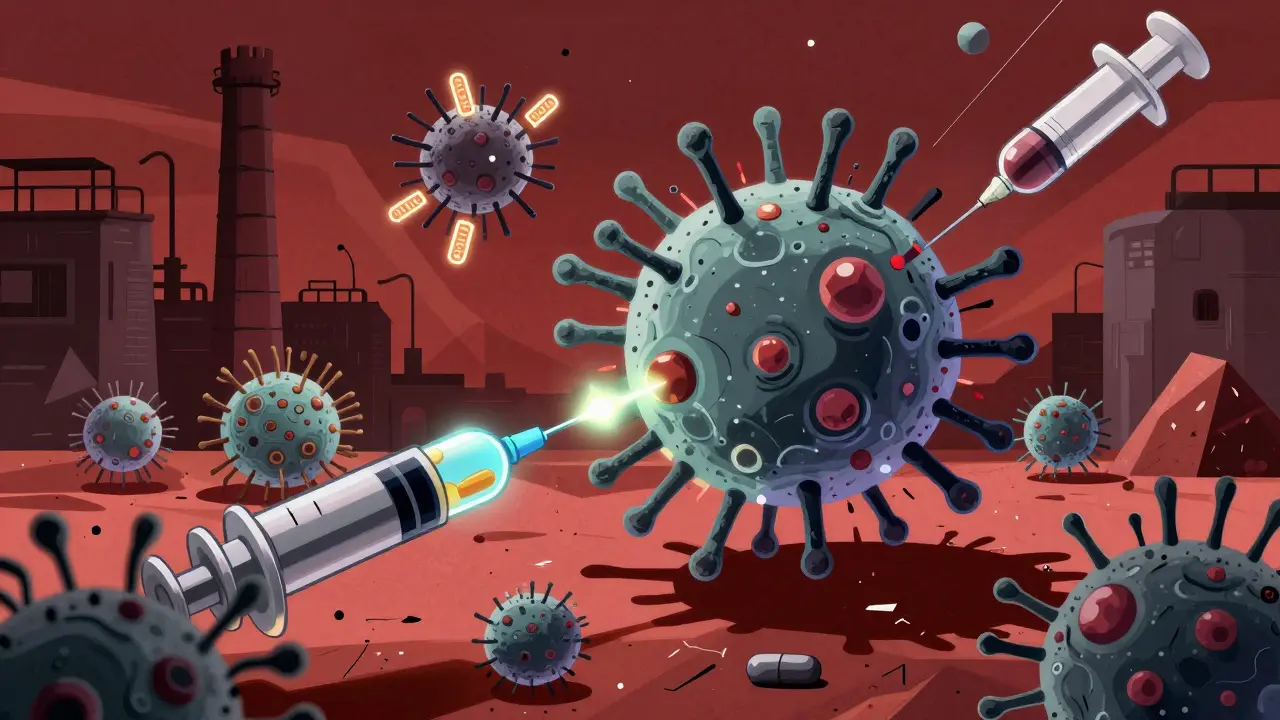
Every time you take an antibiotic when you don’t need it, you’re not just helping yourself-you’re helping bacteria become stronger. That’s not a metaphor. It’s science. And it’s happening right now, in kitchens, hospitals, farms, and rivers around the world. By 2025, antibiotic resistance is already killing over 1.2 million people each year. That’s more than HIV/AIDS or malaria. And it’s getting worse-not because new superbugs are appearing out of nowhere, but because we’ve been feeding them, for decades, with careless use.
How Bacteria Learn to Survive Antibiotics
Bacteria don’t think. They don’t plan. But they evolve-fast. When an antibiotic hits a bacterial population, most die. But a few? They’re lucky. Maybe they have a mutation that changes the shape of a protein the drug targets. Maybe they’ve got a pump that kicks the drug out before it can work. Maybe they’ve picked up a gene from another bacterium that turns the antibiotic into harmless junk.
These aren’t rare accidents. In lab studies, bacteria exposed to low doses of antibiotics over time develop resistance in as few as 150 generations. That’s weeks, not years. And the mutations aren’t random. One study tracked six bacterial species from the food chain and found they all developed resistance to nearly every antibiotic tested. The minimum dose needed to kill them-called the MIC-went up six times on average. That’s not a small change. It’s a full escape.
And here’s the twist: resistance doesn’t start with big, permanent DNA changes. It starts small. With chemical tags-methylation-on genes that control metabolism. These tags turn genes on or off without changing the code itself. It’s like a temporary switch. But if the pressure keeps up, the bacteria don’t just rely on the switch. They rewrite the code. Mutations in genes like gyrA, parC, and fusA become permanent fixes. In some cases, bacteria even mutate their own efflux pumps-tiny molecular vacuums-that spit out antibiotics. One strain of Yersinia enterocolitica accumulated so many mutations it barely survived, but it survived anyway.
It’s Not Just Antibiotics That Cause Resistance
Most people think resistance only comes from taking too many antibiotics. But it’s more complex. Non-antibiotic drugs-like antidepressants, antihypertensives, and even some painkillers-can make bacteria more likely to pick up resistance genes from their environment. These drugs don’t kill bacteria, but they stress them. And stressed bacteria are more likely to grab DNA from dead neighbors, even if that DNA came from a completely different species.
And then there’s the tetracycline puzzle. Scientists found that resistance to this common antibiotic doesn’t come from a single mutation. It comes from two. First, a tiny piece of DNA called a transposon inserts itself into the control region of a gene that normally shuts off the pump. That breaks the off-switch. Suddenly, the pump runs all the time. Only after that does a second mutation improve the pump’s efficiency. It’s like first breaking the lock, then upgrading the engine.
This means even low doses-like those in livestock feed or polluted water-can set off this chain reaction. You don’t need to be sick to contribute to the problem. You just need to live near a farm, a hospital, or a wastewater plant.
Why Doctors Prescribe Too Many Antibiotics
Here’s the hard truth: doctors often prescribe antibiotics because they’re unsure. A kid has a fever. A cough won’t go away. The parent is anxious. The clock is ticking. So they reach for the prescription pad-not because they think it’s necessary, but because they’re afraid of missing something.
In the U.S., about 30% of outpatient antibiotic prescriptions are unnecessary. That’s 47 million prescriptions a year for viral infections like colds, flu, and most sore throats-things antibiotics can’t touch. In Europe, the number is similar. And in many low-income countries, antibiotics are sold over the counter without any prescription at all.
It’s not just about ignorance. It’s about systems. Primary care is rushed. Diagnostic tools are slow. Culture tests take days. By then, the patient is already feeling better-or worse. So the easy answer wins.
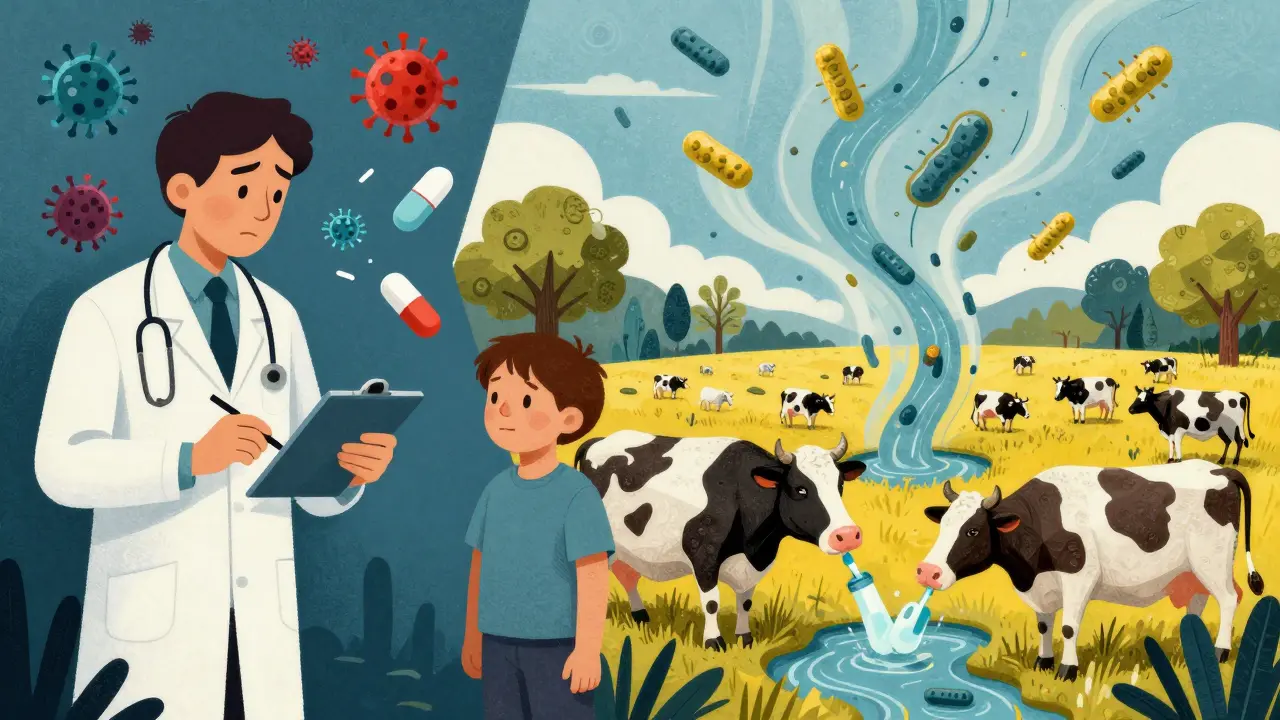
What ‘Appropriate Use’ Actually Means
Appropriate use isn’t just about taking fewer antibiotics. It’s about taking the right one, at the right dose, for the right length of time.
- Don’t use antibiotics for viruses. Colds, flu, most sinus infections, and bronchitis are viral. Antibiotics won’t help. They’ll just train bacteria.
- Finish the full course. Stopping early leaves behind the toughest survivors. They’re the ones that will pass on resistance.
- Don’t save leftovers. That old amoxicillin from last year? It might not be the right drug, the right dose, or even safe anymore.
- Ask: ‘Is this really needed?’ If your doctor prescribes an antibiotic, ask if there’s a chance it’s not bacterial. Ask about alternatives.
And here’s something most people don’t know: some infections get better faster without antibiotics. Studies show that for ear infections in healthy children, or mild sinus infections, watchful waiting works just as well as antibiotics-with fewer side effects and less resistance down the line.
What’s Being Done-and Why It’s Not Enough
Over 150 countries now have national plans to fight antibiotic resistance. But execution is uneven. High-income countries hit 75% of their goals. Low-income nations? Only 35%. Why? Lack of labs, trained staff, clean water, and affordable diagnostics.
Meanwhile, the pipeline for new antibiotics is dry. Of the 67 antibiotics currently in development, only 17 target the most dangerous resistant bacteria. And only 3 are truly new-designed to bypass existing resistance mechanisms. The rest are tweaks of old drugs. Bacteria will outsmart them too.
Some hope lies in CRISPR gene editing-tools that can slice out resistance genes from bacteria. Or in metabolomics, which tracks how bacteria change their metabolism to survive. But these are still in labs. They won’t reach clinics for years.
The real solution? Stewardship. Not just in hospitals, but in every doctor’s office, every farm, every pharmacy. Programs that train doctors to hold off on antibiotics, that use rapid tests to confirm bacterial infections, that track resistance patterns in real time. In places where these programs ran for 12 to 18 months, inappropriate prescribing dropped by 20-30%. No new drugs. Just better habits.

The Bigger Picture: One Health
Antibiotic resistance isn’t a human problem. It’s a One Health problem.
That means bacteria move between people, animals, and the environment. Resistant strains from factory farms end up in meat. They get washed into rivers. They show up in soil where vegetables grow. They’re carried by birds, flies, and even wind.
When you eat meat from animals given antibiotics for growth-not illness-you’re eating resistance. When you flush old pills down the toilet, you’re polluting waterways with drugs that don’t break down. When you don’t wash your hands after the bathroom, you’re spreading resistant strains.
Fixing this means fixing all of it. Better farming practices. Cleaner water. Safer waste disposal. Stronger regulations on antibiotic use in animals. And global cooperation-not just in wealthy nations, but everywhere.
What You Can Do Today
You don’t need to be a scientist or a policymaker to make a difference. Here’s what works:
- Never demand antibiotics. If your doctor says you don’t need them, trust them. Ask for symptom relief instead.
- Wash your hands. It’s the simplest way to stop resistant bacteria from spreading.
- Dispose of old meds properly. Don’t flush them. Take them to a pharmacy drop-off.
- Choose meat raised without routine antibiotics. Look for labels like “no antibiotics ever” or “raised without antibiotics.”
- Support policies that fund stewardship programs. Ask your local representatives to fund rapid diagnostics and antibiotic monitoring.
Antibiotics saved millions. But they’re not magic. They’re tools. And like any tool, they break when misused. We’re running out of time-not because bacteria are getting smarter, but because we stopped listening to the warning signs. Fleming knew this in 1945. We’re just catching up.
Can I get antibiotic resistance from someone else?
Yes. Resistant bacteria spread easily through touch, coughs, contaminated food, and even water. You don’t need to have taken antibiotics yourself to carry or spread resistant strains. That’s why handwashing and good hygiene matter so much.
Are natural remedies better than antibiotics?
No. Natural remedies like honey, garlic, or essential oils may help soothe symptoms, but they don’t kill bacteria the way antibiotics do. For serious bacterial infections-like pneumonia, sepsis, or strep throat-antibiotics are still the only proven treatment. The goal isn’t to avoid antibiotics entirely, but to use them only when they’re truly needed.
Why don’t we just make new antibiotics?
It’s expensive and risky. Developing a new antibiotic costs over $1 billion, and many fail in trials. Plus, when new ones do come out, doctors are told to hold off on using them-so companies can’t make enough profit to justify the cost. That’s why only 3 truly new antibiotics are in development for the most dangerous superbugs.
Does using antibiotics in animals really affect humans?
Absolutely. Up to 70% of antibiotics used in the U.S. go to livestock-not to treat sick animals, but to help them grow faster or prevent disease in crowded conditions. Resistant bacteria from those animals can spread to humans through meat, water, and the environment. That’s why many countries now ban antibiotics for growth promotion.
If I take antibiotics, will I become resistant?
You don’t become resistant-your body doesn’t change. But the bacteria in your body might. After taking antibiotics, resistant strains can take over your gut, skin, or throat. Even if you feel fine, those bacteria can spread to others or cause harder-to-treat infections later. That’s why every course matters.
What Comes Next?
The next decade will decide whether we stay in the antibiotic era-or slip into a post-antibiotic world. In that world, a scraped knee could kill. A C-section could become deadly. Chemotherapy could be too risky to try.
It’s not inevitable. But it won’t be fixed by a single breakthrough. It will be fixed by millions of small choices: a doctor saying no, a farmer changing practices, a parent refusing a prescription, a policymaker funding diagnostics, a consumer choosing antibiotic-free meat.
The bacteria aren’t the enemy. Our habits are. And habits can change.
Wren Hamley
January 4, 2026 AT 20:27Okay, so bacteria are basically the ultimate improv comedians-no script, no plan, just pure evolutionary chaos. One minute they’re chillin’ in your gut, next thing you know they’ve hacked the antibiotic’s API and are running their own version of the app. And the kicker? It’s not even about mutations at first-it’s epigenetic switches flipping like a teenager changing their Spotify playlist every 30 seconds. Methylation as a temporary workaround, then boom-permanent code rewrite. It’s like watching a hacker go from phishing emails to full system root access.
And the tetracycline thing? Two-step unlock: first break the off-switch, then upgrade the pump. That’s not evolution, that’s engineering. We’re not fighting bugs-we’re fighting a species that learned to hack its own genome faster than we can update our phones.
Kerry Howarth
January 5, 2026 AT 15:53Handwashing works. It’s simple, free, and saves lives.
Neela Sharma
January 7, 2026 AT 10:37They don’t think but they evolve-like silent gods of survival whispering in the dark between our antibiotics. We built cathedrals of medicine, then lit candles with gasoline. The bacteria didn’t betray us-they just outlived our arrogance. Every pill, every farm, every flushed tablet-it’s not poison. It’s prayer. And they’re answering.
Shruti Badhwar
January 9, 2026 AT 08:44The data is unequivocal: inappropriate antibiotic prescribing is a systemic failure rooted in healthcare infrastructure deficits, economic incentives, and public misconceptions. The WHO’s Global Action Plan is commendable, yet implementation remains fragmented. Regulatory enforcement in low-resource settings is critically underfunded, and without universal access to rapid diagnostics, empirical prescribing will persist. Structural reform-not individual guilt-is the only viable path forward.
Brittany Wallace
January 10, 2026 AT 14:49It’s wild to think that the same bacteria that’ve been around since before dinosaurs are now the ones teaching us humility 😔
Maybe we’re not the smartest species after all. We invent drugs, they invent escape routes. I’m gonna start asking my doctor ‘Is this really needed?’ like the post said. And I’m buying antibiotic-free chicken now 🐔✨
Michael Burgess
January 11, 2026 AT 16:48My cousin’s a vet in Iowa. She told me they stopped giving tetracycline to calves for ‘growth promotion’ last year. First month? Calf pneumonia spiked. Second month? They started using better ventilation, probiotics, and rotational grazing. Now they’re using 80% less antibiotics-and the calves are healthier.
Turns out, you don’t need drugs to keep animals alive. You just need to stop treating them like factories. The science’s been there for years. We just didn’t want to change the system.
Also, if you’ve ever had a UTI and were told to ‘wait it out’? That’s not a cop-out. It’s science. Your body’s got this. Let it.
Liam Tanner
January 12, 2026 AT 06:02One of the biggest blind spots: we treat resistance like it’s a future problem. It’s already here. Right now, someone in a rural clinic in Bangladesh is trying to treat a kid with pneumonia, and the only antibiotic they have doesn’t work. That’s not abstract. That’s a child dying because we kept pushing pills instead of fixing systems.
It’s not about blame. It’s about responsibility. And responsibility means funding diagnostics, training nurses, and paying doctors to spend five extra minutes explaining why they’re not prescribing.
Hank Pannell
January 12, 2026 AT 19:32Think about it: evolution doesn’t care about morality. It doesn’t care if you ‘meant well’ when you took that amoxicillin for a cold. It only cares about survival. And bacteria? They’re the ultimate survivalists. They don’t need consciousness-they just need time, pressure, and a little bit of DNA floating around in a river.
The real tragedy isn’t that we’re losing antibiotics. It’s that we thought we could outsmart biology with better drugs. We didn’t. We just delayed the inevitable. The solution isn’t a new molecule-it’s a cultural reset. We have to stop treating medicine like a vending machine. It’s not a product. It’s a privilege.
And the worst part? We’ve known this since Fleming warned us in 1945. We just chose convenience over survival. Now we’re paying the price with our children’s futures.
CRISPR might help. But it won’t fix the mindset. We need to stop seeing bacteria as enemies. They’re just doing what life does: adapting. The problem isn’t them. It’s us.
veronica guillen giles
January 12, 2026 AT 21:25Oh wow, I didn’t realize my grandma’s leftover penicillin from 2012 was secretly training superbugs to take over the world. My bad. I’ll just leave it in the medicine cabinet next to my expired sunscreen and that one candle I never lit.
And hey, if I eat chicken that was fed antibiotics, does that mean I’m basically a biohazard? Should I start wearing a hazmat suit to the grocery store?
Ian Ring
January 14, 2026 AT 16:22Handwashing. Seriously. It’s not sexy. It’s not a breakthrough. But it’s the single most effective intervention we have-by far. And yet, we treat it like a footnote. We invest billions in new drugs, but not a dime in public hygiene education. It’s like building a fortress with a hole in the wall and then blaming the invaders.
Also, the ‘no antibiotics ever’ label? It’s not marketing fluff. It’s a signal. Vote with your wallet. Choose the pricier chicken. It’s not a luxury. It’s a lifeline.
And for the love of all that’s holy-don’t flush pills. Use drop-offs. Please. 💩🚯