LDL-C Reduction Multiplier Tool
Calculate your total estimated LDL-C reduction. Unlike simple addition, drug effects are multiplicative—each subsequent medication works on the cholesterol remaining after the previous one.
The Rule of Six: Why More Statin Isn't Always Better
If you've ever wondered why your doctor is hesitant to just keep cranking up your dose, it's because of a phenomenon known as the "rule of six." According to a 2023 analysis in the Journal of the American College of Cardiology, every time you double a statin dose, you only get about an additional 6% reduction in LDL-C. Think of it like this: if you move from 10mg of atorvastatin to 20mg, your LDL reduction might go from 39% to 45%. You've doubled the drug in your system, but you've only gained a tiny bit of extra benefit. This flat dose-response curve is the primary reason why escalating a single drug is often a losing game. Instead of pushing a statin to its limit, adding a second agent with a different mechanism of action provides a much steeper drop in cholesterol.How the Math Actually Works (Multiplicative vs. Additive)
One of the biggest misconceptions is that drug effects simply add up. If Drug A lowers cholesterol by 50% and Drug B lowers it by 20%, you don't get a 70% reduction. Instead, the effects are multiplicative. You get the first reduction, and then the second drug works on the *remaining* cholesterol. Here is the basic formula used by specialists:%A + %B(1 − %A) + %C(1 − %A)(1 − %B).
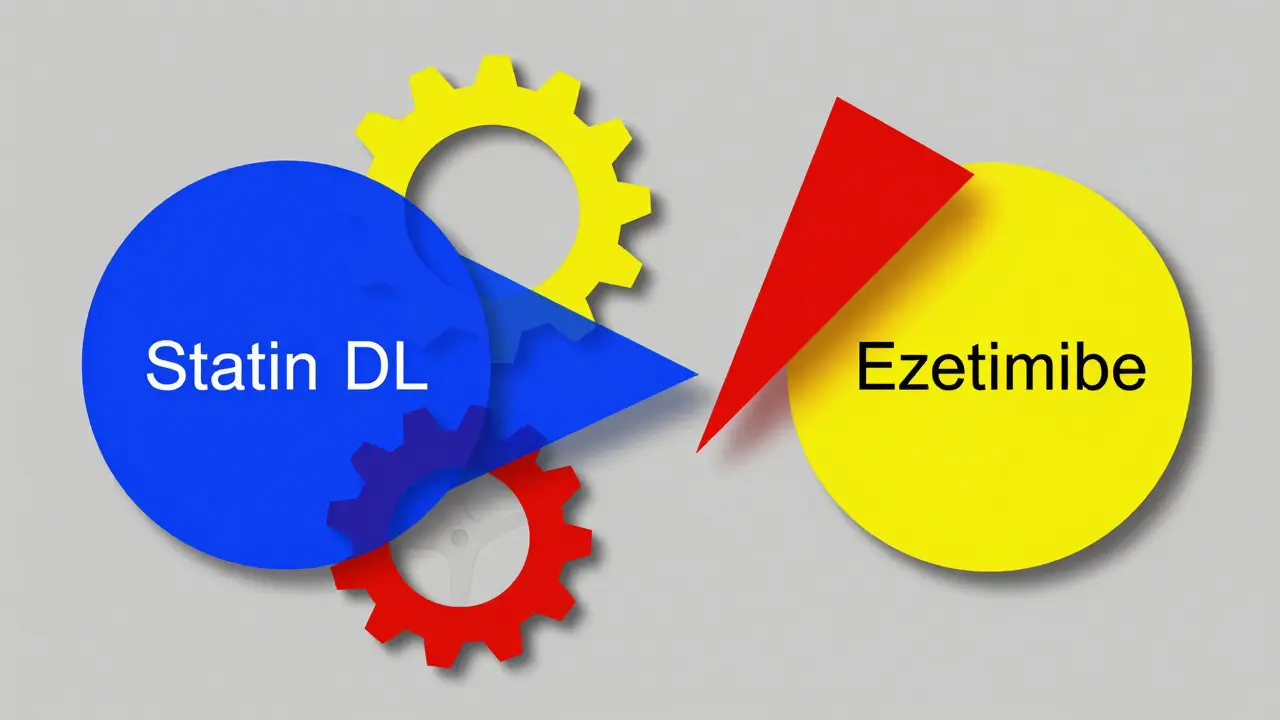
For example, if you use a high-intensity statin (50% reduction) and add Ezetimibe (a medication that blocks cholesterol absorption in the gut), you don't hit 70%. You get 50% from the statin, and then 20% of the remaining 50%, which equals 10%. Your total reduction is 60%. While that sounds like less than a simple addition, this 60% reduction is often comparable to using expensive PCSK9 inhibitors alone, but at a fraction of the cost and with a much simpler regimen.
| Strategy | Typical LDL-C Reduction | Main Benefit | Main Drawback |
|---|---|---|---|
| High-Dose Statin Monotherapy | ~50% | Single pill, well-studied | Higher risk of muscle pain |
| Moderate Statin + Ezetimibe | 50-55% | Fewer side effects than high-dose | Two medications instead of one |
| High-Dose Statin + Ezetimibe | ~60% | Powerful reduction | Potential for additive side effects |
| Triple Therapy (Statin + Ezetimibe + PCSK9i) | ~84% | Maximum possible lowering | High cost and injection requirements |
Dealing with Statin Intolerance
For many, the issue isn't just about the numbers-it's about how they feel. Statin-associated muscle symptoms (SAMS) are a real hurdle, affecting between 7% and 29% of users. When patients are on high-dose statins, muscle-related adverse events happen in about 10-15% of cases. By dropping to a moderate dose and adding another agent, that risk drops to 5-8%. A great alternative for those who truly cannot tolerate statins is Bempedoic Acid. This drug targets the liver's cholesterol production but is not activated in the muscles, meaning it doesn't cause the same aching that statins do. According to the CLEAR Harmony trial, combining a moderate-dose statin with bempedoic acid can achieve the same LDL-C drop as a high-dose statin but with 25% fewer muscle-related side effects.The Shift Toward Early Combination Therapy
For years, the standard medical approach was "statin first, then add more if it fails." However, we're seeing a paradigm shift. The European Atherosclerosis Society now suggests that for very high-risk patients-such as those who have already had a heart attack or have severe diabetes-combination therapy should be the *initial* treatment. Why wait? Data from the European Heart Journal shows that patients starting with a statin/ezetimibe combination hit their cholesterol targets about 4.2 months faster than those starting with a statin alone. In a high-risk scenario, those four months of uncontrolled cholesterol can be the difference between stability and another cardiovascular event.
Practical Challenges and Real-World Results
Despite the evidence, this approach isn't always the first choice in a typical clinic. Many primary care physicians still stick to the old "escalate the dose" method, with some studies showing only 25% of eligible patients are put on combination therapy. Often, this isn't due to a lack of will, but because of insurance hurdles. Non-statin agents often require "prior authorization," which can delay treatment by two weeks. But when it works, the results are striking. Consider a 68-year-old patient who had a heart attack. On 80mg of atorvastatin (high dose), their LDL was still 82 mg/dL-too high for their target of <70 mg/dL-and they were struggling with leg cramps. By switching to 40mg of atorvastatin (moderate dose) and adding 10mg of ezetimibe, their LDL dropped to 64 mg/dL, and the muscle pain vanished. This isn't just a win for the numbers; it's a win for the patient's quality of life.The Bottom Line on Cardiovascular Risk
At the end of the day, the goal isn't to hit a number on a lab report; it's to prevent a heart attack or stroke. The gold standard of evidence-the Cholesterol Treatment Trialists' meta-analyses-shows that for every 1 mmol/L (39 mg/dL) you drop your LDL, you reduce the relative risk of a major vascular event by 22%. Crucially, this benefit happens regardless of *how* you achieve the drop. Whether it's through a massive dose of one drug or a smart combination of two, the heart doesn't care about the pharmacy bill or the number of pills; it only cares that the LDL is low. By using reduced statin doses in combination with other agents, we can reach those targets safely, keeping patients on their meds longer and reducing the likelihood of treatment discontinuation.Will lowering my statin dose make the medication less effective?
Not if you replace that lost potency with another lipid-lowering agent. Because statins have a flat dose-response curve (the rule of six), doubling the dose only gives a small extra benefit. Adding a second drug like ezetimibe often results in a larger total drop in LDL-C than simply increasing the statin dose would have achieved on its own.
What are the most common non-statin drugs used in combination?
The most common is Ezetimibe, which stops cholesterol from being absorbed in the intestine. Others include Bempedoic Acid, which is great for those with muscle sensitivity, and PCSK9 inhibitors, which are powerful injectable drugs used for very high-risk patients or those with familial hypercholesterolemia.
Can combination therapy help with muscle pain?
Yes. Muscle pain is often dose-dependent. By using a moderate-intensity statin instead of a high-intensity one and adding a second agent to hit the target, many patients find their muscle symptoms disappear while their cholesterol levels actually improve.
Is combination therapy more expensive?
It can be. For example, adding ezetimibe can increase annual costs by $300-$400 in the U.S., though generic versions have made it much more accessible. However, this cost is often offset by a reduction in expensive emergency room visits and hospitalizations caused by cardiovascular events.
Who is the best candidate for this approach?
It's particularly effective for "very high-risk" patients (those with existing heart disease or diabetes), people with familial hypercholesterolemia, and anyone who experiences muscle aches on standard high-dose statin therapy.