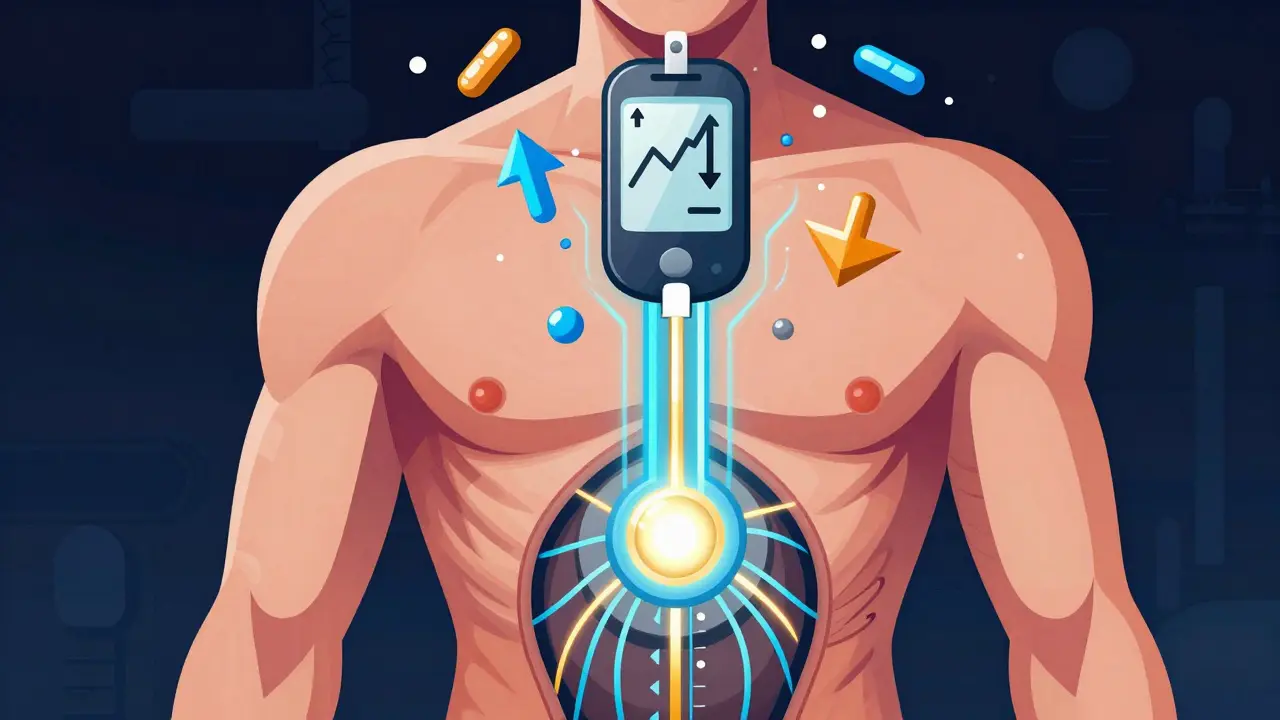
What Exactly Is a Continuous Glucose Monitor?
A continuous glucose monitor, or CGM, is a small medical device that tracks your blood sugar levels all day and night-without you having to poke your finger dozens of times. Instead of testing blood directly, it measures glucose in the fluid just under your skin, called interstitial fluid. This isn’t a guess. It’s science. Sensors use enzymes to react with glucose and turn that reaction into an electric signal. That signal gets sent to your phone or a handheld receiver, showing you your current number and, more importantly, which way your sugar is moving-up, down, or steady.
The first CGM approved by the FDA was Medtronic’s Guardian in 2006. Since then, the tech has exploded. Today’s models like the Dexcom G7, Abbott’s FreeStyle Libre 3, and Eversense E3 don’t just show numbers. They beep when your sugar drops too low, predict a crash 20 minutes before it happens, and even talk to your insulin pump. These aren’t gadgets for tech lovers-they’re life-saving tools.
How Do CGMs Actually Work?
Every CGM has three parts: a tiny sensor, a transmitter, and a display. The sensor, about the size of a coin, goes under your skin-usually on your belly or upper arm. It’s inserted with a quick, spring-loaded applicator. No needle stays in. Just a thin filament, less than half a centimeter long, sits there for days, reading glucose. The transmitter snaps onto the sensor and sends data every minute (Libre 3) or every five minutes (Dexcom G7) via Bluetooth or NFC.
Here’s the catch: it doesn’t measure blood sugar. It measures interstitial fluid sugar. That’s important. There’s a 5- to 20-minute delay between what’s happening in your blood and what the sensor picks up. So if you eat a candy bar and your blood sugar spikes, the CGM might show it 10 minutes later. Same with a low. That’s why you still need to check your finger if you feel symptoms that don’t match the reading.
Modern sensors last anywhere from 7 to 180 days. Dexcom G7 lasts 10 days, Libre 3 lasts 14, and Eversense E3 is implanted and lasts six months. Accuracy? The best models, like Libre 3, are off by less than 8% on average compared to lab blood tests. That’s better than most fingerstick meters.
Who Benefits the Most From a CGM?
If you have type 1 diabetes, a CGM isn’t optional anymore-it’s standard care. The American Diabetes Association says everyone with type 1 should use one. Why? Because your body doesn’t make insulin at all. Your sugar swings wildly. A CGM shows you trends you’d never catch with a finger prick. You’ll see that your sugar drops overnight after dinner, or spikes after walking the dog. You can adjust before it becomes a crisis.
People with type 2 diabetes on insulin also benefit big time. If you’re taking multiple daily shots or using an insulin pump, your risk of dangerous lows is high. A 2022 study in JAMA found CGMs cut severe low-blood-sugar events by 31%. That’s not a small number. That’s someone sleeping through a crash versus waking up, shaking, confused, scared.
Even non-diabetics are using CGMs now-fitness trackers, biohackers, people trying to optimize energy. But that’s not what they were made for. The real power is in medical use. For parents of kids with type 1, a CGM means peace of mind. You can see your child’s sugar from another room. You get an alert if it drops while they’re asleep. One Reddit user wrote: “My Libre 3 alarm saved me from a 32 mg/dL hypo at 3 AM last week-I’d have been dead without it.”
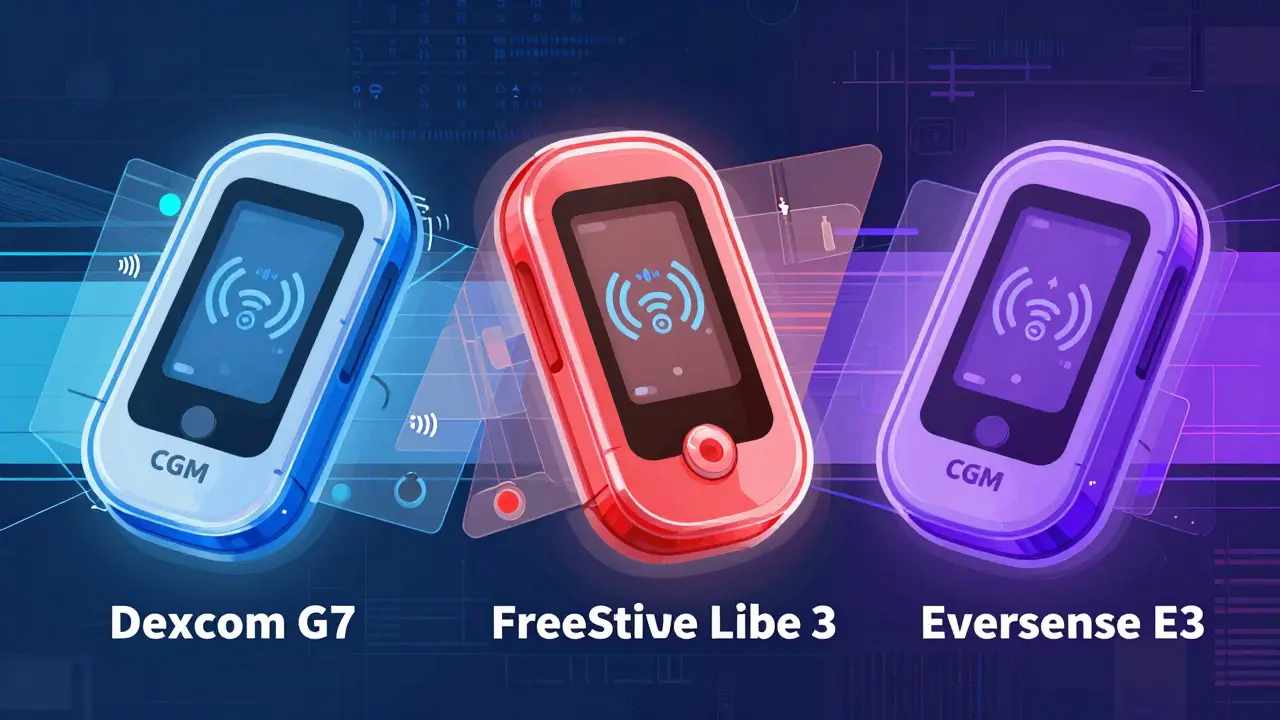
CGM Brands Compared: Dexcom G7 vs. FreeStyle Libre 3 vs. Eversense E3
| Feature | Dexcom G7 | FreeStyle Libre 3 | Eversense E3 |
|---|---|---|---|
| Sensor Life | 10 days | 14 days | 180 days |
| Measurement Frequency | Every 5 minutes | Every minute | Every 5 minutes |
| Calibration Needed | Twice daily | None | None |
| Alerts | Customizable highs/lows | Customizable highs/lows | Vibration alerts + app |
| Insertion | Self-insert | Self-insert | Minor surgery required |
| Monthly Cost (No Insurance) | $399 | $110 | $1,200 (includes removal) |
| MARD Accuracy | 9.1% | 7.9% | 8.5% |
Libre 3 is the most affordable and easiest to use. No fingersticks. No calibration. Just stick it on and go. Dexcom G7 is more accurate but costs more and needs two calibrations a day. Eversense is for people who want to forget about changing sensors for half a year-but you need a doctor to put it in and take it out. If you’re active, travel a lot, or hate dealing with gear, Libre 3 wins. If you need the most reliable alerts and integration with pumps, Dexcom is still the gold standard.
The Hidden Benefits: Trend Arrows and Predictive Alerts
The biggest game-changer isn’t the number on the screen. It’s the arrow. Up. Down. Flat. That’s the trend. Dr. Anne Peters, a leading diabetes expert, says, “The trend arrow showing how quickly glucose levels are changing is arguably more important than the current number itself.”
Here’s why that matters: If your sugar is 120 but dropping fast, you’re heading for a low. You can eat a snack now and avoid a crash later. If it’s 200 and rising, you can take a correction dose before it hits 300. Without a CGM, you’d only know you were high after you felt dizzy or thirsty. By then, it’s too late.
Some CGMs, like Dexcom’s system with Tandem pumps, can even pause insulin delivery before a low happens. That’s called predictive low glucose suspend. It’s not magic. It’s math. The device learns your patterns and reacts before you do. In clinical trials, this feature cut nighttime lows by 40%.
Problems People Actually Have With CGMs
Nothing’s perfect. The most common complaint? Skin irritation. Dexcom’s adhesive is strong-and for some people, it’s too strong. It leaves red, itchy patches. The fix? Skin Tac wipes or Opsite Flexifix tape. Simple, cheap, works.
Another issue: false alarms. One user on a diabetes forum said their Dexcom read 50 mg/dL while they were cycling. They panicked, ate 15 grams of carbs, then checked their fingerstick-it was 110. That’s the lag again. Your body’s glucose moves faster than the sensor can catch up. That’s why you’re told to confirm with a fingerstick if you feel symptoms that don’t match the reading.
And then there’s cost. Without insurance, Dexcom runs $400 a month. Libre 3 is $110. In the U.S., Medicare covers Dexcom and Medtronic for insulin users, but only started covering Libre in 2023. In the U.K., the NHS gives FreeStyle Libre to over half a million people for free. Here in Canada, coverage varies by province. Some cover it fully. Others don’t. If you’re paying out of pocket, Libre 3 is the smartest buy.
What’s Next for CGM Technology?
The future is getting even better. Dexcom’s G7, released in 2023, cuts warm-up time from two hours to 30 minutes. That’s huge. No more waiting to start your day.
Abbott’s Libre 3 Plus now tracks insulin doses right on the app. You scan your sensor, and it logs your shot. No more scribbling in a notebook.
Non-invasive CGMs are coming. Glucowise, a device that reads glucose through your skin using radio waves, finished its second clinical trial in late 2023. No sensors. No sticks. Just a small device you hold to your arm.
Apple’s rumored glucose-sensing watch could change everything. If it works and gets FDA approval, millions who never thought about CGMs might start using them. That could drive prices down and make them mainstream.
Getting Started: What You Need to Know
You can’t just walk into a pharmacy and buy one. You need a prescription. Talk to your endocrinologist or diabetes educator. They’ll help you pick the right one based on your lifestyle, budget, and insurance.
Most people get comfortable in 3 to 5 days. The learning curve is steep at first. You’ll see numbers flying around. You’ll wonder if the alerts are real. You’ll get anxious. That’s normal. Use the apps-Dexcom Clarity, LibreView-they show you charts of your week, month, year. You’ll start seeing patterns. “Oh, my sugar spikes every time I eat oatmeal.” “My afternoon walk always brings me down.” That’s power.
Join online communities. Reddit’s r/diabetes and r/CGM have over 100,000 active users. Facebook groups like CGM Users have 45,000 members. You’ll find answers to every question. And you’ll hear stories like the one from u/Type1Since1995: “My Libre 3 alarm saved me from a 32 mg/dL hypo at 3 AM last week-I’d have been dead without it.”
Final Thoughts: Is a CGM Worth It?
If you’re on insulin, the answer is yes. The data is clear: fewer lows, better A1C, less stress. For people with type 2 on insulin, it’s just as important. For non-diabetics? Maybe not. The health benefits aren’t proven yet.
Cost is the biggest barrier. But if you’re paying $300 a month out of pocket, look into Libre 3. It’s accurate, easy, and quiet. No calibrations. No fingersticks. Just stick it on and go.
CGMs aren’t perfect. They lag. They irritate skin. They beep at night. But they give you something no fingerstick ever could: control. Not guesswork. Not fear. Real-time insight. That’s worth more than money.
Can I use a CGM if I don’t have diabetes?
Yes, some people without diabetes use CGMs to track how food affects their energy, sleep, or mood. Companies like Zoe Health offer CGMs for wellness purposes. But these aren’t FDA-approved for medical use, and insurance won’t cover them. For most people, the cost isn’t justified unless they have a specific health goal under medical supervision.
Do CGMs replace fingerstick tests completely?
Not always. FreeStyle Libre 3 and newer Dexcom models are approved for non-adjunctive use-meaning you don’t need to confirm with a fingerstick under normal conditions. But if your symptoms don’t match the CGM reading (like feeling shaky with a normal number), or if you’re sick, exercising hard, or just not sure-you should always check with a fingerstick. The lag can cause dangerous delays during rapid changes.
How long does it take to learn how to use a CGM?
Most people feel confident within 3 to 5 days. The hardest part is understanding trend arrows and the 5-20 minute lag. Manufacturer apps like Dexcom Clarity and LibreView have built-in tutorials. Many diabetes educators offer free 15-minute video calls to walk you through your first week. Don’t rush it. The first few days are about learning what the numbers mean, not reacting to every beep.
Can I swim or shower with a CGM?
Yes. All modern CGMs are water-resistant. You can shower, swim, and sweat with them. Dexcom G7 and Libre 3 are rated for up to 1 meter of water for 30 minutes. Just avoid saunas or hot tubs longer than 30 minutes-extreme heat can damage the sensor. Don’t try to peel it off to dry it. Let it air dry naturally.
Does insurance cover CGMs in Canada?
Coverage varies by province. Ontario’s OHIP covers CGMs for children under 25 with type 1 diabetes. British Columbia and Alberta cover them for insulin users with a prescription. Other provinces offer partial coverage or require private insurance. Check with your provincial health plan or ask your diabetes clinic-they often have navigators who help with applications.
Sazzy De
January 31, 2026 AT 01:12Still get weird spikes after oatmeal though. Weird.
Blair Kelly
February 1, 2026 AT 19:19Gaurav Meena
February 2, 2026 AT 06:15My cousin with type 1 got one through a nonprofit last year. She went from 12 hospital visits a year to zero. The alerts saved her during college exams. Please, if you have access - don’t take it for granted. This is life-changing, not just convenient.
Carolyn Whitehead
February 2, 2026 AT 11:00Also the trend arrows? Game changer. I didn’t realize how much I was missing before.
Katie and Nathan Milburn
February 4, 2026 AT 06:25Beth Beltway
February 4, 2026 AT 10:46Marc Bains
February 5, 2026 AT 00:14kate jones
February 5, 2026 AT 21:43Natasha Plebani
February 7, 2026 AT 16:01Eliana Botelho
February 9, 2026 AT 14:57Rob Webber
February 9, 2026 AT 22:31Darren Gormley
February 11, 2026 AT 18:17Mike Rose
February 12, 2026 AT 09:16Russ Kelemen
February 12, 2026 AT 22:39