Dechallenge Time Estimator
Drug Information
Enter the half-life of your medication to estimate how long it might take for side effects to resolve after stopping the drug.
How This Works
Dechallenge is the process of stopping a drug to see if symptoms improve. The time it takes for symptoms to resolve depends on the drug's half-life - the time it takes for half of the drug to be eliminated from your body.
Key Principle: It typically takes 2-4 half-lives for a drug to be almost completely eliminated from your system.
For example, if your drug has a half-life of 12 hours, symptoms might improve within 24-48 hours after stopping the medication. For drugs with longer half-lives, it might take days or weeks.
Expected Resolution Timeline
Based on your input, your symptoms might improve within after stopping the drug.
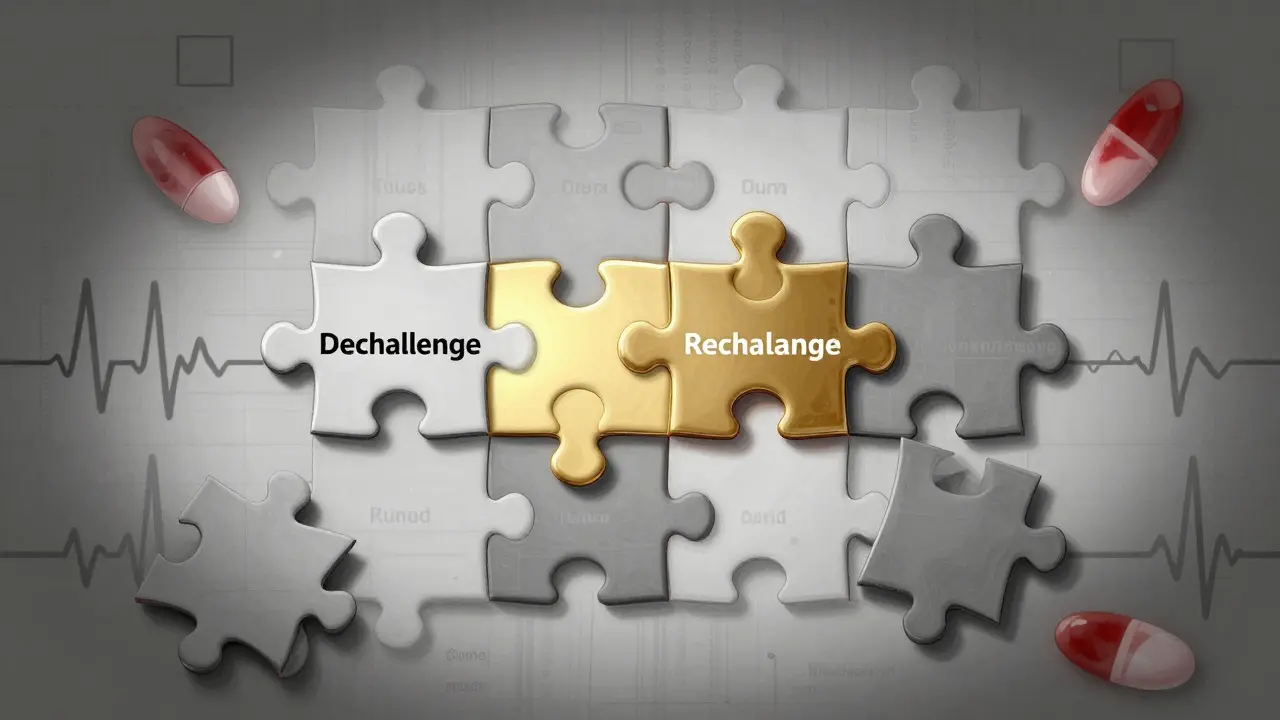
When a patient develops a strange rash, dizziness, or nausea after starting a new medication, doctors don’t just guess what caused it. They use real clinical tools to find out - and two of the most powerful ones are called dechallenge and rechallenge. These aren’t fancy lab tests or scans. They’re simple, direct, and surprisingly effective ways to figure out if a drug is truly responsible for an unwanted side effect.
What Is Dechallenge?
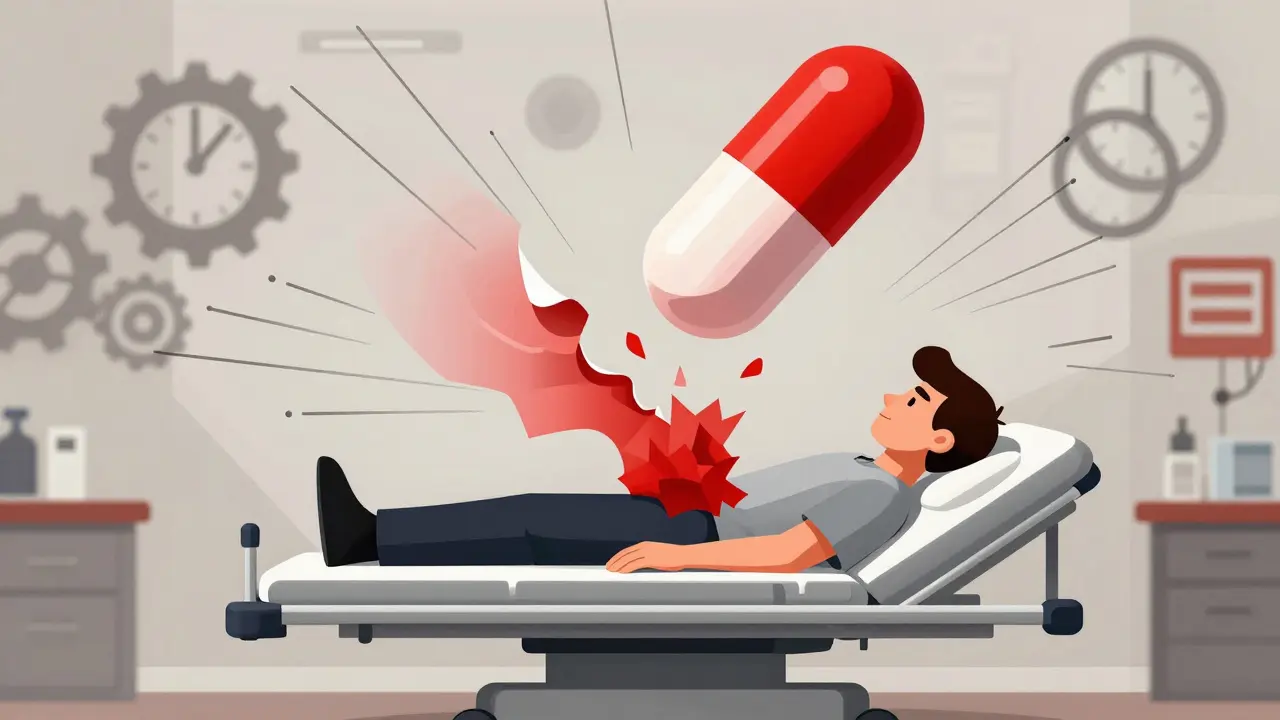
Dechallenge is just stopping the drug and watching what happens. If the side effect gets better - or disappears - that’s a positive dechallenge. It’s a strong clue the drug was the culprit.
For example, someone starts taking a new antibiotic and develops a painful, itchy rash all over their arms. After three days, the doctor tells them to stop the medicine. A week later, the rash fades. That’s a classic positive dechallenge. The timing fits: the rash started shortly after the drug was begun, and it went away soon after it was stopped. That’s not random. That’s a pattern.
But not every side effect clears up fast. Some drugs stick around in your body for days or even weeks. So doctors don’t just wait a couple of days. They look at the drug’s half-life - how long it takes for half the dose to leave your system. If a drug has a half-life of 12 hours, they’ll expect improvement within 2-4 days. If it’s a slow-clearing drug like some antidepressants, they might wait up to two weeks.
Here’s the catch: if the side effect doesn’t improve after stopping the drug, it’s a negative dechallenge. That doesn’t always mean the drug is innocent. Sometimes the damage is permanent - like hearing loss from certain antibiotics, or liver scarring from a bad reaction. In those cases, stopping the drug won’t reverse the harm, even if it caused it.
What Is Rechallenge?
Rechallenge is when the drug is given again - on purpose - to see if the side effect comes back.
This sounds risky. And it is. But when done carefully, it’s the closest thing to a smoking gun in drug safety. If the rash returns exactly the same way after re-dosing, you’ve got near-certain proof the drug caused it.
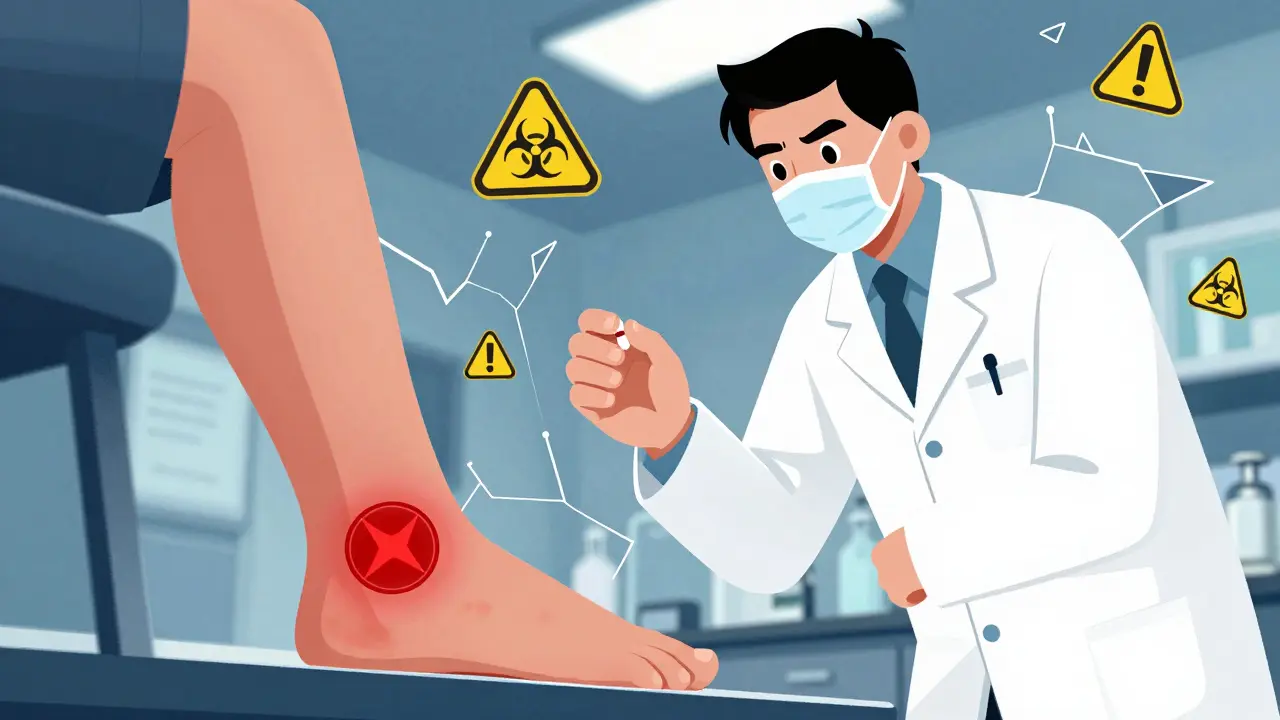
A real case from dermatology: a patient developed a fixed drug reaction - a dark, circular patch on their ankle - after taking metronidazole. After stopping the drug, the patch faded over weeks. Then, under strict medical supervision, they took the same drug again. Within 48 hours, the exact same patch reappeared in the same spot. That’s rechallenge in action. No other drug, no infection, no allergy test could prove it that clearly.
Rechallenge isn’t used often. Why? Because it’s dangerous. If someone had a life-threatening reaction like Stevens-Johnson Syndrome or toxic liver damage, rechallenge could kill them. So it’s only done in very specific situations: when the reaction was mild, the drug is essential (like an epilepsy medicine with no alternatives), and the patient gives full informed consent with emergency care on standby.
In fact, less than 0.3% of serious drug reactions ever get rechallenged. Regulatory agencies like the FDA and EMA require ethics board approval before even considering it.
Why Do These Two Steps Matter?
Doctors and pharmacists use four main clues to decide if a drug caused a side effect:
- Did the reaction happen soon after taking the drug?
- Did it go away when the drug was stopped? (That’s dechallenge.)
- Did it come back when the drug was given again? (That’s rechallenge.)
- Does the reaction make sense based on what we know about how the drug works?
Dechallenge and rechallenge are the only ones that involve actual patient outcomes - not just theory or timing guesses. The others help, but they’re guesswork. Dechallenge and rechallenge are proof.
Take the Naranjo Scale - a tool doctors use to rate how likely a drug caused a reaction. It gives points for things like timing and whether other drugs could be to blame. But if a patient has a positive dechallenge, that alone bumps the score up. A positive rechallenge? That’s the highest score possible - it pushes the rating to “definite.”
Studies show that when rechallenge is done safely, it confirms drug causality in 97% of cases. That’s almost certain. No algorithm, no lab test, no computer model can match that.
Where Are These Tools Used?
Dechallenge is used all the time. In dermatology, it’s part of nearly 9 out of 10 drug reaction investigations. In liver disease, it’s used in 79% of suspected drug-induced liver injury cases. Why? Because skin and liver reactions often clear up quickly after stopping the drug - making dechallenge safe and clear.
But in psychiatry? Not so much. If someone is on an antidepressant and develops dizziness, stopping it might make their depression worse - or even trigger suicidal thoughts. So doctors avoid dechallenge here. They rely more on timing and biological plausibility.
Pharmaceutical companies track this data closely. Since 2023, 82% of major drugmakers now require dechallenge outcomes to be recorded in post-marketing safety reports. Why? Because regulators demand it. The FDA and EU require this info in every safety update. If a drug keeps causing rashes and no one documents whether they went away after stopping it, the company could be fined or forced to change the warning label.
What’s New in Dechallenge and Rechallenge?
Technology is helping, but not replacing, these methods.
Wearable sensors are now being tested to track heart rate, skin temperature, and inflammation markers automatically after a drug is stopped. In one study, these devices captured resolution of side effects 78% of the time - better than asking patients to remember how their rash felt. This makes dechallenge more objective.
There’s also emerging research into blood tests that can predict if someone is likely to react to a drug - without ever giving it to them. Scientists at the NIH have developed lymphocyte toxicity tests that predict reactions to certain drugs with 89% accuracy. That could make rechallenge obsolete for some drugs.
But experts agree: no test is perfect. A machine learning model might predict a reaction, but it can’t replace the moment a patient’s rash fades after stopping a pill. That’s real, human evidence.
As one WHO expert put it: “No algorithm can substitute for the clinical reality of symptom resolution after drug discontinuation.”
Common Problems and Pitfalls
Dechallenge and rechallenge sound simple, but they’re often messed up in real life.
- Patients quit drugs on their own. If someone stops their medicine because they feel bad, but doesn’t tell their doctor, the dechallenge isn’t documented. That makes it useless for future analysis.
- Multiple drugs are stopped at once. If a patient is on five medications and all are pulled because of a side effect, you can’t tell which one caused it. That’s called confounding.
- Delayed reporting. If a reaction happens three months after starting a drug, and the patient forgets to mention it until now, rechallenge isn’t even possible.
Solutions? Electronic health records that flag possible drug reactions. Standardized forms doctors fill out when a side effect is reported. Training for nurses and pharmacists to ask: “Did you stop the drug? Did it help?”
One study found that pharmacovigilance professionals trained in these methods were 42% more accurate at linking drugs to side effects than general providers. That’s huge. It means better safety, fewer wrong warnings, and more precise prescribing.
Bottom Line
Dechallenge and rechallenge are not futuristic science. They’re everyday tools used by doctors, pharmacists, and regulators to keep people safe. Dechallenge - stopping the drug - is routine. Rechallenge - giving it back - is rare, risky, and powerful.
When a side effect clears after stopping a drug, that’s a signal. When it comes back after restarting, that’s proof. And that proof changes everything - from how a drug is labeled to whether it stays on the market.
Next time you hear about a drug recall or a warning label update, remember: behind that decision, there’s probably a patient who stopped the medicine - and got better. Or, in rare cases, someone who took it again - and got the same reaction. That’s how we learn. That’s how we protect people.
Can dechallenge prove a drug caused a side effect on its own?
Yes, a positive dechallenge - where symptoms improve after stopping the drug - provides strong evidence of causality. In fact, it’s often enough to classify a reaction as "probable" in official assessments. But it’s not 100% certain. Other factors, like timing or underlying conditions, can mimic improvement. That’s why rechallenge, when safe, is considered the gold standard.
Why is rechallenge so rarely done?
Rechallenge means deliberately giving a patient a drug that previously caused harm. For severe reactions - like anaphylaxis, liver failure, or skin blistering - this can be life-threatening. Ethical guidelines and regulatory agencies only allow it in very limited cases: mild reactions, no safe alternatives, strict supervision, and full informed consent. Less than 0.3% of serious cases ever go through rechallenge.
What if the side effect doesn’t go away after stopping the drug?
A negative dechallenge doesn’t automatically mean the drug wasn’t the cause. Some reactions cause permanent damage - like hearing loss, nerve damage, or scarring. In those cases, stopping the drug stops further harm, but doesn’t reverse what’s already happened. The drug may still be responsible, even if symptoms don’t improve.
Can rechallenge be done for any drug?
No. Rechallenge is only considered for drugs where the benefit of confirming causality outweighs the risk. It’s most common with medications like antibiotics, anticonvulsants, or pain relievers that cause mild reactions like rashes or nausea. It’s never done for drugs linked to life-threatening reactions like Stevens-Johnson Syndrome, toxic epidermal necrolysis, or drug-induced liver failure.
How do doctors decide if a reaction is "definite"?
A reaction is labeled "definite" when all four criteria are met: 1) the reaction occurred after drug use, 2) it resolved after stopping the drug (positive dechallenge), 3) it returned when the drug was restarted (positive rechallenge), and 4) no other plausible cause exists. Rechallenge is the key factor that pushes the assessment from "probable" to "definite." According to WHO-UMC guidelines, this combination confirms causality in 97% of cases.
Rachel Kipps
February 5, 2026 AT 06:29I never realized how much goes into figuring out if a drug caused a reaction. My cousin stopped her antibiotic after a rash, and they just said "maybe it was the medicine" without even documenting it. It’s wild how often dechallenge gets missed because patients don’t report it properly.
Prajwal Manjunath Shanthappa
February 5, 2026 AT 08:18Dechallenge? Rechallenge? How quaint. In the 21st century, we have pharmacogenomic profiling, AI-driven adverse event correlation engines, and longitudinal EHR analytics-yet we still rely on this antiquated, anecdotal, patient-reported "watch-and-wait" methodology? It’s almost embarrassing. The data is there; we just refuse to use it properly.
Ed Mackey
February 6, 2026 AT 02:46My doc told me to stop my blood pressure med when I got dizzy. It cleared up in 48 hours. I never thought that was "dechallenge"-I just thought they were being careful. Turns out, that’s one of the most powerful tools we have. Kinda humbling.
Katherine Urbahn
February 7, 2026 AT 22:30It is absolutely imperative to note that the notion of "rechallenge"-even under supervision-is not merely a clinical tool, but an ethical minefield. One must consider the Hippocratic Oath in its entirety: First, do no harm. To reintroduce a known harmful agent-even with consent-is to flirt with malpractice. The 97% confirmation rate is statistically compelling, but it does not override the moral imperative to avoid unnecessary risk.
Alex LaVey
February 8, 2026 AT 06:24This is one of those topics that doesn’t get enough attention. Doctors and patients alike treat side effects like background noise. But this? This is how we actually learn. Real people, real reactions, real outcomes. We need more of this kind of thinking-not less. Thank you for highlighting it.
Joseph Cooksey
February 9, 2026 AT 15:45Let’s be honest-the entire pharmacovigilance system is held together by duct tape and patient memory. We’ve got wearable sensors that can detect micro-inflammation changes in real time, AI models that predict hypersensitivity with 89% accuracy, and yet we still rely on someone saying, "Oh yeah, I stopped that pill and my face stopped melting." It’s not just outdated-it’s dangerously fragile. Imagine if we treated car safety the same way: "Well, the airbag deployed, so I guess it worked?"
Lorena Druetta
February 10, 2026 AT 03:14This is so important. I work in a clinic, and we don’t always document dechallenge properly. But when we do-when we ask, "Did you stop the medication? Did you feel better?"-it changes everything. It turns guesswork into truth. And that truth saves lives.
Zachary French
February 10, 2026 AT 21:43Rechallenge? You mean like, "Hey, remember that time your skin turned into a crime scene? Let’s do it again, but this time with a lawyer on standby." That’s not science. That’s a horror movie plot. And yet people do it? For a drug they can’t live without? I’m not impressed-I’m horrified.
Daz Leonheart
February 12, 2026 AT 20:39I’ve seen this firsthand. My mom had a reaction to a new statin. They told her to stop it. Two weeks later, the swelling was gone. No tests, no scans-just stopping the drug and waiting. That’s real medicine. Simple, but powerful.
Amit Jain
February 12, 2026 AT 22:06In India, we don’t always have access to fancy tech. So we use what works. Dechallenge is routine. If a patient gets a rash after a new medicine, we stop it. If it clears, we know. Simple. Effective. No need to overcomplicate.
Keith Harris
February 13, 2026 AT 09:12Oh great, another article pretending dechallenge is some revolutionary breakthrough. Newsflash: doctors have been doing this since the 1950s. What’s new is that now they’re calling it "evidence-based" like it’s a TED Talk. Meanwhile, 80% of adverse events are still underreported because patients are scared to speak up. This isn’t progress-it’s rebranding.
Nathan King
February 15, 2026 AT 00:43The regulatory frameworks governing pharmacovigilance remain fundamentally reactive rather than proactive. While dechallenge and rechallenge provide post hoc confirmation of causality, the absence of predictive biomarkers renders these methodologies inherently limited. The field requires a paradigm shift toward preemptive risk stratification via genomic and proteomic profiling.
rahulkumar maurya
February 15, 2026 AT 06:28Rechallenge is not a technique-it’s a gamble with human lives. The fact that anyone considers it acceptable-even with consent-is a reflection of how broken our medical ethics have become. We don’t test fire extinguishers by setting buildings on fire. Why do we test drugs by re-exposing patients to danger? The answer? Because we’re lazy. And we’re arrogant.
Alec Stewart Stewart
February 16, 2026 AT 05:31My aunt had a reaction to a new migraine med. She stopped it. The nausea went away. They never told her this was "dechallenge." But now she knows. And she tells everyone. That’s how change happens-not in labs, but in kitchens and living rooms.