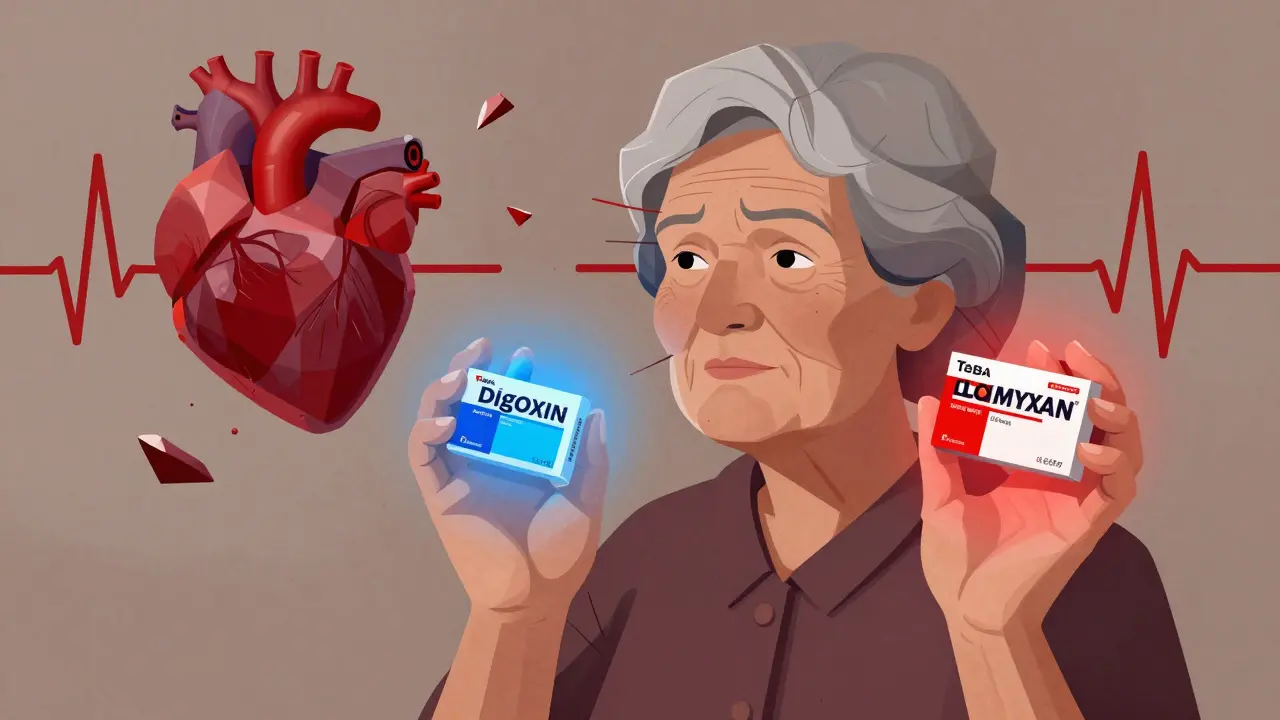
Take a 78-year-old woman with atrial fibrillation. She’s been on digoxin for five years. Her heart rate is steady. Her symptoms are under control. Then, her pharmacy runs out of her usual generic brand and switches her to another one-same dose, same label, different manufacturer. Three days later, she’s nauseous, dizzy, and seeing halos around lights. Her digoxin level? 3.1 ng/mL. Toxic. This isn’t rare. It’s digoxin-a drug where tiny changes in how your body absorbs it can mean the difference between healing and hospitalization.
Why Digoxin Is Different
Digoxin isn’t like most pills. It’s a cardiac glycoside with a razor-thin window between working and poisoning. The safe range? 0.5 to 2.0 ng/mL. Go below 0.5, and it won’t slow your heart enough. Go above 2.0, and you risk deadly arrhythmias. Even worse, digoxin sticks around for days-its half-life is 36 to 48 hours. So if you get too much, it doesn’t just wash out. It builds up. Slowly. Quietly.
That’s why it’s classified as a narrow therapeutic index (NTI) drug. These are the high-risk medications where small changes in dose or absorption can lead to serious harm. Others in this club include warfarin, lithium, and tacrolimus. But digoxin is unique because it’s one of the few NTI drugs still widely used as a generic-and that’s where the real problem begins.
The Generic Digoxin Problem
The FDA says three generic digoxin tablets are bioequivalent to Lanoxin, the brand name. That means, on average, they deliver the same amount of drug into the bloodstream. But here’s the catch: bioequivalence is calculated using group averages. If 12 people take a generic and their average absorption is 95% of Lanoxin, the FDA approves it-even if one person in that group absorbed only 45%.
That’s not a flaw in the system. It’s how bioequivalence works. But for digoxin, it’s dangerous. One patient might absorb 45% of the dose. Another might absorb 110%. Both are within the “acceptable” range. But for the first patient, the drug doesn’t work. For the second, it’s toxic. And if you switch from one generic to another-say, from Teva to Mylan-you’re playing Russian roulette with your heart rhythm.
Studies show that when patients switch between different generic manufacturers, serum digoxin levels can shift by more than 25%. That’s enough to push someone from therapeutic to toxic-or from ineffective to dangerous. And there’s no study proving that Teva’s digoxin is bioequivalent to Mylan’s. The FDA only requires generics to match the brand, not each other.
What Bioavailability Really Means
Bioavailability is how much of the drug actually gets into your bloodstream. For digoxin tablets, it’s usually between 60% and 80%. The rest? Lost in the gut. But that number isn’t fixed. It changes based on your stomach acid, how fast your gut moves, whether you took it with food, and even what other drugs you’re on.
And it gets worse. Digoxin elixir (the liquid form) is absorbed better-70% to 85%-than tablets. So if you switch from a tablet to a liquid, even if the dose looks the same, you’re getting more drug. That’s not a typo. That’s real. One patient I saw went from 0.125 mg tablet to 0.125 mg elixir and ended up with a level of 2.8 ng/mL. She didn’t know the forms weren’t interchangeable.
Generic manufacturers aren’t required to test their product against other generics. Only against the brand. So two generics can both be “bioequivalent” to Lanoxin-and still behave completely differently in your body.
Who’s Most at Risk?
Older adults. That’s who takes digoxin most often. And older adults are more vulnerable. Kidney function declines with age. Digoxin is cleared by the kidneys. So even a small increase in absorption can lead to buildup. Many patients are on multiple drugs too-diuretics, antibiotics, even some antifungals-that can alter digoxin levels.
One study found that 60% of digoxin toxicity cases in the elderly happened after a pharmacy switch. Not a dose change. Not a new illness. Just a different pill.
And here’s the kicker: most patients don’t know they’re on a generic. They don’t know there are different versions. They assume “digoxin 0.125 mg” is the same no matter the label. That’s a dangerous assumption.
How to Stay Safe
If you’re on digoxin, here’s what you need to do:
- Stick to one brand or generic. Don’t let your pharmacy switch you without telling you. Ask: “Is this the same manufacturer as last time?” If they say no, push back. Tell your doctor.
- Get your blood tested after any switch. Don’t wait for symptoms. Check your digoxin level 3 to 5 days after a new prescription. Trough level-right before your next dose.
- Know your numbers. Keep a log: date, dose, manufacturer, and level. Bring it to every appointment.
- Watch for red flags. Nausea, vomiting, loss of appetite, blurred vision, yellow-green halos, irregular heartbeat, fatigue. These aren’t “just side effects.” They’re warning signs.
- Ask about elixir vs. tablet. If your doctor switches you from tablet to liquid, assume the dose needs adjustment. Don’t assume they’ll tell you.
The American College of Cardiology and the American Heart Association both say: Use the same manufacturer’s product whenever possible. That’s not a suggestion. It’s a safety rule.
The Bigger Picture
This isn’t just about digoxin. It’s about how we think about generics. We assume “same drug, same effect.” But for NTI drugs, that’s not true. Bioequivalence studies are designed for population averages-not individual outcomes. And when your life depends on a drug staying within 0.5 ng/mL of safety, averages don’t cut it.
The FDA knows this. That’s why digoxin is one of the few drugs with an “AB” code in the Orange Book that still comes with strong warnings. Most NTI drugs are kept as brand-only. Digoxin isn’t. And that’s because it’s cheap. And old. And we’ve forgotten how dangerous it can be.
But if you’re taking it, you can’t afford to forget.
What Doctors Should Do
When starting digoxin, get a baseline level 4 to 7 days after the first dose. Recheck it after any dose change, any kidney function change, or any new medication. And if a patient switches generics-check again. No exceptions.
Don’t assume the pharmacist’s note says “substitutable.” That’s not a medical green light. It’s a regulatory checkbox.
And if a patient comes in with vague symptoms-fatigue, nausea, dizziness-ask: “Did your digoxin change recently?” That question might save a life.
Bottom Line
Digoxin generics work. But they’re not all the same. Not in your body. Not in your heart. The science says they’re bioequivalent. The real world says they’re not interchangeable without risk.
Don’t let a pharmacy switch be an accident. Be the patient who asks. Be the one who checks. Be the one who knows that when it comes to digoxin, consistency isn’t just good practice-it’s survival.
Crystel Ann
January 17, 2026 AT 06:34This hit me hard. My grandma was on digoxin for years and never knew the pharmacy switched her brand until she ended up in the ER. No one told her. No one asked. Just a different pill in the bottle and she paid the price.
She never complained about the nausea or the halos-thought it was just getting older. We should all be asking more questions.
ellen adamina
January 18, 2026 AT 15:29My mom had the same thing happen. They switched her generic and she started seeing yellow circles around streetlights. Thought it was cataracts. Turned out her level was 3.4. Took three days to get it down. No one warned us. No one even asked if we’d switched meds.
Doctors need to stop assuming patients know this stuff.
Mike Berrange
January 18, 2026 AT 19:11Stop pretending this is a systemic failure. It’s not. It’s patient negligence. If you don’t know what’s in your pill bottle, that’s on you. The label says digoxin 0.125 mg. That’s all you need. If you’re too lazy to read the manufacturer name, don’t blame the FDA or the pharmacy.
Also, elixir vs tablet? That’s basic pharmacology. If you can’t handle that, maybe you shouldn’t be on NTI drugs at all.
Nat Young
January 19, 2026 AT 11:21Let’s be real-this whole post is fearmongering dressed up as medical advice. The FDA approves these generics for a reason. If you’re getting toxic levels from a switch, your kidney function is probably garbage or you’re on a dozen other drugs that interact. Blame the polypharmacy, not the generic.
Also, digoxin is 70 years old. We’ve been using it since the 1950s. People survived without knowing the manufacturer name. What’s changed? Your anxiety.
And yes, I’ve seen the studies. They’re underpowered. Small samples. No control for adherence. This isn’t a crisis. It’s a marketing ploy for pharmacists who want to charge for ‘medication reviews’.
Niki Van den Bossche
January 20, 2026 AT 21:56Ah, the tragicomedy of modern pharmacotherapy-where the sacred alchemy of molecular identity is reduced to a barcode and a corporate logo.
Do we not see the metaphysical rupture here? The pill, once a vessel of healing, has become a commodity in a neoliberal pharmakon-its essence diluted by the bureaucratic fiction of bioequivalence.
Each generic is not merely a substitute, but a betrayal of the body’s sacred chemistry. The body remembers. The heart remembers. The halos around lights? That’s not toxicity. That’s the soul screaming against the mechanization of care.
We have forgotten that medicine is not engineering. It is communion. And we are now administering communion via assembly line.
Jaspreet Kaur Chana
January 22, 2026 AT 01:28I work in a pharmacy in Delhi and we don’t even have branded digoxin here-everything’s generic. But we track the manufacturer by batch number and always tell patients: ‘This is from Cipla, not Sun Pharma.’ We write it on the bag. We show them the label. We don’t assume they know.
And guess what? Our elderly patients are doing fine. Why? Because we talk to them. Not because we have perfect science, but because we care enough to explain.
It’s not the drug. It’s the system that forgets people are human.
Here in India, we don’t have fancy guidelines-but we have respect. And that’s worth more than any FDA code.
Haley Graves
January 22, 2026 AT 19:35THIS. So many people don’t know this. I’m a nurse and I’ve seen it too many times. Patients come in with digoxin toxicity and say ‘I’ve been taking the same pill.’ No-you haven’t. The label changed. The logo changed. The color changed.
Here’s what you do: take a Sharpie and write the manufacturer name on the pill bottle cap. Every time. Even if it’s the same brand. Write it. Do it. Your life depends on it.
And if your doctor doesn’t check levels after a switch? Find a new doctor.
Sohan Jindal
January 23, 2026 AT 02:57Why are we letting Chinese and Indian factories make our heart medicine? The FDA is asleep at the wheel. This is why America is falling apart. You think some guy in Mumbai knows how to make a pill that won’t kill your grandma? No. He’s just printing labels and shipping boxes.
Buy American. Buy Lanoxin. Pay the extra $5. It’s not about money-it’s about loyalty. About patriotism. About not letting foreign labs poison our seniors.
And if your pharmacist switches it without asking? Report them. Call the state board. This is treason against the elderly.
Frank Geurts
January 23, 2026 AT 16:37With due deference to the author’s meticulous exposition, and in full recognition of the profound clinical implications delineated herein, I must respectfully submit that the prevailing discourse, while empirically sound, remains insufficiently contextualized within the broader sociopolitical architecture of pharmaceutical regulation.
Indeed, the dichotomy between bioequivalence as a statistical construct and individual pharmacokinetic variance underscores a fundamental epistemological rupture in contemporary medical episteme-where population-based norms are erroneously transposed onto the phenomenological reality of the somatic subject.
Furthermore, the commodification of therapeutic agents, facilitated by regulatory frameworks predicated on cost-efficiency rather than therapeutic fidelity, constitutes a systemic erosion of the healer-patient covenant.
It is, therefore, incumbent upon all stakeholders-clinicians, regulators, and patients alike-to reconstitute the therapeutic encounter as a sacred, individualized endeavor, wherein the pill is not a mere molecule, but a covenantal artifact of trust.
May we, in our collective wisdom, restore dignity to the dose.