Fish Oil and Aspirin Risk Calculator
Your Dosage
Risk Assessment
Every year, millions of people take aspirin to protect their heart and fish oil to support their joints or brain. But when you put them together, does the risk of bleeding go up? It’s a common question - especially if you’re taking both and suddenly notice more bruising, or your dentist tells you to stop one before surgery. The short answer? For most people, fish oil and aspirin together don’t create a dangerous blood-thinning effect. But there are important details you need to know.
How Aspirin Actually Works
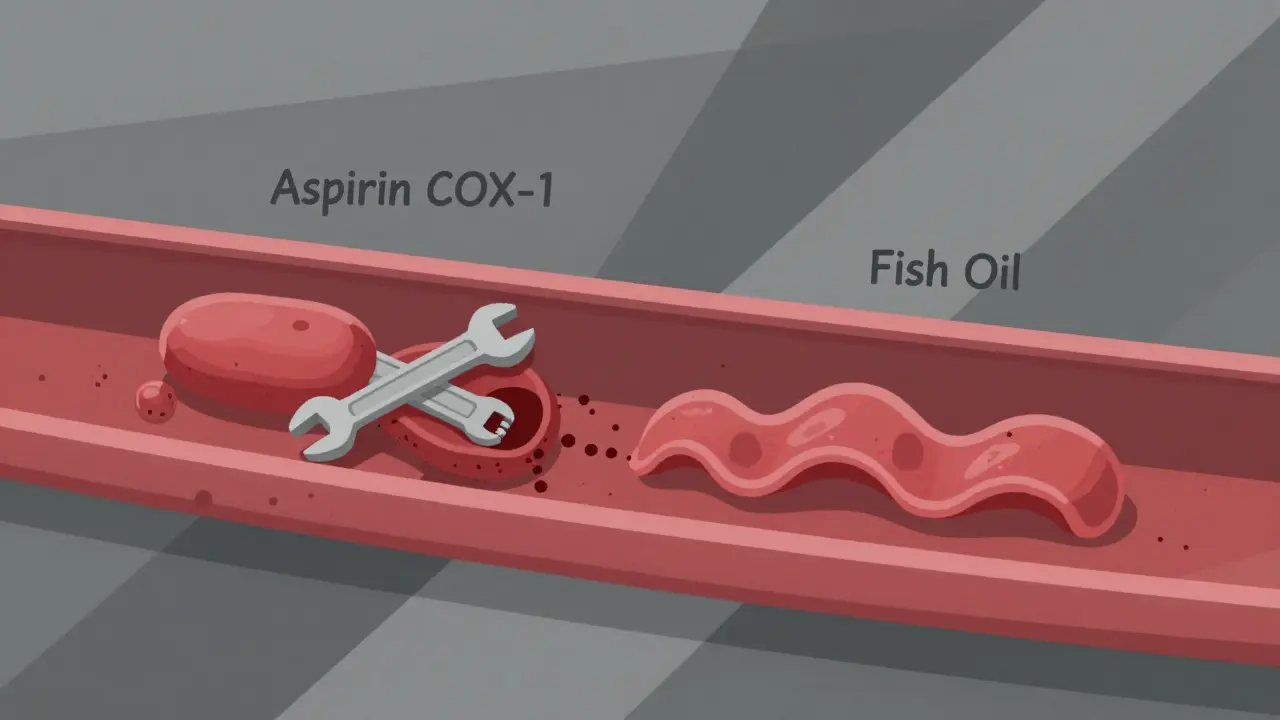
Aspirin isn’t just a painkiller. At the low dose most people take - 81 mg daily - it’s an antiplatelet drug. That means it stops your blood platelets from clumping together too easily. Platelets are the tiny cells in your blood that form clots when you cut yourself. But if they clump too much inside your arteries, they can cause heart attacks or strokes. Aspirin works by permanently blocking an enzyme called COX-1 in platelets. Once it’s blocked, those platelets can’t make thromboxane, a chemical that tells other platelets to stick together. Since platelets live for about 7-10 days, aspirin’s effect lasts until your body makes new ones. That’s why one daily pill works all week.What Fish Oil Actually Does
Fish oil contains two omega-3 fatty acids: EPA and DHA. These aren’t magic bullets, but they do change how your blood behaves. When you take fish oil daily, EPA and DHA get incorporated into the membranes of your platelets. This makes the membranes more flexible and less responsive to signals that trigger clumping. Studies show fish oil reduces platelet aggregation - but not nearly as much as aspirin. At typical supplement doses (1 gram daily), the effect is barely noticeable. Even at higher doses (3-4 grams), it only cuts platelet stickiness by 20-40%. Compare that to aspirin, which knocks it down by 70-90%. Fish oil doesn’t block enzymes like aspirin does. Instead, it changes the environment around the platelets.Do They Add Up?
The real question isn’t whether they both thin blood - it’s whether combining them makes bleeding more likely. A 2012 study of 56 people with type 2 diabetes found that those taking both 81 mg aspirin and 4 grams of fish oil had 32% less platelet aggregation than those taking aspirin alone. That sounds alarming - until you look at the bigger picture. These patients had diabetes, which makes platelets extra sticky. In this high-risk group, the combination helped. But for healthy people? Not so much. Then came the big trials. The ASCEND trial followed 15,480 diabetics for over seven years. Half took 1 gram of fish oil daily. The other half took a placebo. The results? No increase in major bleeding events. Not even a hint. The VITAL study, which included over 25,000 people, found the same thing. Even at 1 gram daily, fish oil didn’t raise bleeding risk - even when people were also taking aspirin. And here’s the kicker: the OPERA trial gave cardiac surgery patients 8 grams of fish oil before surgery. That’s more than most people take in a month. Even then, there was no increase in bleeding or need for blood transfusions.
What About Real-World Experiences?
Online forums are full of stories. One Reddit user said they took 3 grams of fish oil and aspirin for two years and had no issues - even after dental surgery. Another said they bled excessively after wisdom teeth removal and were told to stop fish oil. That’s the problem with anecdotes. One person’s experience doesn’t prove a rule. The data says bleeding is rare. But doctors still advise caution. The Mayo Clinic’s patient boards show that 89% of doctors tell patients to stop fish oil 7-10 days before surgery. Why? Not because the science says it’s dangerous. But because it’s easier to say “stop it” than to explain the nuances. And if something goes wrong, you don’t want to be the doctor who said, “It’s probably fine.”Dose Matters - A Lot
This isn’t about whether you take fish oil. It’s about how much. At 1 gram daily (the most common supplement dose), the antiplatelet effect is minimal. You’re not going to bleed more than someone who doesn’t take it. But if you’re taking 3 grams or more - especially if it’s a prescription-strength formulation like Vascepa - then yes, there’s a theoretical risk. The FDA issued a warning in 2019 about bleeding at doses over 4 grams daily. But even that was based on isolated case reports, not large studies. The VITAL and ASCEND trials, which included thousands of people, didn’t find that risk. The American Heart Association says omega-3 supplements don’t increase bleeding risk, even with aspirin. The European Society of Cardiology says to be cautious with doses over 3 grams. So who’s right? Both. The risk is low, but not zero - and it climbs with dose.Who Should Be Extra Careful?
You don’t need to stop fish oil if you’re healthy. But if you fall into one of these groups, talk to your doctor:- You’re on blood thinners like warfarin or apixaban (fish oil can add to their effect)
- You have a bleeding disorder like hemophilia or von Willebrand disease
- You’re scheduled for surgery - especially brain, eye, or spinal surgery
- You’ve had a recent stroke or major bleed
- You take high-dose fish oil (3g+ daily) without medical supervision

What Should You Do?
If you’re taking low-dose aspirin (81 mg) and a standard fish oil supplement (1 gram daily), keep doing it. The evidence says it’s safe. If you’re taking more than 2 grams of fish oil daily, ask your doctor whether it’s necessary. Most people don’t need that much. And if you’re on other blood thinners, don’t combine them with fish oil without medical guidance. If you’re about to have surgery, tell your surgeon you take fish oil. They’ll tell you whether to stop it. Most will say to stop it 7 days before - not because it’s dangerous, but because it’s easier to manage.The Bottom Line
Fish oil and aspirin don’t create a dangerous combo for most people. The idea that they “add up” to cause bleeding is based on outdated fears and small studies. The big, long-term trials don’t support it. The real risk isn’t from the combination - it’s from taking high-dose fish oil without knowing why. If you’re taking it for heart health, stick to 1 gram. If you’re taking 4 grams because you read it online, talk to a doctor. You might not need it. And if you’re worried about bleeding? Look at your overall picture. Are you on multiple blood thinners? Have you had unexplained bruising? Are you about to have surgery? Those are the red flags - not the simple combo of aspirin and a daily fish oil capsule.Frequently Asked Questions
Can fish oil and aspirin cause bleeding?
At standard supplement doses (1 gram daily of fish oil and 81 mg aspirin), the risk of bleeding is extremely low. Large studies involving tens of thousands of people found no increase in bleeding events. The risk only becomes a concern with very high doses of fish oil (3g+ daily), especially when combined with other blood thinners.
Should I stop fish oil before surgery?
Many surgeons recommend stopping fish oil 7-10 days before surgery, even though evidence doesn’t show a clear risk. This is a precautionary measure, not a requirement. Always tell your surgical team you take fish oil - they’ll give you specific advice based on your procedure and dose.
Is prescription fish oil different from store-bought?
Yes. Prescription omega-3s like Vascepa contain only EPA at high doses (4g daily), while most store-bought fish oil contains EPA and DHA at lower doses (usually 1g). Prescription versions are used for specific conditions like high triglycerides and have been studied in clinical trials. Store-bought supplements vary widely in quality and potency.
Does fish oil thin blood like warfarin?
No. Fish oil affects platelets differently than warfarin. Warfarin works on clotting factors in the liver and requires regular blood tests. Fish oil changes how platelets behave, but doesn’t affect INR levels. Combining fish oil with warfarin may increase bleeding risk more than with aspirin, so medical supervision is needed.
Can I take fish oil and aspirin if I have a history of ulcers?
Aspirin can irritate the stomach lining, especially in people with ulcers. Fish oil doesn’t cause ulcers, but if you’re already at risk for bleeding in the digestive tract, adding anything that affects clotting - even mildly - should be discussed with your doctor. You may need to avoid aspirin altogether or switch to a different heart protection strategy.
Jayanta Boruah
February 19, 2026 AT 09:24While the article presents a reassuring narrative grounded in large-scale trials, it overlooks the fundamental pharmacodynamic divergence between aspirin's irreversible COX-1 inhibition and fish oil's membrane fluidity modulation. The clinical relevance of this distinction is not merely theoretical; in patients with metabolic syndrome, concurrent use may potentiate subclinical hemostatic dysfunction undetected by standard coagulation panels. Furthermore, the normalization of platelet aggregation metrics in diabetic cohorts does not extrapolate to healthy populations with intact endothelial function, where the additive effect may be negligible but not absent. Regulatory bodies err on the side of precaution precisely because bleeding events, though statistically rare, carry catastrophic individual consequences.
Ashley Paashuis
February 19, 2026 AT 20:23Thank you for this thorough, evidence-based breakdown. It's refreshing to see a discussion that doesn't sensationalize supplement interactions. I've had patients worry unnecessarily about their daily fish oil and low-dose aspirin, and this clarity will help guide our conversations. The distinction between statistical risk and individual clinical concern is so important - especially when people are already managing so many health variables.
Arshdeep Singh
February 21, 2026 AT 00:29lol so you're telling me this whole 'don't take fish oil before surgery' thing is just doctors being lazy? yeah right. they're not lazy - they're protecting their asses. if you bleed out on the table, guess who gets sued? not the guy who took 4g of fish oil because he read a blog. it's always the doctor who didn't say 'stop it.' so yeah, stop it. because the world runs on liability, not peer-reviewed journals.
Jeremy Williams
February 21, 2026 AT 23:02It's fascinating how cultural attitudes toward medical authority shape clinical practice. In the U.S., the precautionary principle dominates - stop everything before surgery, even if evidence is weak. In contrast, in countries like Japan or Germany, where physician-patient trust is higher and litigation is less prevalent, practitioners are more likely to maintain therapy unless clear contraindications exist. This isn't about science - it's about legal risk architecture. The article's reliance on RCTs ignores this sociological layer entirely.
Ellen Spiers
February 23, 2026 AT 09:24The assertion that 'fish oil doesn't increase bleeding risk' is misleadingly reductive. The ASCEND and VITAL trials measured 'major bleeding,' defined as intracranial, gastrointestinal, or ocular hemorrhage requiring transfusion or hospitalization. However, they did not capture minor bleeding events - epistaxis, gingival bleeding, ecchymoses - which are more common and clinically significant for patients. Furthermore, the exclusion of patients on concomitant anticoagulants from primary analyses invalidates generalizability. The conclusion, therefore, is not 'safe,' but 'not statistically significant in a narrow cohort under defined parameters.'
Marie Crick
February 24, 2026 AT 00:21People are dying because they think supplements are harmless. This isn't a 'harmless combo' - it's a ticking time bomb disguised as wellness. If you're taking fish oil with aspirin, you're playing Russian roulette with your blood. Stop pretending science is on your side - it's not.
Maddi Barnes
February 24, 2026 AT 03:52Okay but like… I’ve been taking 2g fish oil + 81mg aspirin for 5 years and I’ve had zero issues. My dentist didn’t even blink when I told her. My husband? He took 4g for a month and then had a nosebleed that lasted 4 hours. Coincidence? Maybe. But now he’s on 1g and says he feels ‘clearer.’ 🤷♀️ Also, my cat just knocked over my coffee. That’s my life.
Jonathan Rutter
February 26, 2026 AT 00:06You know what's scary? The fact that 90% of people taking fish oil don't even know what's in their pills. Most store brands are oxidized, contaminated with mercury, or contain way less EPA/DHA than advertised. So when someone says 'I took fish oil and bled,' they're not even taking the same thing as in the studies. The real problem isn't the combo - it's the unregulated supplement industry. FDA doesn't even test these things before they hit shelves. You think your '1000mg fish oil' is pure? Nah. It's probably mostly soybean oil and plastic.
John Cena
February 26, 2026 AT 10:14Appreciate the balanced take. I’ve seen both sides - patients who swear fish oil helps their arthritis, and others who bled after surgery. I think the key is transparency: tell your doctor what you’re taking, don’t assume it’s ‘safe’ because it’s natural. And if you’re taking high doses, ask why. Is it for triglycerides? Inflammation? Just because? There’s no one-size-fits-all. But for most people doing 1g daily? Yeah, probably fine.
aine power
February 27, 2026 AT 14:25Aspirin is a pharmaceutical drug. Fish oil is a dietary supplement. The conflation of the two reflects a broader societal failure to distinguish between evidence-based medicine and wellness marketing. The article's tone is dangerously dismissive of regulatory caution. One does not equate to the other.
Irish Council
February 28, 2026 AT 10:27they told you to stop fish oil before surgery? they also told you the moon landing was real. ask yourself why the same people who say 'trust science' are the ones who want you to stop taking omega-3s. who profits? the hospital. the surgeon. the blood bank. not you. you think they care if you bruise? they care if you sue them. so they make you stop. not because it's dangerous. because it's easier.
Nina Catherine
March 1, 2026 AT 13:34OMG I’m so glad someone finally said this! I’ve been taking fish oil and aspirin for years and my skin used to bruise like crazy - like, I’d get a purple mark from hugging my dog 😅 Then I started using a brand with 80%+ EPA and the bruising stopped! Maybe it’s not the combo… maybe it’s the quality? Also, I read that cooking with olive oil helps too? Is that true? 🤔
Taylor Mead
March 1, 2026 AT 23:53Love this. I’ve been telling my clients for years: don’t panic, don’t stop, but do talk to your doc. I had a guy come in last week terrified he was going to bleed out because his dentist told him to stop fish oil. He was taking 1g - same as the studies. We laughed about it. He’s still taking it. And his dentist? Still telling everyone to stop. Guess who’s winning? The patient who asked questions.