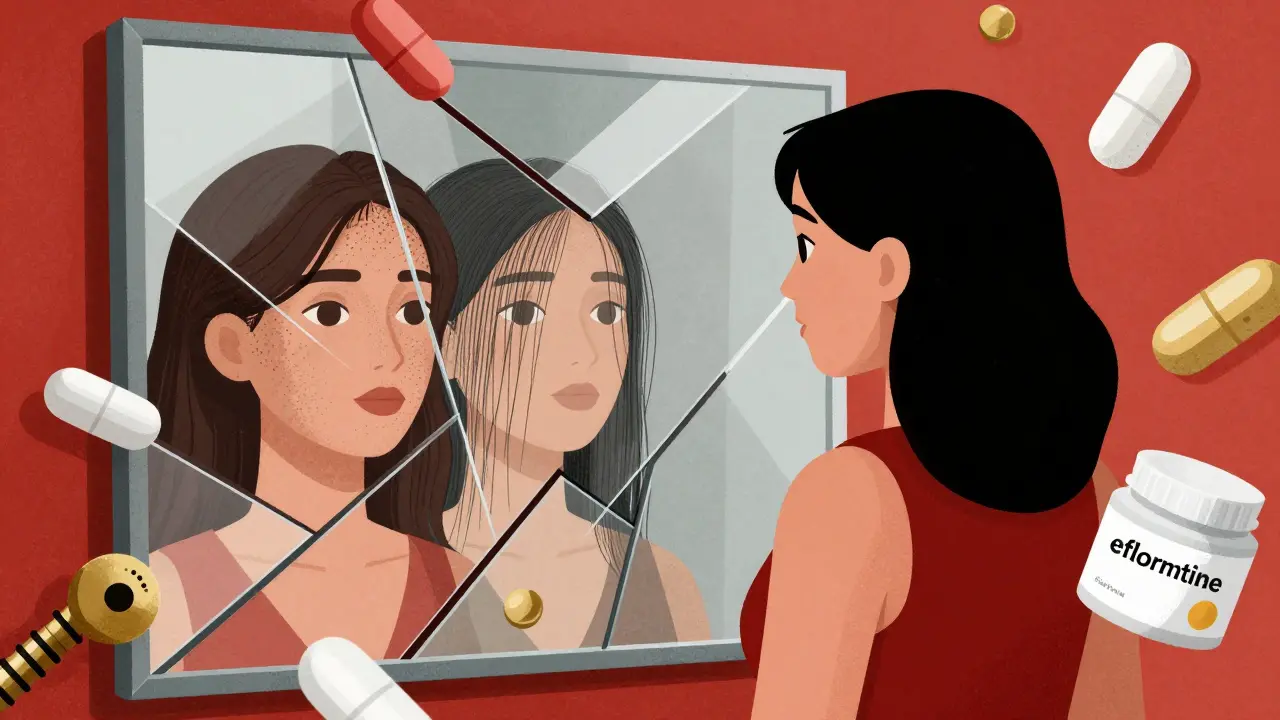
When you have PCOS, unwanted facial or body hair isn’t just a cosmetic issue-it’s a constant reminder of something deeper going on inside your body. About 70 to 80% of women with PCOS deal with hirsutism, the growth of thick, dark hair in places like the upper lip, chin, chest, or back-areas where men typically grow hair. It’s not about grooming. It’s about hormones. And while birth control pills are often the first step, they don’t work for everyone. That’s where antiandrogens come in.
What Exactly Are Antiandrogens?
Antiandrogens are medications that block the effects of male hormones-like testosterone and DHT-in your body. They don’t eliminate these hormones, but they stop them from binding to receptors in your hair follicles. That’s key. Hair growth in hirsutism isn’t just about having too much testosterone; it’s about how your skin reacts to it. Some women with PCOS have hair follicles that are extra sensitive, even with normal hormone levels. The most common antiandrogens used today are spironolactone, finasteride, and eflornithine cream. Spironolactone, originally a blood pressure pill, blocks androgen receptors and also reduces the enzyme that turns testosterone into its stronger form, DHT. Finasteride targets only that enzyme, making it more specific. Eflornithine is different-it’s a cream applied directly to the skin, slowing hair growth at the root without affecting hormones systemically.Why Not Just Use Birth Control Pills?
Combined oral contraceptive pills (COCPs) are still the first-line treatment for hirsutism in PCOS. They work by lowering overall androgen production and increasing sex hormone-binding globulin, which traps free testosterone. But here’s the reality: about 30% of women don’t get enough improvement after six months of consistent use. Some can’t take them because of blood clots, migraines, or high blood pressure. Others feel worse-mood swings, bloating, low libido-so they stop. That’s where antiandrogens fit. They’re not replacements for birth control. They’re add-ons-or alternatives when birth control fails or isn’t an option. A 2023 meta-analysis from Monash University found that when COCPs alone didn’t cut it, adding spironolactone or finasteride led to significantly better hair reduction. In one study, women’s modified Ferriman-Gallwey (mFG) scores dropped from 18 to 11 after six months on combo therapy. That’s noticeable. Not perfect, but enough to make a difference in daily life.How Long Does It Take to See Results?
This is the hardest part for most patients: patience. Hair doesn’t vanish overnight. Hair grows in cycles, and antiandrogens don’t kill existing hairs-they make new ones finer, lighter, and slower-growing. You won’t see changes in the first month. Maybe not even in three. Most women start noticing a difference around six months. The best results come after 12 to 18 months of daily use. That’s why so many people give up too soon. One Reddit user, PCOSWarrior2020, wrote: “I thought it wasn’t working until month 7. Then I looked at my chin in the mirror and realized I hadn’t threaded in weeks.” Another, HirsuteHannah, switched from spironolactone to finasteride because the dizziness was unbearable. She got results but paid $85 a month out of pocket. Cost and side effects are real barriers. Spironolactone can cause fatigue, dizziness, or irregular periods. Finasteride is expensive without insurance. Eflornithine cream (Vaniqa) costs about $245 for a month’s supply. And none of them work if you’re not consistent. Missing doses slows progress dramatically. Daily use cuts hair growth twice as effectively as every-other-day dosing, according to the same 2023 study.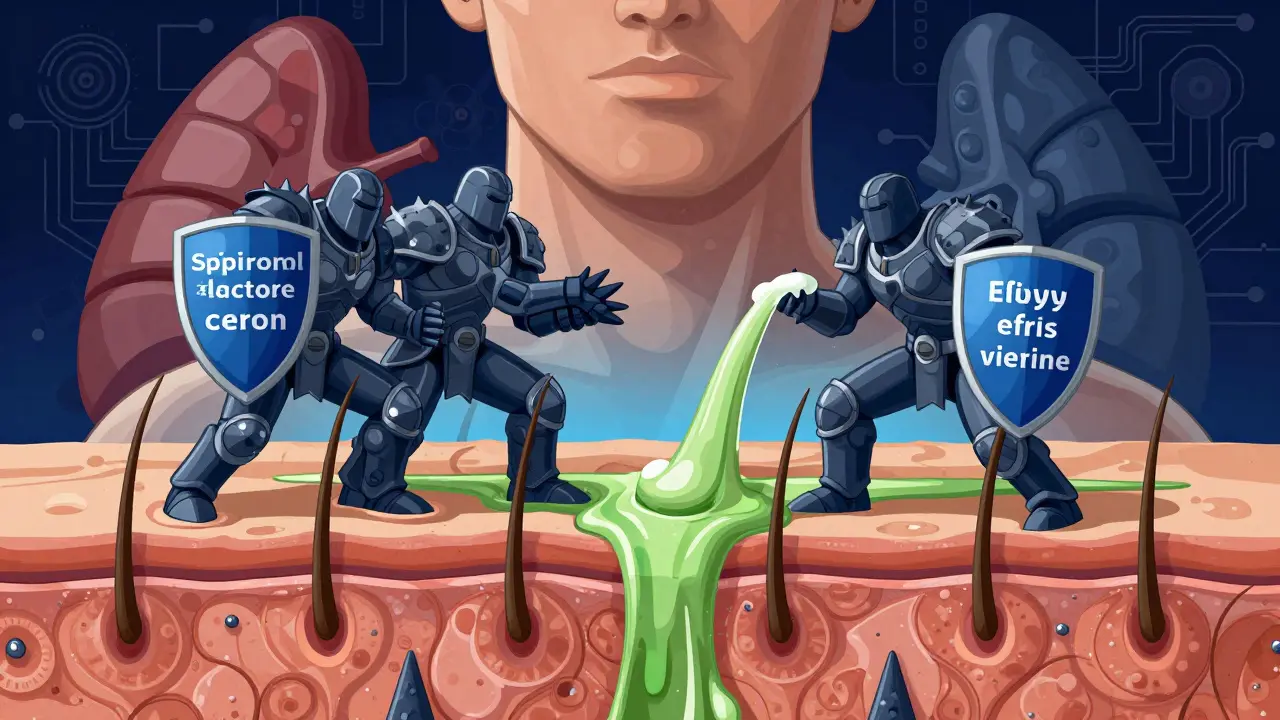
What About Safety?
All antiandrogens carry a major warning: they can harm a developing male fetus. That’s why you need two forms of birth control while taking them-even if you’re already on the pill. Spironolactone is Category B (no proven risk in humans), but finasteride is Category X (known to cause birth defects). If you’re sexually active and not using reliable contraception, don’t take these meds. Spironolactone can also raise potassium levels, especially in people with kidney problems or those taking other meds like ACE inhibitors. Regular blood tests are recommended. Flutamide, once used, was pulled from the market because of liver damage. Bicalutamide is used off-label but still carries risks. Eflornithine cream is the safest option for those who can’t take oral meds. It doesn’t enter your bloodstream. Side effects? Minor skin irritation, redness, or ingrown hairs. It won’t remove hair-it just slows regrowth. But when paired with laser therapy, it boosts results by 35% compared to laser alone.Combination Therapy: The Real Game Changer
The most effective approach isn’t one drug-it’s a stack. Many dermatologists and endocrinologists now recommend combining treatments:- COCPs to lower overall androgen production
- Spironolactone or finasteride to block hormone action in follicles
- Eflornithine cream to slow hair growth locally
- Laser or IPL for permanent reduction of existing dark hairs
What’s Next? The Future of Hirsutism Treatment
The 2023 International PCOS Guideline was a turning point. For the first time, antiandrogens were formally recognized as second-line therapy after COCP failure. Before that, guidelines said there wasn’t enough evidence. Now, we know better. Research is moving fast. New drugs called selective androgen receptor modulators (SARMs)-like enobosarm-are in Phase II trials. Early results show 28% greater hair reduction than placebo, with fewer side effects than spironolactone. These could become the next standard within five years. There’s also growing interest in personalized medicine. Scientists are studying genetic markers that predict who will respond best to which drug. Maybe one day, a simple blood test will tell you whether spironolactone or finasteride is right for you. For now, the best approach is simple: start with birth control. Wait six months. If no improvement, talk to your doctor about adding an antiandrogen. Don’t rush. Don’t quit early. And remember-you’re not alone. Thousands of women are on this same path, adjusting, waiting, and slowly gaining back control.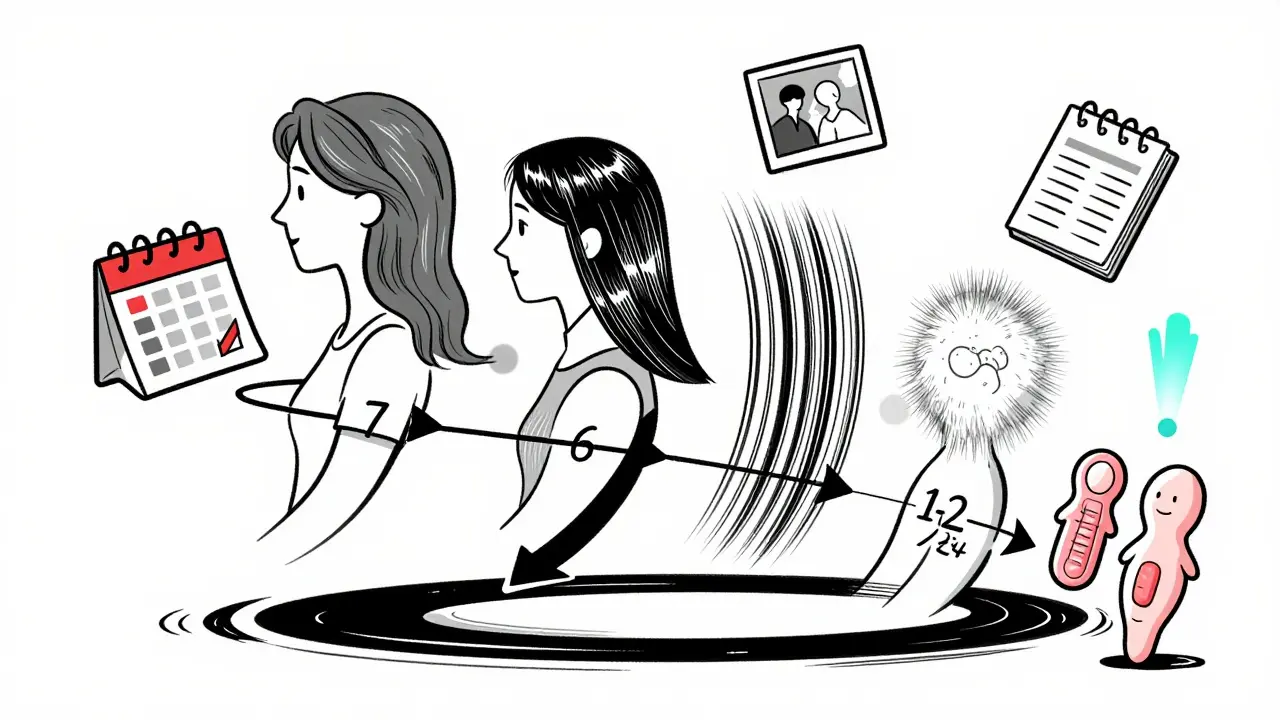
What to Expect If You Start Antiandrogens
If you’re considering this route, here’s what to plan for:- Month 1-3: No visible change. You might feel side effects like dizziness or fatigue. Keep taking it.
- Month 4-6: Hair growth slows. You may notice less stubble between shaves or fewer dark hairs popping up.
- Month 7-12: Hair becomes finer and lighter. Some women report being able to skip threading.
- Month 12-24: Maximum benefit. Many see 30-50% reduction in hair density and coarseness.
When to Avoid Antiandrogens
You should not use these medications if:- You’re pregnant or planning to become pregnant
- You have severe kidney disease (especially with spironolactone)
- You’ve had liver damage from other medications
- You’re already on potassium-sparing diuretics or ACE inhibitors
- You can’t commit to daily dosing and reliable contraception
Josh Kenna
January 19, 2026 AT 16:22Man, I wish I’d known this stuff when I was 19. I spent years waxing my upper lip like it was a war zone, then gave up and just let it grow-felt like surrendering to my own body. Then my endo put me on spironolactone and I cried the first time I saw stubble instead of dark threads. It’s not magic, but it’s the closest thing I’ve found to reclaiming my skin.
Malikah Rajap
January 21, 2026 AT 01:51It’s fascinating, really-how our bodies are these silent battlegrounds of hormones we never asked for, and yet we’re told to just ‘tough it out’ or ‘shave more.’ But here’s the truth: hirsutism isn’t vanity. It’s a biological echo of insulin resistance, of inflammation, of a system screaming for balance. And antiandrogens? They’re not suppressing you-they’re helping your body whisper back.
It’s not about looking ‘normal.’ It’s about feeling like you’re not a walking symptom.
I’ve watched friends go from hiding their chins to wearing tank tops again. That’s not medical progress. That’s liberation.
And yes, it takes time. But so does healing from trauma. So does learning to love yourself. Why should this be any different?
Also-why is Vaniqa so expensive? It’s a cream. Not a luxury yacht.
Erwin Kodiat
January 22, 2026 AT 17:39Big respect to anyone sticking with this for 18 months. I’m still on month 4 and my chin looks like a bad pencil sketch, but I’m keeping at it. Also, laser + spironolactone is a game-changer. My dermatologist said I’m a ‘poster child’ for combo therapy. I’m not a poster child-I’m just tired of hiding.
Christi Steinbeck
January 24, 2026 AT 03:45STOP GIVING UP AT 3 MONTHS. I did. Then I restarted. Month 8, I wore a turtleneck to a family dinner and didn’t feel like I needed to explain myself. That’s the win. You’re not broken. You’re just healing slower than society thinks you should.
Jacob Hill
January 25, 2026 AT 22:47Just to clarify-spironolactone isn’t a diuretic for weight loss, right? I’ve seen people on Reddit taking it for ‘bloat’ and it’s terrifying. It’s for androgen blockade. Please, if you’re not diagnosed, don’t self-prescribe. Your potassium levels will thank you.
Lewis Yeaple
January 26, 2026 AT 00:59While the clinical data presented is largely accurate, the author omits critical caveats regarding off-label use of finasteride in females. The FDA has not approved finasteride for hirsutism in women, and its long-term safety profile remains incompletely characterized in this population. Moreover, the referenced Monash meta-analysis, while methodologically sound, exhibits moderate heterogeneity in outcome measures across included studies. Therefore, while the therapeutic rationale is plausible, the recommendation for widespread adoption without individualized risk stratification is premature.
Jackson Doughart
January 27, 2026 AT 01:59I’ve been on spironolactone for 14 months. The dizziness? Real. The fatigue? Yeah. The fact that I can now wear a white shirt without checking for shadowy fuzz? Priceless. I didn’t expect this to be a miracle. I expected it to be hard. And it was. But I’m glad I didn’t quit when it felt pointless. My skin didn’t change overnight. But I did.
sujit paul
January 28, 2026 AT 17:12They say antiandrogens help-but have you considered that this is all part of a global agenda to feminize men and masculinize women? The pharmaceutical industry profits from making women feel broken. Why not embrace nature? Why not let your body be as it was designed? The ancients knew: body hair is a sign of vitality. This is not medicine. This is control.
Tracy Howard
January 29, 2026 AT 11:12Ugh. I’m Canadian and we don’t need this American pharmaceutical circus. We have universal healthcare-why are we paying $245 for cream? And why are you all so obsessed with ‘fixing’ your natural biology? In my country, women just wear scarves and move on. You’re making a medical problem out of a cultural one.
Aman Kumar
January 30, 2026 AT 13:00Let’s be clear: hirsutism is a metabolic derangement rooted in insulin resistance, not a hormonal imbalance per se. The overreliance on antiandrogens is symptomatic treatment, not root-cause resolution. You’re treating the phenotype, not the endotype. Until we address the underlying insulin signaling cascade via low-carb diets, time-restricted eating, and metformin as first-line, you’re just rearranging deck chairs on the Titanic. And don’t get me started on the overprescribing of COCPs as a band-aid. This is a systemic failure of endocrine care.
Jake Rudin
February 1, 2026 AT 02:43There’s something deeply poetic about the fact that the same hormones that drive aggression, muscle growth, and facial hair in men are the ones that, when misaligned in women, become a source of shame. It’s not just biology-it’s culture. We’ve turned a physiological variation into a moral failing. Antiandrogens don’t just reduce hair-they reduce the weight of expectation. And maybe that’s the real cure.
Lydia H.
February 2, 2026 AT 00:35My mom said, ‘Just pluck it.’ I said, ‘Mom, I’ve been plucking since I was 12.’ She didn’t get it. Until she saw my face after 10 months on spiro. Then she cried. Not because I looked different-but because I finally looked like me again. Thank you for writing this. I’m not alone.
Astha Jain
February 2, 2026 AT 14:53soo i started finasteride last month and my hair is like… not growing? but also i think i got a headache? and my boobs hurt? idk if its worth it??
Phil Hillson
February 3, 2026 AT 18:31Okay but who actually believes this works? I’ve seen 3 people try it. One quit after 2 months, one had a panic attack from the dizziness, and one got pregnant and had to stop. This isn’t treatment. It’s a gamble with your hormones and your mental health. And don’t even get me started on the cost. You’re basically paying to be less hairy so you can fit into a beauty standard that doesn’t even care about you.