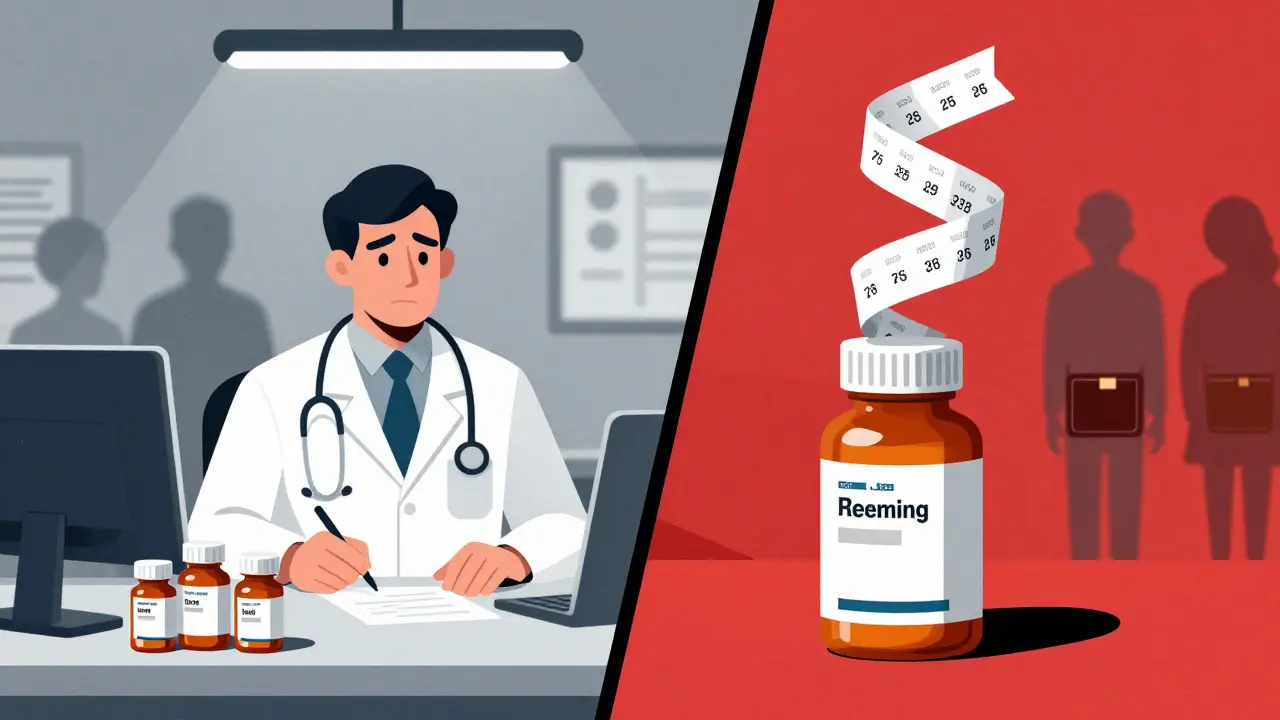
When you walk into a pharmacy and get a pill labeled as a generic version of your brand-name drug, do you wonder what your doctor really thinks about it? In the U.S., most doctors prescribe generics without a second thought-90% of prescriptions are for them. But that’s not the whole story. Across the globe, doctors and pharmacists see generics in wildly different ways. In some countries, they’re seen as a lifeline. In others, they’re a last resort. And in a few, they’re the only option that makes sense.
Europe: Generics as Policy, Not Preference
In Germany, France, and the U.K., doctors don’t just accept generics-they’re pushed to prescribe them. Government rules require pharmacists to swap brand-name drugs for generics unless the doctor specifically says no. It’s not about trust. It’s about budgeting. European healthcare systems are under constant pressure to control costs. Generics save billions every year. In 2025, Europe accounted for nearly 29% of the global generic drug market, worth over $122 billion. German doctors, for example, prescribe generics in over 80% of cases. The system works because the quality is tightly controlled. Regulatory agencies like the EMA don’t cut corners. If a generic doesn’t match the brand’s bioequivalence, it doesn’t get approved. So European providers don’t worry about effectiveness. They worry about supply. When a shortage hits-say, a critical antibiotic from India-doctors feel it immediately. But overall, they see generics as a reliable, necessary tool.Asia-Pacific: Generics as the Foundation of Healthcare
In India and China, generics aren’t just affordable-they’re the backbone of the entire system. India alone produces 20% of the world’s generic drugs and supplies 40% of what the U.S. uses. Indian doctors don’t ask, “Should I prescribe a generic?” They ask, “Which generic do I prescribe?” There’s no debate. For millions, brand-name drugs are simply out of reach. A month’s supply of insulin or blood pressure medication can cost a week’s wages if it’s branded. Generics change that. Chinese providers see the same reality. With an aging population and rising rates of diabetes and heart disease, the government actively promotes generic use. Hospitals stock them first. Prescriptions are written with generics in mind. The result? Asia-Pacific is growing the fastest-projected to expand at 5% to 6.5% annually through 2034. Doctors there don’t view generics as a compromise. They view them as the standard. And because Indian and Chinese manufacturers have mastered low-cost production, the quality has improved dramatically. Many U.S. doctors now rely on these same generics without knowing where they come from.United States: High Volume, Low Trust
In the U.S., generics are everywhere-but trust is fragile. Nine out of ten prescriptions are generic. Yet they make up less than 20% of total drug spending. Why? Because even generics can be expensive. A single dose of a generic antibiotic might cost $5. But a generic cancer drug? That could be $500. The price gap isn’t always wide. Sometimes, it’s just a marketing trick. But doctors have seen too many stories: a patient gets a generic, it doesn’t work as well, and they’re sent back for a brand. Or worse-a shortage hits, and the only version available is from a plant that failed an FDA inspection. That erodes confidence. U.S. providers know generics are safe 95% of the time. But that 5%? It sticks with them. They also know the system is broken. When a drug loses its patent, the first generic maker drops the price. Then five more jump in. Prices crash. Then, suddenly, one company buys up the others. Prices spike again. Doctors see this cycle. They know it’s not about science-it’s about market control. So while they prescribe generics out of necessity, many still keep a few brand-name options on standby. Especially for complex conditions like epilepsy or thyroid disease, where tiny differences in absorption matter.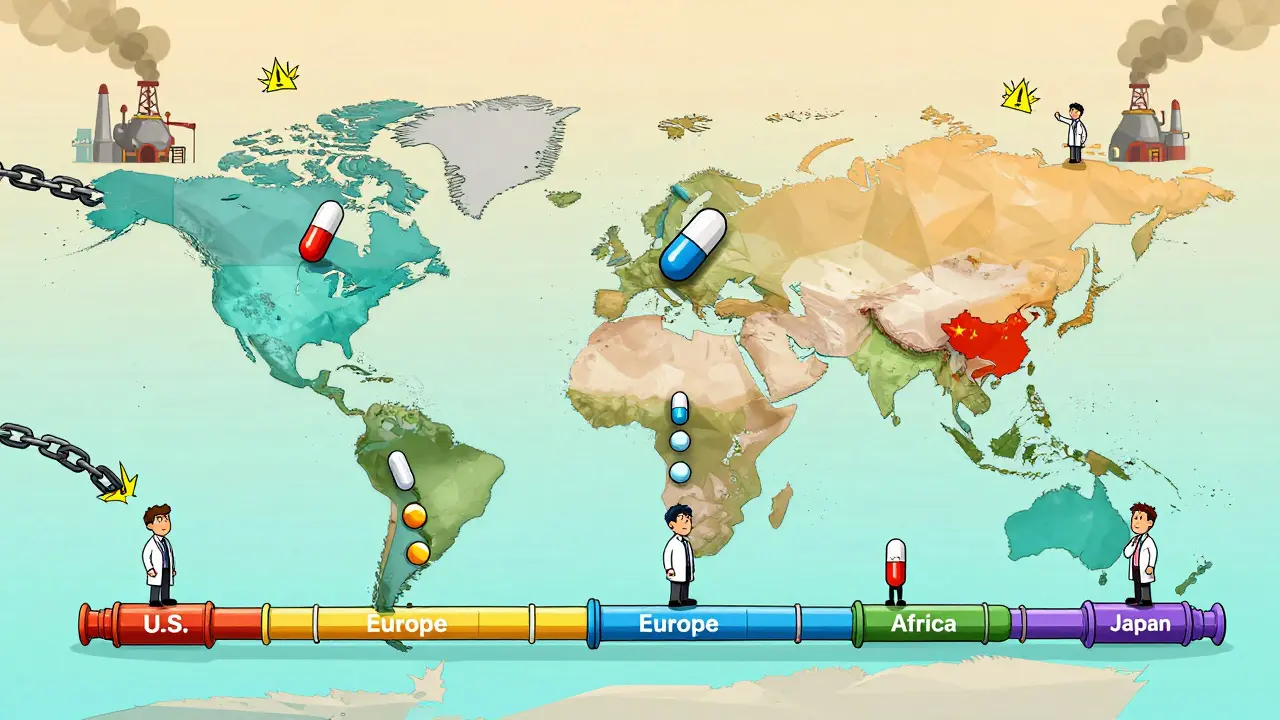
Japan: Price Cuts, Not Choice
Japan’s approach is unique. The government doesn’t just encourage generics-it forces them. Every two years, the health ministry slashes prices on nearly every drug on the market. Brand-name drugs lose value fast. Generics get a small boost. Doctors have no real choice. If they prescribe a brand, they risk getting audited. Patients are told upfront: “This generic is just as good.” And over time, they believe it. Japan’s generic use rate jumped from 25% in 2010 to over 80% today. The result? The overall pharmaceutical market is shrinking, even as the population ages. Doctors don’t complain. They adapt. They know the system works because it’s predictable. No surprises. No price hikes. Just steady, affordable access.Emerging Markets: Generics as Survival
In Brazil, Turkey, and parts of Africa, the story is simpler. If you can’t afford it, you don’t get it. Generics aren’t a policy-they’re a necessity. In these regions, healthcare spending is rising fast, but most of that money goes to generics. IQVIA estimates that so-called “pharmerging” markets will add $140 billion in drug spending by 2025, and nearly all of it will be for generics. Doctors in these places don’t have the luxury of debating quality. They have to choose what works and what’s available. If a patient comes in with high blood pressure and can’t pay for a $100 brand-name pill, the doctor writes a prescription for the $2 generic. There’s no stigma. No hesitation. It’s just how care is delivered. And because these countries are building their health systems from the ground up, generics are the default. They’re not seen as inferior. They’re seen as the only realistic path forward.
Ritwik Bose
January 9, 2026 AT 11:23India has been the silent engine of global generics for decades 🌏💊
Our manufacturers don't just copy-they innovate to meet WHO-GMP standards while keeping costs below $0.01 per pill.
When I was a med student in Delhi, we prescribed generics because they worked-not because we had to.
Now, even U.S. pharmacies stock Indian-made insulin and metformin without blinking.
It's not about cheapness-it's about scalability and integrity.
The stigma? That's a Western myth.
My grandfather took a generic blood pressure pill for 20 years-lived to 94.
Quality isn't determined by the label, but by the lab.
And yes, I still use emojis when I talk about life-saving medicine 😊
Let’s stop pretending generics are second-class.
They’re the reason millions breathe, walk, and live.
Shoutout to every Indian pharmacist who prints those blister packs at 3 AM.
Global health owes you more than thanks-it owes you equity.
Paul Bear
January 11, 2026 AT 07:36Let’s be precise here: bioequivalence isn’t a suggestion-it’s a regulatory requirement under 21 CFR 320.23.
The FDA mandates AUC and Cmax within 80–125% confidence intervals for approval.
So when you say ‘it works,’ you’re conflating clinical outcomes with pharmacokinetic equivalence.
And yes, 90% of U.S. prescriptions are generic-but that’s because insurers force it, not because providers trust it.
The 5% failure rate? It’s not anecdotal-it’s documented in the FDA’s Drug Shortage Database.
Look up the 2018 heparin contamination crisis or the 2021 losartan recall.
These aren’t edge cases-they’re systemic failures masked by volume.
And don’t get me started on the consolidation of generic manufacturers.
When Teva bought Actavis, prices spiked 1,000% overnight.
That’s not capitalism-it’s monopolistic rent-seeking.
So no, generics aren’t ‘the future.’ They’re a broken system we’ve normalized because we refuse to fix drug pricing at the source.
anthony martinez
January 13, 2026 AT 01:50So basically, the U.S. is the only country where doctors prescribe generics but don’t believe in them.
Interesting.
Meanwhile, the rest of the world just… uses them.
And somehow, people still live.
Go figure.
Mario Bros
January 15, 2026 AT 00:05Man, I used to think generics were sketchy until my kid needed asthma inhalers.
Brand name? $400 a month.
Generic? $35.
Same exact medicine.
Same exact results.
My kid’s breathing fine.
My wallet’s not crying.
Doctors in other countries get it.
We’re the weird ones for overpaying.
Just sayin’ 🙌
Christine Milne
January 16, 2026 AT 15:33Let me be clear: the notion that India or China produces high-quality generics is a dangerous fallacy propagated by anti-American ideologues.
The FDA has repeatedly flagged facilities in these countries for GMP violations.
China’s State Drug Administration has less transparency than the Soviet-era KGB.
And India? They export more counterfeit drugs than legitimate ones.
Why do you think the U.S. spends billions on domestic pharmaceutical manufacturing?
Because we don’t trust foreign supply chains.
And we shouldn’t.
Generic drugs are acceptable only if made under American oversight.
Anything else is a public health gamble-and Americans are not guinea pigs.
Bradford Beardall
January 17, 2026 AT 04:49It’s fascinating how the same pill means something completely different in Berlin vs. Bangalore vs. Brooklyn.
In Germany, it’s a policy tool.
In India, it’s dignity.
In the U.S., it’s a negotiation between fear and finances.
And yet-same molecule.
Same mechanism of action.
Same FDA or EMA approval.
Why do we assign moral weight to a label?
Is it the color of the pill?
The shape?
The brand name on the blister pack?
Or is it just that we’re trained to equate price with value?
I’ve watched patients in rural Kenya weep because they got their first generic antiretroviral.
They didn’t care if it was made in India.
They just knew they’d live another day.
That’s the real metric.
Not market share.
Not patent cliffs.
Just survival.
McCarthy Halverson
January 18, 2026 AT 16:01Generics work.
Most of the time.
Doctors know.
Patients know.
Insurance companies know.
Pharma doesn’t.
So they game the system.
Simple as that.
Fix pricing.
Not blame generics.
Michael Marchio
January 19, 2026 AT 19:46It’s ironic, really, how the U.S. spends more per capita on healthcare than any nation on earth-and still treats its citizens like they’re lucky to get a generic tablet.
We have the technology, the capital, the scientific infrastructure to produce every single drug domestically with flawless quality control.
Yet we outsource the manufacturing of life-saving medications to countries with lax labor laws and questionable regulatory oversight, then wonder why people distrust the system.
And when patients report adverse reactions to a generic? We blame the patient.
Or the ‘placebo effect.’
Never the fact that the active ingredient came from a factory that failed an inspection three times.
Or that the same company bought out every competitor and raised prices 700% because they could.
And now we’re about to see the biggest wave of biologic generics ever-drugs that cost $100,000 a year becoming available for $5,000.
But who will get them?
Will it be the people who need them?
Or will it be the same corporations that made the original drugs, now just rebranding them as ‘biosimilars’ and charging $40,000 anyway?
History says the latter.
And we’re still pretending this is about health, not profit.
It’s not about the pill.
It’s about who owns the right to heal.