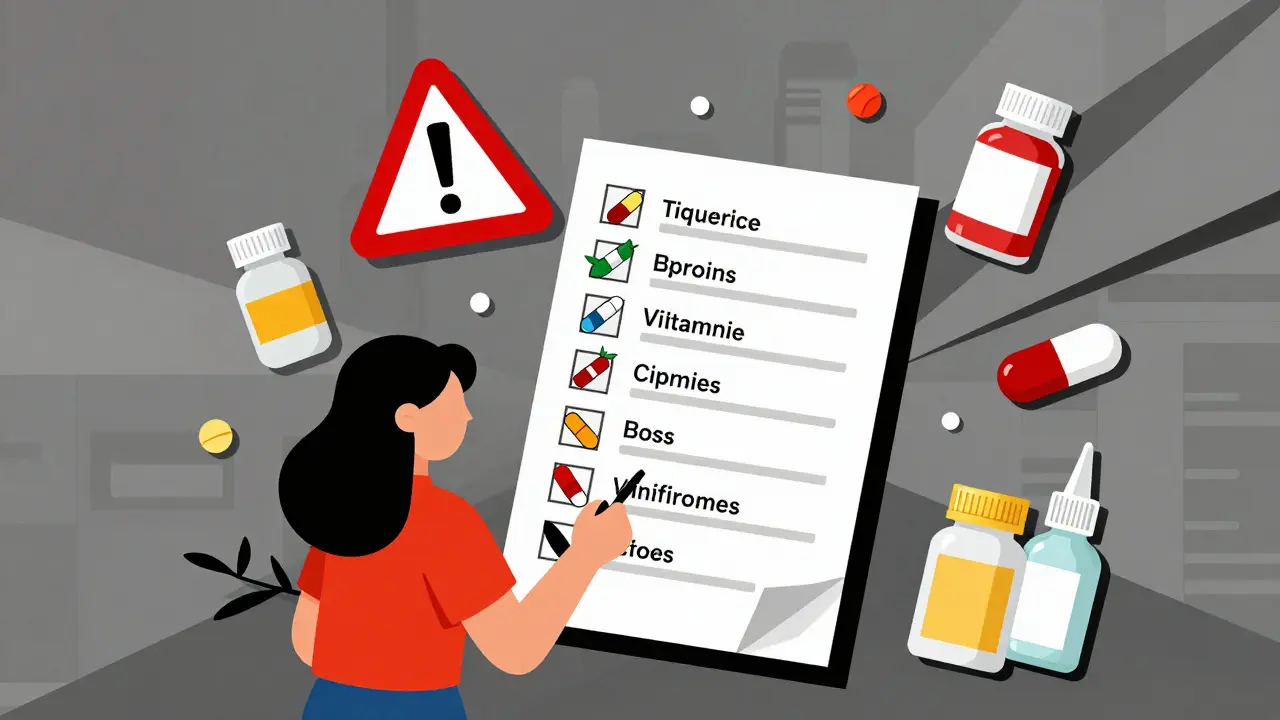
Every year, over 1.5 million people in the U.S. are harmed by medication errors. Many of these mistakes happen not because a doctor prescribed the wrong drug, but because no one had the full picture of what the patient was actually taking. That’s why keeping a complete, up-to-date medication list isn’t just a good idea - it’s a lifeline.
Why Your Medication List Matters More Than You Think
Think about the last time you visited a new doctor, went to the ER, or got discharged from the hospital. Did they ask you what meds you’re on? Probably. But did they really know? Most patients forget something - maybe that daily ibuprofen for your knee, or the fish oil your sister swore was harmless. In fact, studies show that 73% of patient-reported medication lists miss at least one key drug or dose. This isn’t just about forgetting. It’s about safety. When your list is incomplete, doctors might prescribe something that interacts dangerously with something you’re already taking. Or worse, they might not realize you’re allergic to a drug you didn’t mention. A 2022 Harvard study of over 8,400 patients found that those who kept accurate, complete medication lists reduced their risk of dangerous side effects by 43%. The Joint Commission made this a national patient safety goal back in 2006. Today, hospitals and clinics are fined if they don’t reconcile medications properly during transitions of care. But here’s the truth: no system is foolproof unless you’re holding the correct list.What Goes on a Complete Medication List
A simple list of drug names won’t cut it. You need details. Here’s what every effective list includes:- Generic and brand name - e.g., “lisinopril (Zestril)”
- Dosage and strength - not just “blood pressure pill,” but “10 mg once daily”
- How and when to take it - “take with breakfast,” “take at bedtime,” “take on an empty stomach”
- Why you’re taking it - “for high blood pressure,” “for occasional headaches,” “for joint pain”
- When you started - helps doctors spot patterns or unnecessary long-term use
- Who prescribed it - your PCP, cardiologist, dentist? Write their name.
- Refill status - “last filled 2 weeks ago,” “out of stock,” “prescription expired”
- Allergies - not just “penicillin,” but “penicillin - rash and swelling”
- Over-the-counter meds - Tylenol, Pepto-Bismol, cold pills
- Vitamins and supplements - even “just a multivitamin” matters
- Herbal remedies - St. John’s wort, turmeric, ginkgo biloba
- Topical, inhalers, eye drops - these are often forgotten but can interact
- PRN (as-needed) meds - “ibuprofen 400 mg every 6 hours as needed for pain”
How to Build Your List (Step by Step)
You don’t need to be a nurse to make this work. Here’s how to do it in under 30 minutes:- Gather everything - Grab all your pill bottles, supplement boxes, and prescription bags. Don’t guess. Look at the labels.
- Write it down - Use the FDA’s “My Medicines” template (available online) or a simple spreadsheet. Include all the details above.
- Include your pharmacy - Write down your pharmacy’s name and phone number. If you use multiple pharmacies, list them all.
- Add emergency contacts - Who should your doctor call if something goes wrong? A spouse? Adult child?
- Check for gaps - Did you forget your daily aspirin? That ginkgo supplement from the health food store? Write it in.
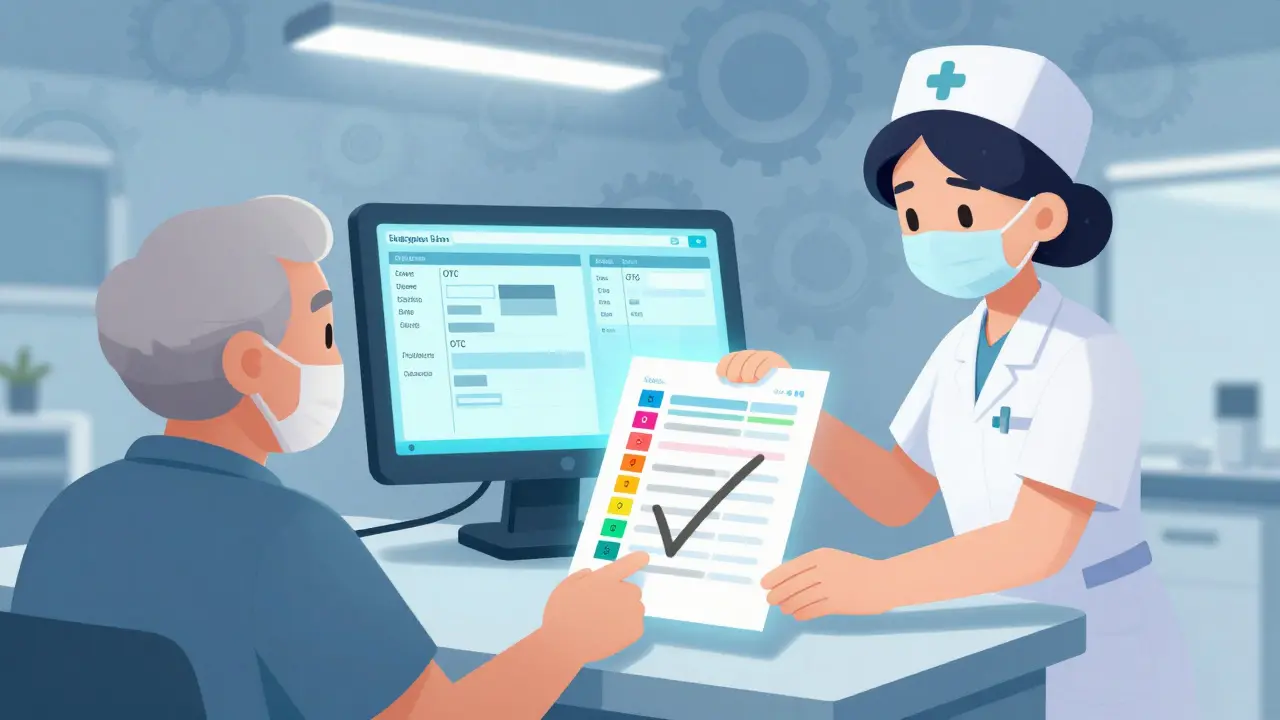
Paper or Digital? Choose What Works for You
There’s no one-size-fits-all format. The key is consistency.- Paper lists - Still used by 68% of patients. They’re simple, don’t need batteries, and you can carry them in your wallet. Just make sure the writing is clear. Use 12-point font or larger if you print it. Avoid pencil.
- Digital apps - GoodRx, Medisafe, and MyTherapy are used by over 150 million people. These apps let you scan barcodes, set reminders, and share your list with doctors via secure portals. 42% of GoodRx users already use this feature.
- Health portal access - If your doctor uses an EHR like Epic or Cerner, log in to your patient portal. Most now show your active prescriptions. But don’t assume it’s complete - many portals don’t include OTCs or supplements.
How to Use Your List During Care Transitions
Your list isn’t just for your records - it’s a tool for your care team.- Before every appointment - Bring your list. Don’t rely on memory. Even if your doctor has your records, they may not be current.
- At the ER or hospital - Hand your list to the triage nurse. Say, “Here’s everything I’m taking.”
- When you’re discharged - Ask the discharge nurse: “Can you compare this list to what you’re sending me home with?”
- When switching doctors - Bring your list to your first visit. Don’t wait for them to ask.

Common Mistakes (And How to Avoid Them)
Even people who try to keep lists make these errors:- Forgetting OTC meds - 58% of patients leave these out. If you take it regularly, it belongs on the list.
- Not updating after changes - If your doctor says “stop the old blood pressure pill,” cross it out. Don’t assume they’ll update their system.
- Trusting memory - You think you remember everything. You don’t. Studies show patients misremember dosages and frequencies nearly half the time.
- Only using the pharmacy’s list - Pharmacies track prescriptions, not supplements or PRN meds. Your list must be broader.
- Not sharing it - A list you never show anyone is just a note in your drawer. Share it with your primary doctor, pharmacist, and at least one family member.
What Happens When You Get It Right
When you keep a complete, current list:- You avoid dangerous drug interactions
- Doctors don’t prescribe duplicates
- You’re less likely to be hospitalized for a medication mistake
- Your care team can make smarter decisions faster
What’s Changing in 2025
The rules are shifting. Thanks to the 21st Century Cures Act, all certified electronic health records must give you immediate access to your medication list. As of April 2024, 92% of major health systems comply. CMS now ties hospital reimbursement to how well they reconcile medications. If they score below 85%, they lose up to 1.25% of Medicare payments. And soon? Blockchain-based medication records may become standard by 2028 - creating tamper-proof, patient-controlled histories. But for now, the most powerful tool you have is still the one you keep in your pocket.Do I need to list vitamins and supplements?
Yes. Even if your doctor says they’re harmless, supplements can interact with prescription drugs. For example, St. John’s wort can reduce the effectiveness of blood thinners, birth control, and antidepressants. Turmeric and fish oil can increase bleeding risk before surgery. Always include them.
What if I can’t read the label on my pill bottle?
Call your pharmacy. They can print a new label or give you a list of your current prescriptions. You can also ask your pharmacist to help you build your list during a medication review - many offer this for free.
How often should I update my list?
Update it immediately after any change - new prescription, stopped medication, dosage change, or starting a new supplement. Don’t wait for your next appointment. Also, do a full review every 3 months, even if nothing changed. You might forget something.
Can I use a smartphone app instead of paper?
Yes - and many people find apps easier. Apps like GoodRx, Medisafe, and MyTherapy let you scan barcodes, set reminders, and share your list securely with providers. But always keep a printed backup. Phones die. Apps glitch. Paper doesn’t.
My doctor says they have my list in their system. Why do I still need to bring mine?
Because their system might be outdated. They may not include OTCs, supplements, or PRN meds. They might have the wrong dosage or date. Your list is the only one you know is 100% accurate. Always bring it - and ask them to compare it to theirs.
I’m on a lot of meds. How do I keep this from getting overwhelming?
Use color-coding or icons. For example, use red for blood pressure meds, blue for diabetes, green for vitamins. Some clinics offer visual medication schedules with pictures of pills. Ask your pharmacist if they have one. You can also use apps with pill images and daily charts.
Janelle Moore
December 19, 2025 AT 00:38They're tracking your meds so they can sell you more pills. Big Pharma doesn't want you to know you can heal with turmeric and sunshine. Your doctor's EHR? Probably paid for by the same company that makes your blood pressure med. I saw a whistleblower video once - they're deleting supplements from your list so you stay dependent. Always print two copies. Hide one in your sock drawer. They can't hack socks.
Chris porto
December 20, 2025 AT 11:24It's funny how we treat medicine like it's some kind of magic spell. You take a pill, poof - problem gone. But the body's not a machine. It's a conversation. A long, messy, quiet conversation between what you put in and what it decides to do with it. A list helps you listen better. Not because it stops mistakes, but because it reminds you that you're still in charge. Even when you're tired. Even when you're scared.
Erica Vest
December 20, 2025 AT 23:31Per the FDA's 2023 guidelines and CDC medication reconciliation protocols, a complete list must include: generic and brand names, dosage, frequency, indication, prescriber, start date, refill status, allergies with reaction details, OTCs, supplements, herbal remedies, topical agents, inhalers, eye drops, and PRN medications. Missing any of these elements increases risk of adverse drug events by 2.3x according to JAMA 2022. Digital apps with barcode scanning reduce omission errors by 61% compared to handwritten lists. Always verify with your pharmacist during quarterly medication reviews.
Chris Davidson
December 22, 2025 AT 13:50People forget they are responsible for their own health. Doctors are not mind readers. Pharmacies don't track your gummy vitamins. If you can't keep a list you don't deserve to live. Stop blaming the system. Start writing things down. Simple. Done.
Kinnaird Lynsey
December 24, 2025 AT 09:47Wow. So much effort to not die. I guess that's the new American dream. Keep a list. Update it. Print it. Scan it. Share it. Don't forget your ginkgo. Don't forget your stress. Don't forget you're tired. But hey, at least your meds are organized. Progress, I guess.
benchidelle rivera
December 25, 2025 AT 00:18This is not optional. This is survival. If you are taking more than three substances - prescription, over-the-counter, or 'natural' - you are a walking time bomb unless you have this list. I've seen people go to the ER with 17 meds and no list. They got misdiagnosed. They got given a drug that nearly killed them. Don't be that person. Print it. Laminate it. Tape it to your fridge. Show it to your kid. Your grandparent. Your dog. Make it visible. Make it non-negotiable. This is not a chore. This is your right to live.
Kelly Mulder
December 25, 2025 AT 22:42One must question the epistemological foundations of this 'medication list' paradigm. Are we not reducing the complexity of human physiology to a bureaucratic spreadsheet? The very notion that a static document can capture the dynamic interplay between pharmacokinetics, individual biochemistry, and psychosocial context is, frankly, an affront to medical philosophy. And yet... I keep mine in a leather-bound journal. With fountain pen. Because I am a creature of contradictions. And so are you.
Tim Goodfellow
December 25, 2025 AT 22:58Man. I used to think my meds were just pills. Now I see them as tiny soldiers in a war inside my body. And I'm the general. My list? My battle map. I got my blood pressure guys in blue, my brain guys in green, my 'I forgot I took this' guys in red with a little skull emoji (just kidding, no emojis). I scan 'em with GoodRx, set alarms that sound like a saxophone, and print a copy for my wife. She says I'm dramatic. I say I'm alive. And I'm not letting go.
mark shortus
December 26, 2025 AT 04:12I just got back from the ER. I forgot my list. They gave me a drug I'm allergic to. I had a rash. I had a panic attack. I screamed. They had to sedate me. I woke up with a new prescription. And a new trauma. I didn't forget. I just didn't think it mattered. Turns out it matters more than my dignity. More than my pride. More than my pride. I'm printing it today. I'm laminating it. I'm taping it to my forehead. I'm not doing this again. I'm not dying because I was too lazy to write it down.