Drug Interaction Checker
Check if your medications might interact dangerously with each other. This tool helps you identify potential risks before taking multiple medications. Always consult your pharmacist or doctor for personalized advice.
Check Your Medications
Every time you pick up a prescription, there’s a hidden safety manual on the bottle. It’s not in big, bold letters. It’s not always easy to read. But if you skip it, you could be putting your health at risk. The safety and warnings section on your prescription label isn’t just fine print-it’s your first line of defense against dangerous side effects, deadly interactions, and preventable mistakes.
What the Boxed Warning Really Means
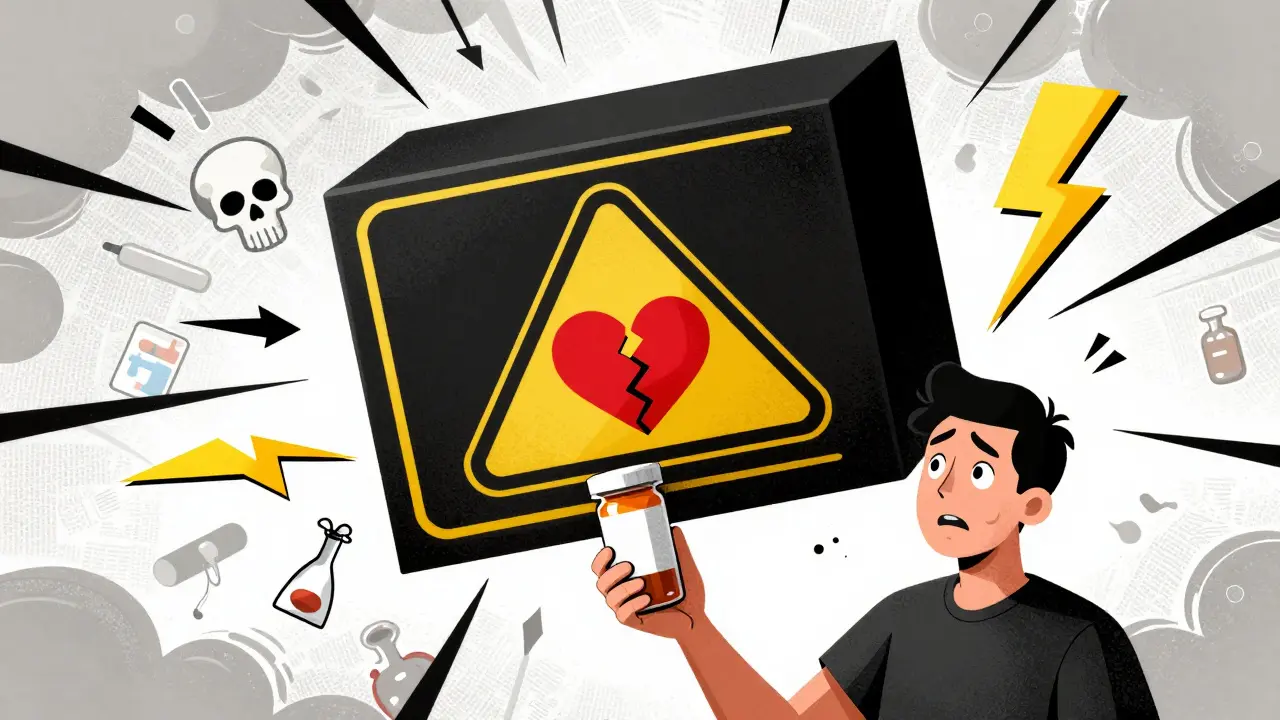
The most serious warning on any prescription label is the boxed warning, also called a black box warning. It’s called that because it’s printed in a thick black border around the text, making it impossible to miss on the official drug packaging. The FDA requires this warning only when there’s clear evidence of life-threatening risks-like organ failure, severe allergic reactions, or sudden death.
For example, the drug clozapine, used for treatment-resistant schizophrenia, carries a boxed warning for agranulocytosis-a condition where white blood cells drop dangerously low. Without regular blood tests, this can be fatal. Another example is isotretinoin (Accutane), which has a boxed warning for severe birth defects. If you’re pregnant or planning to be, this warning isn’t a suggestion-it’s a red flag that demands action.
Here’s the catch: only about 32% of patients actually understand what a boxed warning means. Many think it’s just a general caution. It’s not. A boxed warning means: if you ignore this, you could die. Don’t assume your doctor already covered it. Read it yourself.
Warnings and Precautions: The Details That Save Lives
Beneath the boxed warning is the Warnings and Precautions section. This is where the drug manufacturer lists all known serious side effects, conditions that make the drug dangerous, and situations that need extra monitoring.
Look for phrases like:
- “May cause severe liver damage”
- “Has been associated with suicidal thoughts in young adults”
- “Avoid if you have kidney disease”
- “Monitor blood pressure weekly during first month”
These aren’t random guesses. They’re based on clinical trials and real-world data. A 2021 study in JAMA Internal Medicine found that patients who understood these warnings had 50% fewer hospital visits due to drug-related complications.
Pay special attention to warnings about:
- Age restrictions-Some drugs are unsafe for children or seniors.
- Pregnancy and breastfeeding-Even over-the-counter painkillers can be risky.
- Underlying conditions-Heart disease, liver issues, or diabetes can change how your body handles a drug.
Don’t just read the warning-ask yourself: Do any of these apply to me? If yes, talk to your pharmacist before taking the pill.
Drug Interactions: When Your Other Medications Turn Dangerous
Most people don’t realize that the biggest danger isn’t the drug itself-it’s what happens when it mixes with something else. The Drug Interactions section tells you exactly which other medications, supplements, or even foods can cause harm.
Here’s a real case: A 68-year-old man took dextromethorphan (a common cough medicine) with his antidepressant. He didn’t see the warning because it was printed in 6-point font on the bottom of the bottle. Within hours, he developed serotonin syndrome-a life-threatening surge of brain chemicals. He ended up in the ICU.
Look for these exact phrases:
- “May increase blood levels of [Drug X] by up to 400%”
- “Avoid with CYP3A4 inhibitors like grapefruit juice or clarithromycin”
- “May reduce effectiveness of [Drug Y]”
It’s not enough to know your own meds. You need to know what’s in your cabinet. That includes vitamins, herbal teas, and over-the-counter pain relievers. A 2022 study found that 73% of patients on five or more medications didn’t recognize a dangerous interaction until after they got sick.

Pharmacy Labels: What’s on the Bottle Matters Too
The original drug packaging has the full warnings. But the bottle your pharmacist gives you? That’s where the real-world safety info lives. Pharmacy labels are required by law to include critical warnings in large, clear print-minimum 10-point font.
Look for these common stickers:
- “May cause drowsiness-do not drive or operate machinery”
- “Take on an empty stomach-wait 2 hours before or after eating”
- “Do not drink alcohol while taking this medication”
- “May cause sun sensitivity-use sunscreen”
These aren’t suggestions. They’re legal requirements. But here’s the problem: 38% of patients say these warnings are printed on the bottom of the bottle, where they get hidden when stored in a medicine cabinet. If you can’t see it, you can’t follow it.
Pro tip: When you get your prescription, turn the bottle around. Read every sticker. If it’s hard to read, ask the pharmacist to print a larger version. Many will do it.
How to Make Sure You Don’t Miss Anything
Reading the label isn’t enough. You have to understand it. Here’s how to make sure you’re not missing the most important details:
- Ask the pharmacist to explain the black box warning-in plain language. Don’t settle for “It’s serious.” Ask: “What exactly could go wrong?”
- Use the “teach-back” method-After they explain, say: “So, if I take this with my blood pressure pill, I could get dizzy and fall. Is that right?” If they nod, you got it.
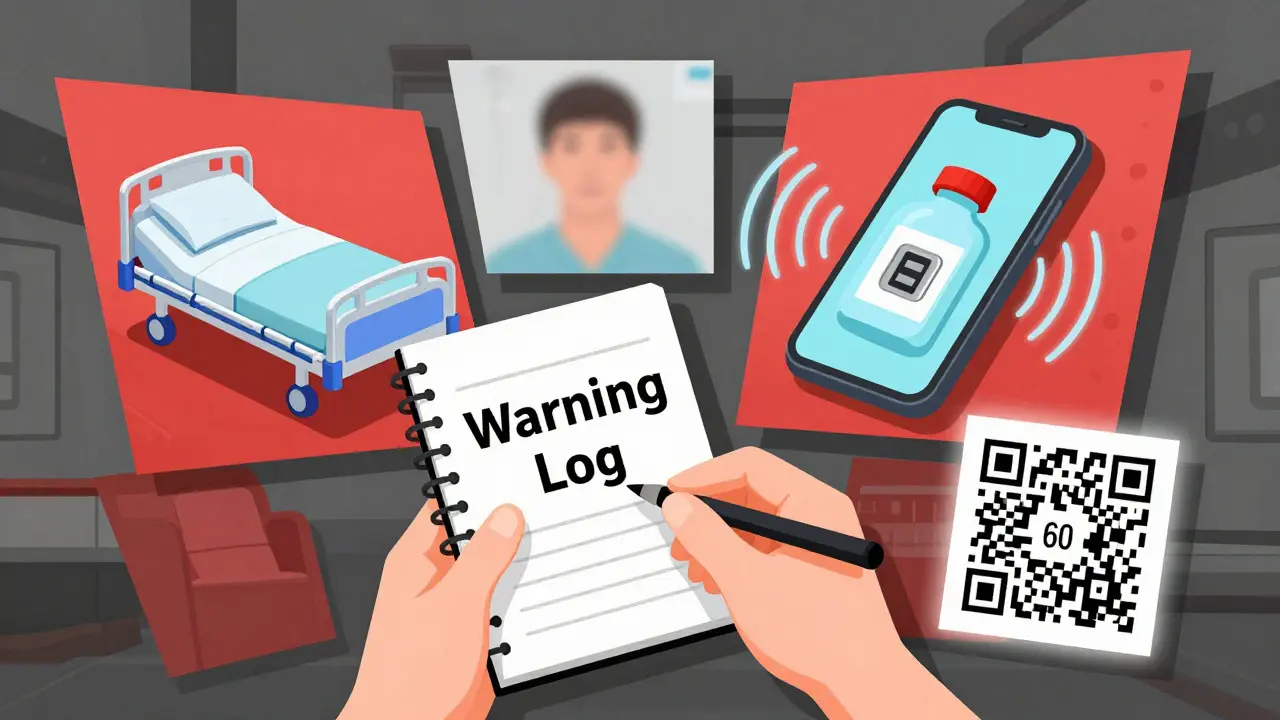
- Create a warning log-Keep a small notebook or phone note listing each drug, its biggest warning, and what you need to avoid. Update it every time you get a new prescription.
- Check for digital help-Apps like Medisafe let you scan your pill bottle and alert you to interactions. They’re 89% accurate when used consistently.
- Speak up if the label is too small-If the warning is in tiny print or faded, ask for a printed copy. You have the right to clear, readable safety info.
A University of Florida study found that patients who kept a warning log were 41% more likely to follow safety rules. That’s not just good advice-it’s life-saving behavior.
What’s Changing in 2025
The FDA is making big changes to make warnings clearer. Starting in 2024, all new drugs must include warning language tested on people with low literacy. By 2025, you’ll start seeing:
- Color-coded warnings-Red for critical, yellow for moderate, blue for general.
- QR codes-Scan one and watch a 60-second video explaining the risk.
- NFC chips-Tap your phone to the bottle and get audio instructions in your language.
Walgreens piloted NFC tags in 2022. Patients understood 92% of the warnings-compared to just 63% with regular labels. But here’s the catch: 24 million Americans don’t use smartphones regularly. That’s why pharmacies are still required to offer printed versions.
Don’t wait for technology to fix this. You can start today. Read your label. Ask questions. Write it down.
What Happens When You Ignore Warnings
Every year, over 1.3 million people in the U.S. end up in the emergency room because they didn’t understand their drug warnings. About 350,000 of them end up hospitalized. Many of these cases are preventable.
One woman took a new antibiotic and didn’t read the warning about sun sensitivity. She went to the beach. Within hours, her skin blistered. She spent three weeks in the hospital with second-degree burns.
A man with diabetes took a cold medicine that raised his blood sugar. He didn’t see the warning because it was buried in a paragraph. He ended up in diabetic ketoacidosis.
These aren’t rare. They’re common. And they happen because people assume the doctor told them everything. Or they think the label is just there to protect the company.
It’s not. It’s there to protect you.
Final Rule: Never Guess. Always Ask.
Prescription labels are written for doctors-not patients. But you’re the one taking the pill. You deserve to understand the risks.
Here’s your simple rule: If you’re not 100% sure what a warning means, stop. Don’t take the pill. Call your pharmacist. Or ask your doctor. It’s not a bother. It’s your right.
The system isn’t perfect. Labels are crowded. Fonts are small. Warnings get buried. But you have more power than you think. You can ask for larger print. You can request a warning summary. You can use an app. You can write it down.
One page of text on a bottle can save your life. Don’t let it go unread.
jaspreet sandhu
December 31, 2025 AT 23:57People don't read because they think doctors know better. That's the problem. Not the font size. Not the wording. The belief that someone else is handling it. You hand over your life to a stranger in a white coat and wonder why things go wrong.
Alex Warden
January 2, 2026 AT 03:52USA has the best drug safety system in the world. If you can't read the label, that's your fault. Stop blaming the system. Get glasses. Ask. Learn. This isn't rocket science.
LIZETH DE PACHECO
January 3, 2026 AT 01:50I give my mom a printed summary of every new med. She's 72. We sit down. I read it to her. We highlight the big stuff. She doesn't trust apps. She trusts me. Simple. Human. Works every time.
Dusty Weeks
January 4, 2026 AT 14:09QR codes? NFC chips? LOL. They're just tracking you. Big Pharma + the FDA + your phone = surveillance. They don't care if you live. They care if you're data points. 🤫📱
Bryan Anderson
January 5, 2026 AT 23:38The teach-back method is underutilized. It's not just about comprehension-it's about accountability. When patients restate the risk in their own words, retention increases dramatically. It’s a low-cost, high-impact intervention.
Matthew Hekmatniaz
January 6, 2026 AT 02:34I grew up in a household where meds were taken without reading anything. My dad had a stroke because he mixed his blood thinner with a herbal supplement he thought was 'natural.' I now carry a laminated card in my wallet with every med I take and its warning. It saved me last year.
Olukayode Oguntulu
January 7, 2026 AT 23:23The entire pharmacological apparatus is a performative theater of risk mitigation. The boxed warning is a semiotic artifact-designed not to inform, but to absolve. The FDA doesn't want you to understand; it wants you to *feel* the weight of authority. The real danger isn't the drug-it's the epistemic violence of institutionalized obfuscation.
When the label says 'avoid with grapefruit,' it's not a warning-it's a linguistic trap. You're not meant to decode it. You're meant to obey. And obedience, my friends, is the true pharmacological mechanism.
That 89% app accuracy? It's a placebo effect wrapped in code. The human mind doesn't process risk through notifications. It processes it through ritual. You need a ritual. Not an app.
And let's be honest: if your pharmacist can't explain a black box warning in under 90 seconds, they're not a pharmacist-they're a compliance officer in scrubs.
QR codes? NFC? You think this is progress? No. This is the commodification of dread. Soon, your bottle will whisper your mortality into your ear via Bluetooth. And you'll thank them for it.
Read the label? Please. The label is the last illusion of agency. The real safety lies in refusing to participate. Don't take the pill. Don't scan the code. Don't ask questions. Just... exist. Outside the system.
They want you to be informed. But informed people don't take pills. They ask why they're needed in the first place.
And if you're still reading this? You're already part of the problem.
Sally Denham-Vaughan
January 8, 2026 AT 10:34My grandma used to keep all her meds in a shoebox with sticky notes on each bottle. 'Don't mix with tea.' 'Watch for dizzy.' 'Call if leg swells.' She didn't read the tiny print. She made it human. I do the same now. Works better than any app.
Liam George
January 9, 2026 AT 22:19They’re adding NFC chips? That’s the tip of the iceberg. The FDA knows what you’re taking. They know when you take it. They know if you skip doses. And they’re feeding it to insurers. You think this is about safety? No. It’s about denying coverage when you ‘fail compliance.’ This isn’t medicine. It’s behavioral control.
sharad vyas
January 10, 2026 AT 13:26In India, we don’t have fancy labels. We have a pharmacist who tells us what to do. Sometimes it’s wrong. But we trust the person. Not the print. Maybe the answer isn’t bigger fonts. Maybe it’s better human connection.
Richard Thomas
January 10, 2026 AT 20:13It’s not just about reading the label-it’s about understanding the context behind it. Every warning is a story: a trial that failed, a patient who died, a family that lost someone. Those words on the bottle are the echoes of real pain. When I read them, I don’t just see instructions. I see grief. And that makes me pause. I don’t just take the pill. I honor the cost.
That’s why I keep a small notebook. Not just for the drugs, but for the stories behind them. The woman who had liver failure after mixing ibuprofen with her antidepressant. The teenager who had a seizure because she didn’t know the warning about sleep deprivation. These aren’t statistics. They’re names. Faces. Families.
When I take a new prescription, I ask myself: who paid the price so this warning exists? And then I ask: am I willing to become the next footnote?
It’s not fear that keeps me reading. It’s respect.
And if you think that’s overthinking? Maybe you’ve never lost someone to a pill that could’ve been avoided.
Don’t read the label because you’re told to. Read it because someone already died so you could.
Paul Ong
January 11, 2026 AT 02:40Just turn the bottle around and read the sticker. That’s it. No apps. No notebooks. No PhDs. Just turn it. Done. 💪
Bill Medley
January 11, 2026 AT 15:14It is imperative that patients be provided with legible, standardized, and linguistically appropriate safety information. The current paradigm is inconsistent and fails to meet minimum standards of patient autonomy. Regulatory mandates must be enforced with precision.