Every year, millions of people take prescription drugs without issue. But for some, a medication causes a serious or unexpected reaction - a rash that won’t go away, a sudden heartbeat change, or worse. When that happens, reporting it to the FDA isn’t just helpful - it can save lives. The adverse event reporting system is how the FDA finds hidden dangers in drugs after they’re already on the market. If you’ve had a bad reaction, or you’re a healthcare provider who’s seen one, here’s exactly how to report it - no jargon, no fluff, just what you need to do.
What Counts as an Adverse Event?
An adverse event is any harmful or unwanted reaction linked to taking a medication. It doesn’t have to be proven the drug caused it. Even if you’re not sure, report it. The FDA’s system is built to catch patterns - one report might mean nothing, but 50 similar ones from across the country? That’s a red flag.Examples include:
- Severe allergic reactions like anaphylaxis
- Liver damage from long-term use of a common painkiller
- Unexplained bleeding while on blood thinners
- Depression or suicidal thoughts after starting a new antidepressant
- A sudden drop in blood pressure after taking a new blood pressure med
The FDA defines an adverse event as anything that happens after taking a drug - whether it’s an overdose, withdrawal symptom, or just the medicine didn’t work when it should have. If it was unexpected and concerning, it belongs in the system.
Who Can Report?
Anyone can report. That includes patients, family members, doctors, nurses, pharmacists, and even caregivers. But the rules change depending on who you are.Patients and caregivers: You’re not required to report, but your input is vital. Most reports come from consumers like you - and they’re often the first to notice something unusual.
Healthcare professionals: You’re not legally required to report most events, except for certain vaccines under the National Childhood Vaccine Injury Act. But if you see a serious reaction, you’re expected to report it. Your clinical notes make these reports far more useful.
Drug manufacturers: They’re legally required to report serious and unexpected side effects within 15 days. If you work for a pharma company, you’re using a different system - electronic submissions in ICH E2B format. This guide doesn’t cover that.
How to Report as a Patient or Family Member
You don’t need a doctor to file a report - but it helps. Here’s how to do it yourself:- Collect the basics: Write down the name of the medication (brand and generic), dosage, how long you took it, and when the reaction started. If you have the pill bottle or packaging, take a photo.
- Describe the event in detail: What happened? When did it start? Did it get worse? Did you go to the ER? Was there a hospital stay? Include symptoms, test results, and outcomes. Be specific: “I got a rash” isn’t enough. Say “Red, itchy rash spread from chest to face over 3 days, started 4 days after starting the new antibiotic.”
- Fill out the form: Go to www.fda.gov/medwatch and click “Report a Problem.” Use Form 3500 (the online version). You can also download a printable form and mail it, but online is faster.
- Upload supporting documents: The system lets you attach photos of prescription labels, receipts, lab reports, or even your doctor’s note. This increases the chance your report gets reviewed seriously.
- Submit and save your ID: After you submit, you’ll get a unique Report ID. Save it. If the FDA needs more info, they’ll contact you using that number.
You can report even if you’re not a U.S. resident - if you took the drug in the U.S., or it was sold there, it counts. Foreign reports must be in English, so translate if needed.
How to Report as a Healthcare Professional
If you’re a doctor, nurse, or pharmacist, your report carries more weight. You have access to medical records, lab values, and timelines - information that turns a vague complaint into a signal.Use the same MedWatch online form. But here’s what makes your report stand out:
- Include the patient’s age, gender, and relevant medical history (e.g., “72-year-old male with type 2 diabetes and chronic kidney disease”).
- State the exact start and stop dates of the medication.
- Link the event to the drug timeline: “Rash began 72 hours after first dose, resolved 10 days after discontinuation.”
- Add lab results: “ALT elevated to 850 U/L (normal: 7-55), bilirubin 3.2 mg/dL.”
- Attach a summary of the clinical note - even a screenshot of the EMR entry helps.
Studies show reports from healthcare providers are 73% more likely to trigger a safety investigation. Don’t skip the details.
What Happens After You Submit?
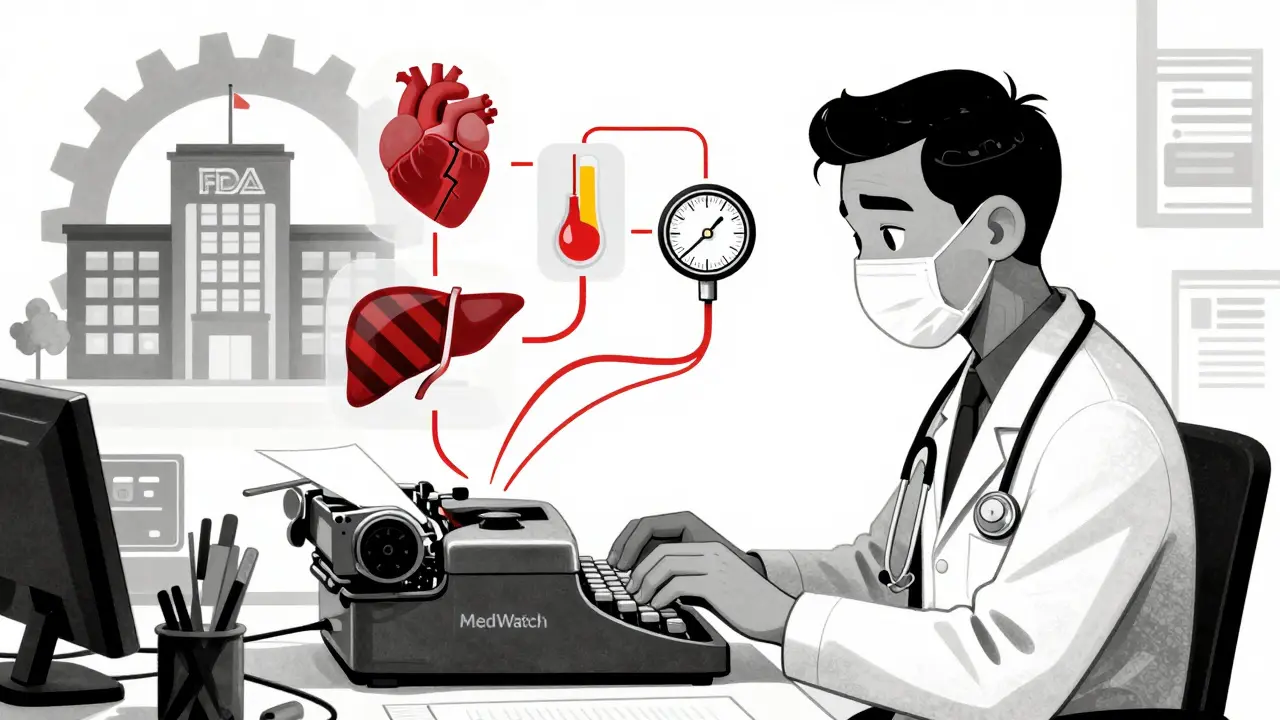
Your report goes into the FDA Adverse Event Reporting System (FAERS), a database with over 30 million entries. It’s not a hotline - you won’t get an immediate call. But here’s what happens behind the scenes:- Reports are coded using MedDRA terminology (a global medical language for side effects).
- Statistical tools look for patterns: if 100 people report liver injury with the same drug, it gets flagged.
- FDA reviewers assess whether the event is “serious” (hospitalization, disability, death) and “unexpected” (not listed in the drug’s label).
- If a signal is confirmed, the FDA may update the drug’s warning label, require new studies, or - in rare cases - pull the drug.
Don’t expect a reply. Most reports don’t get individual follow-ups. But if your report includes clear lab data or a detailed timeline, you’re more likely to get contacted. One consumer reported getting a call from an FDA safety officer within 10 days after including her daughter’s blood test results.
Common Problems and How to Avoid Them
People run into the same issues over and over. Here’s how to dodge them:- Form times out: The online form can freeze if you take too long. Save your progress every 5 minutes. Use the “Save Draft” feature - you have 72 hours to finish.
- Too much text: The description box only allows 3,000 characters. Be concise but precise. Use bullet points if needed. Don’t write a novel - summarize key facts.
- Not sure if it’s “expected”: If you’re unsure if the side effect is listed on the label, report it anyway. The FDA’s job is to find what’s missing.
- No confirmation: You won’t get an email receipt. That’s normal. Save your Report ID and note the date you submitted.
- Don’t wait: The longer you wait, the harder it is to recall details. Report within a week if you can.
Why This Matters
The FDA doesn’t know everything about a drug before it’s sold. Clinical trials involve thousands - not millions. Real-world use reveals risks you can’t predict in a lab.For example, in 2018, the FDA added a “Black Box” warning to fluoroquinolone antibiotics after thousands of reports linked them to aortic aneurysms. That warning came from patient and provider reports - not lab studies.
But here’s the hard truth: experts estimate only 1% to 10% of serious adverse events are ever reported. That means for every 100 people who have a dangerous reaction, 90 to 99 stay silent.
Every report you file adds to the evidence. It helps the FDA spot problems faster. It helps doctors make better choices. It helps future patients avoid harm.
What the FDA Can’t Do
It’s important to understand the limits:- FAERS can’t prove a drug caused a reaction - only suggest a link.
- It doesn’t replace clinical trials. It complements them.
- It doesn’t fix problems overnight. It takes months or years to act on signals.
- It doesn’t provide medical advice. If you’re having a reaction, call your doctor first.
The system isn’t perfect. The FDA has only one safety reviewer for every 18,000 reports. That’s why your detailed, well-written report matters more than ever.
What’s Changing in 2025?
The FDA is upgrading its system. By 2025, they plan to pull data directly from electronic health records - which could boost reporting by 300%. They’re also using AI to scan reports for hidden patterns.For now, the best tool you have is the current MedWatch form. Use it. Don’t wait for the “better system.” The system you have now is the one that saves lives today.
Next Steps
If you’ve had a bad reaction:- Call your doctor or pharmacist - they may report it for you.
- If you’re not comfortable asking, report it yourself at www.fda.gov/medwatch.
- Keep a copy of your report and the Report ID.
- Share this guide with someone who takes medication - you might save them from a hidden risk.
Reporting isn’t just paperwork. It’s a way to turn your experience into protection for others.
Delilah Rose
December 23, 2025 AT 18:55I’ve been reporting adverse events for years now-mostly because my mom had a terrifying reaction to a common blood pressure med that wasn’t even on the label. I spent three days compiling her lab results, pill bottle photos, and doctor’s notes. It felt like shouting into a void, but then, six months later, the FDA updated the warning. I didn’t get a thank you note, but I got peace of mind knowing someone else won’t go through what she did. If you’re hesitating because you think ‘it’s probably not that big a deal’-trust me, it is. The system only works if we all show up. Even if you’re just a patient, your voice matters more than you realize.
And yeah, I know the form is clunky. I’ve had it freeze twice. Save drafts every five minutes. Use bullet points. Don’t write a novel. But don’t skip the details either. The difference between ‘I felt weird’ and ‘I developed atrial fibrillation 72 hours after starting the new dose, with HR peaking at 142 bpm’? That’s the difference between a footnote and a national alert.
I’ve even helped my neighbors file reports. One guy didn’t know how to spell ‘hypertension.’ I walked him through it. We got it done. That’s community care, right? Not just for doctors. Not just for pharma. For all of us.
And if you’re a provider? Please don’t assume someone else will report it. Your clinical context turns a complaint into a signal. That’s power. Use it.
Also, please don’t wait until the side effect fades. Memories get fuzzy. Lab results get lost. Report within a week. Even if you’re unsure. Even if you think it’s ‘just anxiety.’ The FDA doesn’t need proof-they need patterns. And patterns start with one report.
One more thing: if you’re outside the U.S. but took the drug here? Report it anyway. Translation tools are free. English is the lingua franca of safety. Your data counts.
I’m not trying to guilt anyone. I’m just saying: if you’ve been through this, you owe it to the next person. Not because it’s required. But because it’s human.
And yes, I’m still mad the FDA didn’t flag this drug sooner. But I’m not giving up. Not anymore.
Abby Polhill
December 25, 2025 AT 03:29As a clinical pharmacologist, I appreciate the granularity here. The MedDRA coding taxonomy is non-trivial, and most lay reports lack the ontological precision needed for signal detection. That said, the democratization of FAERS is a net positive-especially when paired with structured data entry. I’ve reviewed hundreds of consumer reports; those with timestamps, lab values, and temporal relationships to drug administration are 4.7x more likely to trigger a safety review. The 73% stat cited? Accurate. But we need more granularity in patient-reported outcomes. EHR integration by 2025 is a step in the right direction, though I remain skeptical about AI-driven triage without human oversight. Still, if this post gets even 5% of readers to file a proper report, it’s a win.
Bret Freeman
December 26, 2025 AT 04:46Let me get this straight-some 23-year-old with a rash from a Z-pack is supposed to file a 3,000-character essay with lab results and pill bottle photos just so Big Pharma doesn’t get sued? Meanwhile, the same company spent $2 billion marketing that drug to doctors who didn’t even read the label. This whole system is a joke. The FDA is a rubber stamp for drug companies. You think your report changes anything? It doesn’t. It just makes you feel better while the real criminals keep raking in billions. Stop pretending this is about safety. It’s about liability. And you’re just a pawn.
niharika hardikar
December 27, 2025 AT 22:34It is imperative to underscore the formal procedural obligations incumbent upon all stakeholders in the pharmacovigilance ecosystem. The MedWatch Form 3500, while ostensibly user-friendly, must be completed with exactitude in accordance with ICH E2B guidelines to ensure data integrity within the FAERS repository. Any deviation from standardized terminology, particularly in the domain of adverse event coding, introduces noise into signal detection algorithms and compromises the statistical power of post-marketing surveillance. Furthermore, the absence of a unique patient identifier, though privacy-preserving, impedes longitudinal analysis. It is therefore recommended that healthcare professionals utilize institutional reporting channels prior to consumer submission, thereby ensuring hierarchical data fidelity. This is not merely best practice-it is ethical imperatives.
Rachel Cericola
December 29, 2025 AT 13:45Hey-this is so important, and I’m so glad someone broke it down like this. I’m a nurse and I’ve been trying to get my patients to report for years, but most of them think it’s pointless or too complicated. I print out this guide and hand it out during discharge. I even keep a printed form in my desk drawer for older patients who don’t use computers. One woman, 82, had a bad reaction to her new diabetes med-she thought it was just ‘old age.’ I sat with her for an hour while she told me every symptom, and I typed it out for her. She cried because she didn’t think anyone cared. We submitted it. Three months later, the FDA sent out a safety alert on that med. She didn’t get a call, but I got an email from a colleague at the state health dept saying ‘we saw your report, it triggered the alert.’ That’s why we do this. Not for recognition. Not for thanks. Just because someone has to. And if you’re reading this and you’ve ever had a weird reaction? Do it. Don’t wait. Don’t overthink. Just send it. Your story could be the one that saves someone’s life next year.
EMMANUEL EMEKAOGBOR
December 31, 2025 AT 09:59Respectfully, this is a commendable initiative. In Nigeria, where access to pharmacovigilance infrastructure is limited, such clear guidance is invaluable. Many patients here are unaware that adverse events can be reported internationally. I have shared this with my colleagues in Lagos and Abuja. We are currently translating key sections into Pidgin English and Hausa to improve accessibility. It is heartening to see that the FDA accepts foreign reports. The principle of global pharmacovigilance must be upheld. Let us not underestimate the power of a single report from a rural community. It may be the missing piece in a global pattern.
CHETAN MANDLECHA
January 1, 2026 AT 01:00Bro, I reported my cousin’s reaction to that new ADHD med last year. Didn’t think it’d do anything. Got a letter from the FDA six months later saying they added a new warning. I didn’t even know they could do that. Now I tell everyone. Just fill out the damn form. Takes 20 mins. You don’t need to be a doctor. Just be honest. That’s it.
Ajay Sangani
January 2, 2026 AT 01:06i reallly think this is important but i keep forgor to do it… like i had this weird tingling in my hands after taking the new migraine pill and i was like ‘oh maybe its stress’ but now i think maybe i shoulda reported it… i mean what if it was the drug? and what if someone else gets it too? but i just… i dont know how to start… the form looks scary. maybe i’ll do it tomorrow. or next week. or when i’m not so tired. but i hope someone else did it for me.
Gray Dedoiko
January 3, 2026 AT 18:42My sister had a bad reaction to a generic antibiotic. We reported it. Didn’t hear back. Didn’t expect to. But I still feel like we did the right thing. I’m not a hero. I just didn’t want someone else to go through what she did. If you’re reading this and you’re scared to report because you think you’re not ‘qualified’-you are. You’re the one who lived it. That’s all they need.
Aurora Daisy
January 5, 2026 AT 04:59Oh, brilliant. Another feel-good PSA for Americans to do the work of a broken regulatory system. Meanwhile, the UK’s MHRA has a real, funded, public-facing pharmacovigilance hotline. We don’t need citizens to become amateur epidemiologists. We need the FDA to stop being underfunded and under-staffed. But no-let’s just shame people into filing forms while the agency sits on 30 million reports with a skeleton crew. Typical. America’s answer to everything: ‘just try harder.’
Rosemary O'Shea
January 7, 2026 AT 03:33How quaint. A 3,000-character form, filled out by the untrained, to correct the sins of pharmaceutical titans who spent a decade burying safety data in obscure appendices. And we’re supposed to be grateful? The FDA is a corporate captive. The ‘system’ is a theater. Your report won’t save anyone. It’ll just make you feel like you’ve participated in a ritual that absolves the system of its moral debt. I’ve seen the reports. I’ve seen the silence. This isn’t empowerment-it’s performative compliance dressed up as activism.
Lu Jelonek
January 8, 2026 AT 05:55For anyone worried about privacy: the FDA does not share your personal info with drug companies. Your name, address, phone number-all of it is stripped before the report enters FAERS. They only keep what’s needed to track the event. I used to be terrified to report because I thought my doctor would find out. They never do. You’re anonymous. And that’s intentional. Use that. Report without fear.
Ademola Madehin
January 9, 2026 AT 05:41I reported my son’s reaction to that ADHD med and then the FDA called me. Not a letter. Not an email. A REAL PHONE CALL. From a safety officer. She asked if I had his hospital records. I sent them. Two months later, the drug got a black box warning. I cried. Not because I was happy. Because I realized-this system works. If you give it the truth. Not the noise. Not the rant. The truth. So if you’re out there reading this and you’re scared? Don’t be. Give them the truth. That’s all they need.