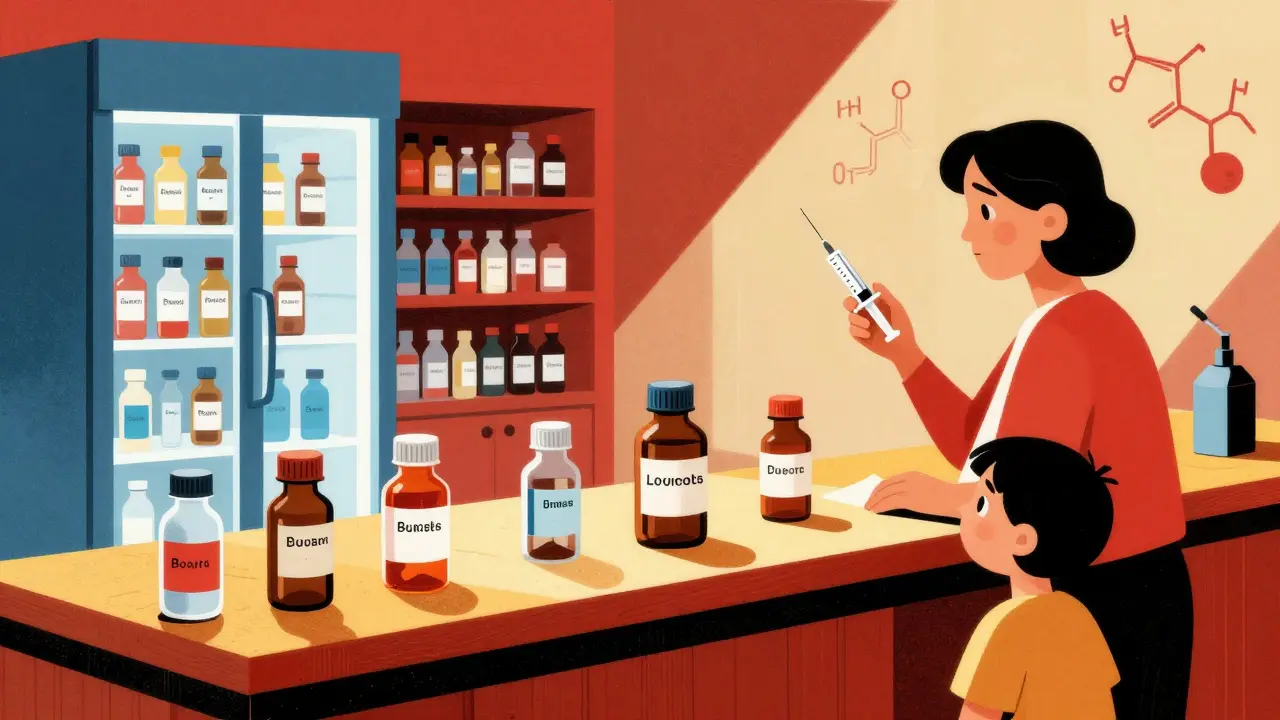
Storing liquid antibiotics the right way isn’t just a suggestion-it’s what keeps your child’s infection from coming back. If you’ve ever had to reconstitute a powdered antibiotic for a sick kid, you know how confusing the instructions can be. Some say refrigerate. Others say room temperature is fine. Some say throw it out after 7 days. Others say 14. What’s the truth? The answer isn’t one-size-fits-all. It depends on the drug, the formulation, and even how your home is set up.
Not All Liquid Antibiotics Need the Fridge
It’s a common myth that all liquid antibiotics must be kept cold. The truth? Refrigerating some can actually make them less effective. Walgreens pharmacists confirm that certain formulations break down faster when chilled. This isn’t a mistake-it’s science. Antibiotics like amoxicillin can be stored at room temperature (68-77°F) without losing potency, according to the Cleveland Clinic. But other antibiotics, like some penicillin-based suspensions, absolutely need refrigeration (36-46°F) to stay stable.
Why the difference? It comes down to the chemical structure. Some antibiotics are more sensitive to heat, others to cold. For example, the clavulanate part of amoxicillin-clavulanate (Augmentin) degrades faster than the amoxicillin part when left out too long. That’s why you can’t treat all liquid antibiotics the same way.
Check the Label-Every Single Time
The only reliable source for storage instructions is the label on the bottle. Your pharmacist printed those directions for a reason. They’re based on FDA-mandated stability testing. The FDA requires drugmakers to prove their products stay strong, pure, and safe under specific conditions before they can be sold. That means the instructions you get with your prescription are backed by real lab data-not guesswork.
If the label says “Refrigerate,” do it. If it says “Store at room temperature,” don’t put it in the fridge. If it says “Protect from light,” keep it in the original bottle and away from windows. Don’t rely on what you heard from a friend, a Facebook group, or even a previous prescription. Each antibiotic is different. Even two versions of amoxicillin from different manufacturers might have different storage rules.
How Long Do Reconstituted Suspensions Last?
Once you mix the powder with water, the clock starts ticking. The shelf life varies wildly:
- Amoxicillin (alone): Lasts up to 14 days at room temperature or in the fridge, according to the Cleveland Clinic.
- Amoxicillin-clavulanate (Augmentin): Should be used within 10 days if refrigerated. Some studies show it can last 5 days at room temperature, but don’t risk it-stick to 10.
- Cephalexin: Typically lasts 14 days when refrigerated. Room temperature storage isn’t recommended.
- Azithromycin: Once mixed, it’s stable for up to 10 days at room temperature. Refrigeration isn’t required.
Don’t assume longer is better. A 2013 study in JAPSONLINE found that amoxicillin kept submerged in water at room temperature stayed stable for 7 days-but that’s not the same as the suspension you get from the pharmacy. The formulation matters. The container matters. The humidity matters. When in doubt, throw it out.
Temperature Matters More Than You Think
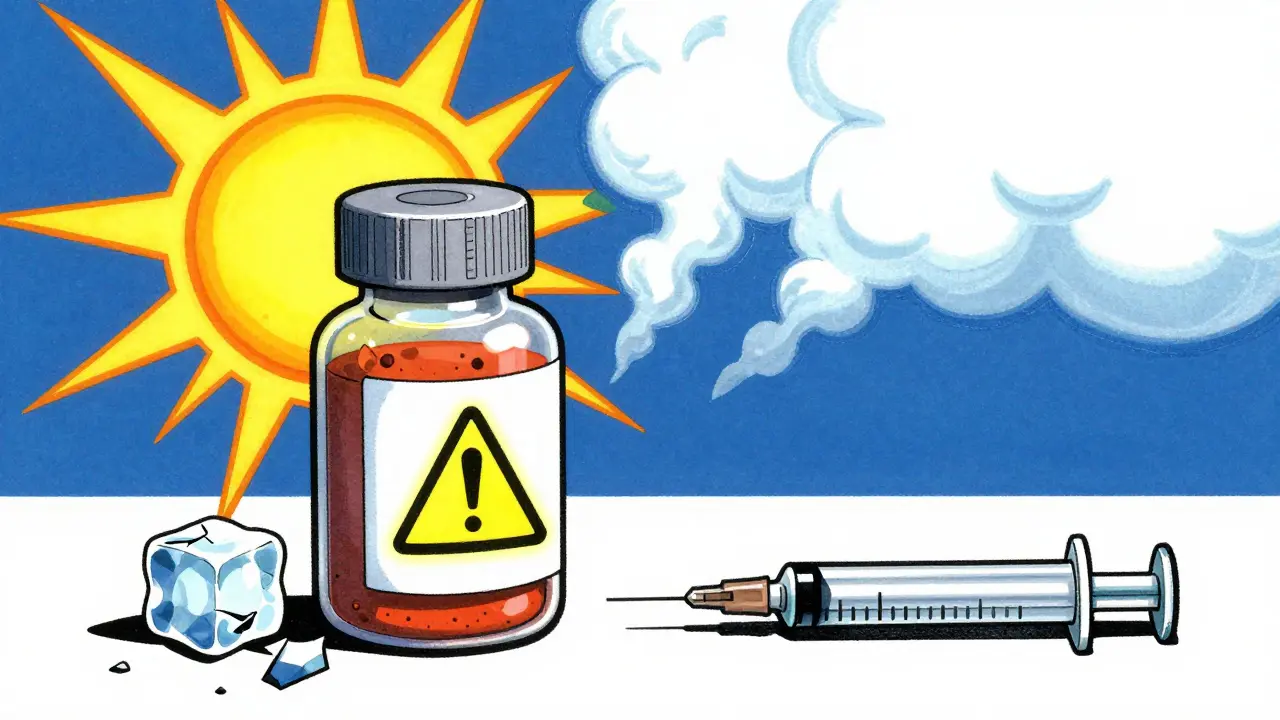
It’s not just about fridge vs. counter. Extreme heat, freezing, and sunlight can wreck your medication. The FDA warns that exposure to temperatures outside the recommended range can cause drugs to lose potency-even before the expiration date. That means:
- Don’t leave antibiotics in a hot car. Even a few hours in 90°F weather can degrade them.
- Don’t store them on a windowsill. Sunlight breaks down chemicals.
- Don’t freeze them. Freezing can destroy the structure of proteins and active ingredients in many antibiotics.
- Don’t keep them in the bathroom. Humidity from showers can ruin the suspension.
Baystate Health found that about 30% of households store medications improperly. Most of the time, it’s because people don’t know better. But the consequences are real: infections don’t clear up, bacteria survive, and resistance grows. That’s why proper storage isn’t just about saving money-it’s about stopping the spread of superbugs.
Traveling with Liquid Antibiotics?
If you’re flying, road-tripping, or staying overnight somewhere without a fridge, plan ahead. Use a small insulated cooler with a cold pack to keep refrigerated antibiotics between 36-46°F. Don’t use ice cubes-they can leak and damage the bottle. Instead, use gel packs designed for medicine. If you can’t keep it cold, check the label. Some antibiotics (like azithromycin) are stable at room temperature for days. That’s your best bet for travel.
Always carry the original bottle with the label attached. Airport security and hotel staff might ask what it is. Having the label shows it’s legitimate and gives you the storage info if needed.

How to Measure Doses Accurately
Getting the dose right matters just as much as storing it right. Household spoons? Don’t use them. They vary too much in size. A teaspoon from your kitchen might hold 4 mL, or it might hold 7 mL. That’s a huge difference when you’re giving a child a precise dose.
Use the syringe, dropper, or measuring spoon that came with the bottle. If you lost it, ask your pharmacy for a new one-most give them out for free. Mark the correct dose on the syringe with a permanent marker so you don’t have to guess. Shake the bottle well before each use. The medicine can settle to the bottom, and if you don’t mix it, you might give too little-or too much.
What to Do When It’s Gone Bad
When the expiration date hits-or when you’ve gone past the recommended days-don’t just toss it in the trash. Don’t flush it down the toilet. Both can pollute water systems.
Look for a drug take-back program. Many pharmacies, hospitals, and police stations have drop boxes for old or unused medications. If that’s not available, mix the liquid with something unappetizing-cat litter, coffee grounds, or dirt-pour it into a sealed plastic bag, and throw it in the trash. This keeps kids and pets from getting into it.
And never save leftover antibiotics for next time. Even if your child had strep throat last month, the bacteria this time might be different. Using old, possibly degraded antibiotics can make things worse.
Why This All Matters
More than 15% of pediatric antibiotic prescriptions are for liquid suspensions. That’s millions of doses every year. If even a small percentage are stored wrong, the public health impact adds up. Antibiotics that lose potency don’t just fail to cure-they teach bacteria how to fight back. That’s how we get drug-resistant infections like MRSA and resistant E. coli.
Proper storage isn’t about being perfect. It’s about being intentional. Read the label. Follow the instructions. When in doubt, call your pharmacist. They’re trained to know exactly how your child’s medicine should be kept. Don’t guess. Don’t assume. Don’t rely on memory.
Every dose you give should be strong enough to do its job. That starts with how you store it.
Alexandra Enns
January 24, 2026 AT 13:53Ugh I can't believe people still think refrigerating amoxicillin is universal. My pharmacist in Toronto told me last week that chilling it actually accelerates degradation in some formulations. The FDA doesn't even require all of them to be refrigerated. You're literally making your kid's infection worse by overcooling it. Stop listening to your mom's friend on Facebook.
Marie-Pier D.
January 26, 2026 AT 00:49Thank you so much for this!! 🙏 I just reconstituted Augmentin for my 3-year-old and was totally confused. I was about to stick it in the fridge because 'that's what you do with medicine.' Now I'm checking the label and it says room temp! You just saved me from messing up my baby's treatment. 💕
Sawyer Vitela
January 28, 2026 AT 00:06Amoxicillin lasts 14 days. Augmentin 10. Cephalexin 14 refrigerated. Azithromycin 10 room temp. Stop overcomplicating it.
Shanta Blank
January 29, 2026 AT 02:16Y'ALL. I once left my kid's azithromycin in a hot car for 3 hours. It looked like swamp water after. I thought I was saving money by not throwing it out. Turns out? The infection came back worse. And now I have a 5-year-old who's allergic to three antibiotics because we let bacteria evolve in our kitchen. Don't be me. 🙃
Tiffany Wagner
January 30, 2026 AT 03:58I always use the syringe that comes with it but I forget to shake it sometimes. I think I've been giving uneven doses. Should I mark the line on the syringe too? I don't want to mess this up.
Chloe Hadland
January 31, 2026 AT 07:23So many parents are scared to throw out meds because they cost so much. But honestly? A kid's health is worth more than $20. I used to save leftovers too. Now I just toss 'em. My kid's been sick less since I stopped playing antibiotic roulette.
Amelia Williams
February 2, 2026 AT 02:30Wait-so if I'm traveling and my kid needs refrigerated antibiotics, can I use a thermos with ice packs? Or does the bottle need to be in a cooler? Also, does the label say anything about humidity? I'm going to the beach next week and I'm terrified my meds will turn to mush.
lorraine england
February 3, 2026 AT 02:08Interesting. I've been storing all my kids' antibiotics in the fridge since 2018. My pharmacist never corrected me. But now I'm wondering-did I ruin half of their treatments? I feel like a bad mom. 😔
Kevin Waters
February 3, 2026 AT 05:49Good breakdown. I'm a nurse and I see parents mix up storage all the time. The key is: label first, then pharmacist. Never assume. And if you're unsure, call the pharmacy-they're happy to help. No judgment. Just facts.
Kat Peterson
February 4, 2026 AT 13:40OMG I just realized I stored my daughter’s Augmentin on the windowsill for 3 days because I thought ‘it’s medicine, it’s fine.’ Like I was storing basil. 😭 I’m so embarrassed. And now I’m Googling ‘antibiotic resistance symptoms’ at 2am. Thanks for the trauma, internet.
Izzy Hadala
February 5, 2026 AT 22:27Per FDA 21 CFR 211.137, pharmaceutical stability testing must be conducted under ICH Q1A(R2) guidelines. The storage parameters referenced in this post are consistent with the approved labeling for each respective drug product. Deviations may constitute a violation of 21 CFR 211.132. Consult the manufacturer’s package insert for definitive parameters.
Elizabeth Cannon
February 7, 2026 AT 12:50why do ppl think the fridge is magic? i had to call my pharmacy twice because my cousin said to freeze it. no. just no. and the syringe thing? yes. i lost mine and the pharmacist gave me a new one for free. they’re nice like that. also shake it like you’re making a cocktail 🍸
Sushrita Chakraborty
February 7, 2026 AT 18:30This is an exceptionally well-researched and clinically accurate guide. In India, where antibiotic misuse is rampant due to over-the-counter availability, such clear, evidence-based information is desperately needed. I have shared this with my community health group. Proper storage is not merely a pharmacological detail-it is a public health imperative. Thank you for the clarity, precision, and responsibility demonstrated here.