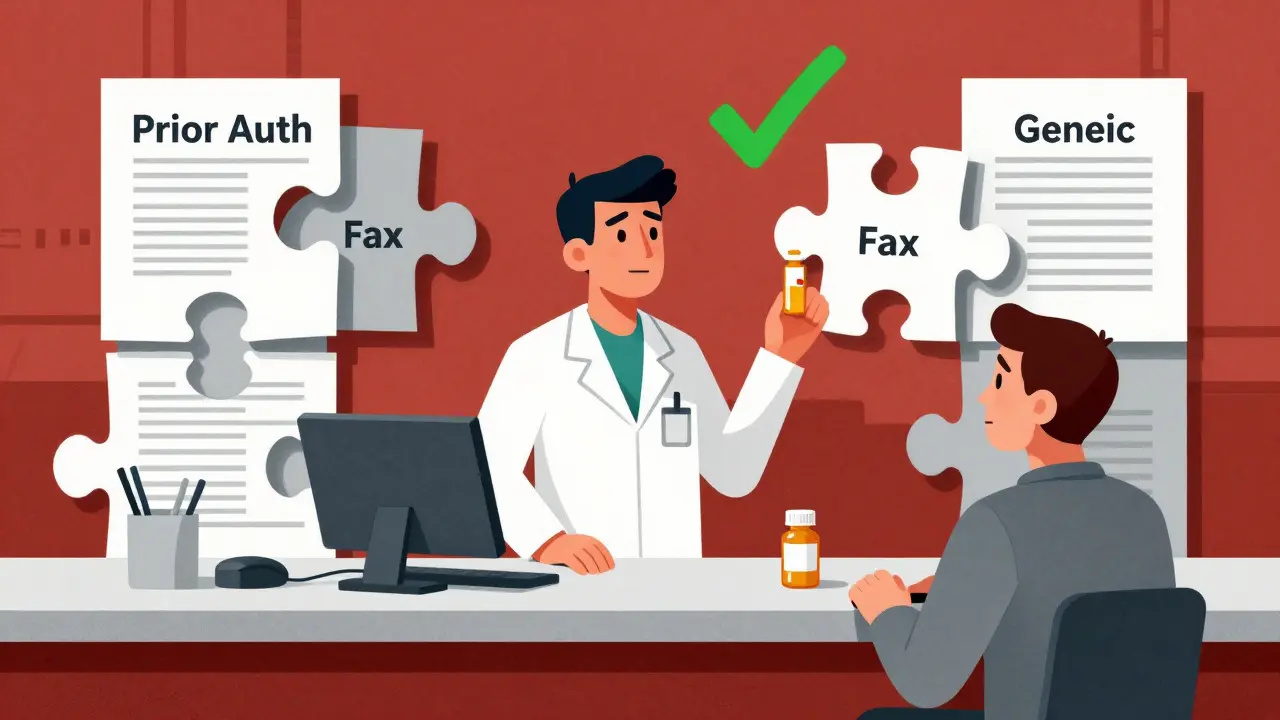
When a patient walks into the pharmacy with a prescription for a brand-name drug, but a perfectly good generic version exists, something unexpected often happens: the pharmacist can't just fill it. Instead, they're stuck in a back-and-forth with the insurance company, trying to get approval for something that should be simple. This is prior authorization for generic alternatives - a bureaucratic hurdle that's become routine in U.S. pharmacy practice, even though it's not always medically necessary.
Here's the reality: insurance companies require providers to prove that cheaper, FDA-approved generic drugs didn't work before they'll cover the more expensive brand-name version. It sounds logical - save money, use generics first. But in practice, it often delays care, frustrates patients, and burns out pharmacy staff. In 2023, pharmacists and prescribers spent an average of 43 prior authorization requests per week, and nearly 7 out of 10 of those were for generic alternatives. That's not just paperwork - it's hours of work each day that could be spent counseling patients or managing medications safely.
How Prior Authorization for Generics Actually Works
The process isn't complicated to describe, but it's messy in execution. It follows seven steps, and every one of them can go wrong.
- A prescriber writes a prescription for a brand-name drug, but the pharmacy's system flags it because a generic exists and the insurer requires prior authorization.
- The pharmacist gathers clinical notes: patient history, previous attempts with generics, lab results, symptoms, and dosage records. This isn't just a form - it's evidence.
- The request gets submitted electronically, by fax, or sometimes even by phone. Electronic submission cuts approval time in half, but many smaller clinics still fax.
- A clinical pharmacist or medical director at the insurance company reviews the case against their internal guidelines.
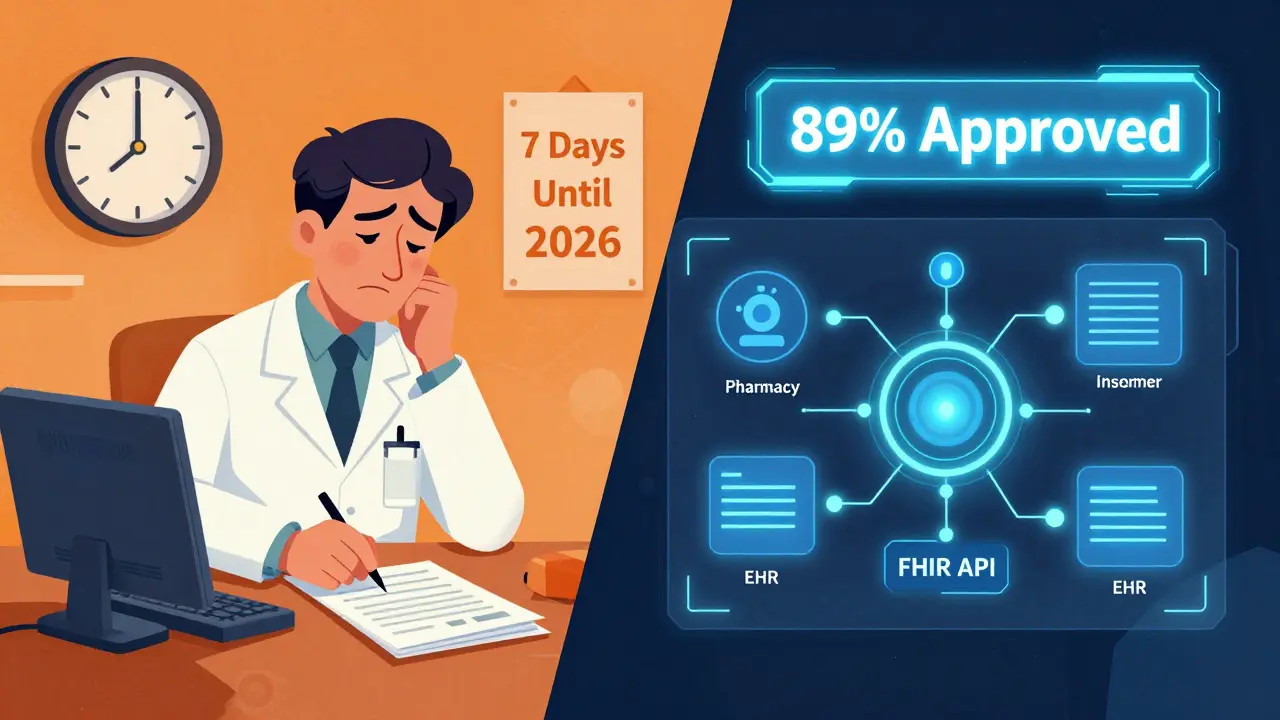
- They make a decision: approve, deny, or ask for more info. Timelines vary. Cigna says 5-10 business days. UnitedHealthcare says 7-14 calendar days. But starting January 1, 2026, Medicaid plans must decide within 7 days for standard requests - a big shift.
- The pharmacy gets notified. If denied, they must decide whether to appeal or switch the patient.
- If denied, the provider can appeal. But appeals take extra time, and patients often stop treatment before it's resolved.
Here's the kicker: 41% of these requests get denied the first time. Why? Inadequate documentation. Too many providers write vague notes like "patient didn't respond to generic." That's not enough. Insurers need specifics: "Patient took 10 mg of lisinopril daily for 6 weeks; blood pressure remained at 158/94; no side effects reported." That kind of detail increases approval rates by over 40%.
Why Some Insurers Are More Restrictive Than Others
Not all insurance plans are created equal. Some are stricter, some are more flexible, and it's not always based on medical logic.
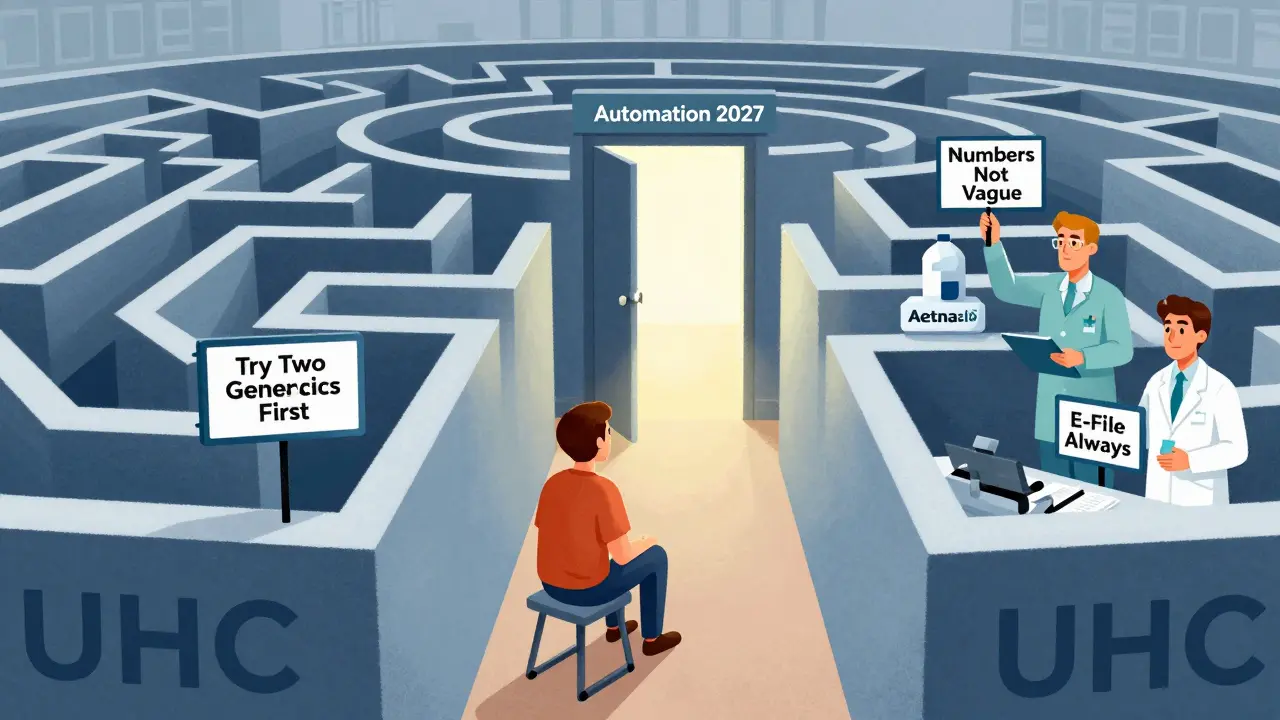
UnitedHealthcare, for example, requires patients to try two different generic alternatives for diabetes medications - and stay on each for a full 30 days - before approving a brand-name drug. Aetna? Only 14 days, and they require documented HbA1c levels. That's a huge difference in real-world practice. One patient might be stuck waiting a month. Another gets approved in two weeks.
Medicare Part D plans require prior authorization for about 19% of brand-name prescriptions when generics are available. Commercial plans? Over 32%. That’s almost double. Why? Commercial insurers are more aggressive about cost control. Medicare, while still using prior authorization, has more standardized rules and fewer profit-driven incentives.
Specialty drugs are the worst. In oncology, 94% of brand-name treatments require prior authorization when biosimilars (generic-like biologics) exist. That means a cancer patient might wait weeks just to get the drug their doctor prescribed - even if the generic version isn't appropriate for their case.
The Hidden Cost: Time, Stress, and Abandoned Treatments
Behind every denied prior authorization is a patient who might not get their medicine. A 2024 study from Patients Rising found that 67% of people stopped taking their medication because of delays in prior authorization - especially for mental health, diabetes, and migraine drugs. One Reddit thread from July 2024 had over 1,200 comments from people trying to get approval for Wegovy after metformin failed. Many reported going through 3-5 rounds of paperwork.
For pharmacists, it’s exhausting. A physician on Sermo reported spending 14.6 hours a week just on prior authorizations - and 62% of that time was spent on generic alternatives. That’s over two full workdays a month spent on paperwork instead of patient care.
The financial cost is staggering. A 2024 JAMA Internal Medicine study estimated that $13.4 billion a year is wasted on provider time processing prior authorizations. Of that, 63% comes from requests for generic alternatives. That’s not just lost time - it’s lost revenue, lost productivity, and lost trust in the healthcare system.
What Works: Real Strategies That Cut Through the Noise
Some pharmacies and clinics have figured out how to navigate this mess. Here’s what actually helps:
- Submit 14 days before the prescription is due. Waiting until the last minute guarantees delays. Start early.
- Use payer-specific templates. Every insurer has its own form. Using their exact template reduces denials by 37%.
- Document failure with numbers. Don’t say "didn’t work." Say: "HbA1c dropped from 9.2 to 8.1 after 8 weeks on metformin - still above target of 7.0." Specifics win.
- Use electronic submission. E-filing gets 78% of requests approved within the same week. Fax? Only 34%.
- Designate a prior auth specialist. Clinics with one person focused on this process cut processing time by over half.
- Check for "gold carding." If your practice has a 95%+ approval rate for certain drugs, some insurers automatically approve future requests. Only 29% of eligible providers even know they qualify.
One success story comes from the University of Pittsburgh Medical Center. They automated their workflow with a dedicated platform. Result? Approval time dropped from 9.2 days to 2.1 days. First-time approval rates jumped from 58% to 89%. That’s not magic - it’s systems.
The Future: Automation, AI, and Regulation
Change is coming - fast. Starting in 2026, all Medicaid plans must approve or deny requests within 7 days. Expedited cases? 72 hours. That’s a game-changer. And the CMS Interoperability Rule, set to roll out in 2026, will require insurers to show prior authorization requirements right at the point of prescribing - meaning doctors will know upfront if a drug needs approval.
AI tools are already helping. Some health systems are using natural language processing to auto-fill prior auth forms from clinical notes. Early results show a 44% reduction in submission time. Blockchain pilots are testing secure, tamper-proof prior auth logs - Mayo Clinic’s version has a 92% approval rate for exceptions.
By 2027, all major payers must adopt FHIR-based APIs - a standardized digital language that lets systems talk to each other. If it works, routine generic alternative requests could be approved in under 24 hours. No calls. No faxes. No waiting.
But the biggest threat isn’t bureaucracy - it’s burnout. A 2024 Medscape survey found 43% of physicians would reduce their patient load if prior authorization got worse. And 68% said generic alternatives were the most frustrating part of the process. If pharmacists and doctors keep leaving the field, who’s left to fill prescriptions?
What You Can Do Right Now
If you're a pharmacist, prescriber, or patient:
- Always ask: "Does this drug need prior authorization?" before the prescription is even written.
- Keep a running log of which insurers are slow or easy to work with.
- Push for electronic submission - no exceptions.
- Document everything with measurable outcomes: numbers, dates, lab values.
- If denied, appeal. Many denials are overturned on review.
- Advocate for your clinic to adopt a dedicated prior auth workflow. Even one person can make a difference.
Generic drugs save billions. They’re safe. They’re effective. But the system treating them like they’re risky is broken. It’s not about saving money anymore - it’s about saving time, trust, and care.
Why do insurers require prior authorization for generic alternatives if they're cheaper?
Insurers don't require prior authorization because generics are cheaper - they require it because they want to ensure brand-name drugs are only used when truly necessary. The goal is step therapy: try the cheapest effective option first. But in practice, many insurers apply this rule too broadly, even when the generic isn't appropriate for the patient's condition. Some use it as a cost-control tool rather than a clinical one.
Can a pharmacist override a prior authorization denial?
No, pharmacists cannot override a denial. Only the prescriber can appeal or submit a new request with additional documentation. The pharmacist's role is to flag the issue, communicate the denial to the provider, and help gather the necessary clinical information. In rare cases, if a patient is at immediate risk, the pharmacist may contact the prescriber to discuss an emergency override, but that’s not guaranteed.
How long should I wait before following up on a prior authorization request?
Wait at least 72 hours after submission before following up. Most insurers have processing windows of 5-14 days. If you submitted electronically and it's been more than 5 business days without a response, call the payer’s provider services line. Keep a record of the date, time, and person you spoke with. Delays beyond 10 days are common - and often require escalation.
What if a patient can't afford the brand-name drug even after approval?
Even after approval, cost can still be a barrier. Many patients still can’t afford copays for brand-name drugs. In these cases, pharmacists should check for manufacturer coupons, patient assistance programs, or nonprofit aid. Some insurers also offer tiered copay structures - switching to a lower-tier brand may reduce out-of-pocket costs. Always ask the patient about affordability before finalizing the prescription.
Are there states that have banned prior authorization for generics?
No state has banned it entirely, but 27 states have passed laws limiting how it's applied to generic alternatives. For example, Texas (HB 1415) requires decisions within 72 hours for urgent cases. California mandates automatic approval if the generic has an FDA AB rating. New York requires insurers to use the same criteria for both brand and generic drugs. These laws don’t eliminate prior auth, but they make it faster and fairer.
Justin Rodriguez
March 4, 2026 AT 11:02I've seen this firsthand in my clinic. We used to spend 12+ hours a week just chasing prior auths for generics. Then we assigned one pharmacist to own the process. Now it's under 3 hours. The key? Templates. Every payer has their own form. Stop guessing. Use their damn template. It cuts denials by a third. Also, submit 14 days out. Always. Last-minute? You're setting yourself up to fail.
And document like your license depends on it. Not "didn't work." Say: "HbA1c 8.9 on metformin 1000mg BID for 10 weeks. No side effects. Patient adherent." That’s what they want. Numbers. Dates. Evidence. Not opinions.
Also - gold carding. If your approval rate is above 95% on a drug? Some insurers auto-approve future requests. 71% of providers don't even know this exists. Ask your rep. It's free efficiency.
Gretchen Rivas
March 4, 2026 AT 20:44One sentence: Stop faxing. Ever.
Levi Viloria
March 5, 2026 AT 10:06Man, I’ve had patients cry in my aisle because they couldn’t get their migraine med. They’d been waiting 11 days. The generic was fine - they’d taken it before. But the insurer needed a 30-day trial period they didn’t need.
It’s not about cost anymore. It’s about control. And it’s broken. I don’t blame pharmacists. I blame the system. We’re all just trying to keep people alive, and we’re stuck in a maze made of PDFs and hold music.
Jeff Card
March 7, 2026 AT 08:03My wife’s a pharmacist. She told me about a patient who missed a chemo dose because the biosimilar auth got denied. The doctor had to redo everything. Took 12 days. Patient got sicker. That’s not healthcare. That’s paperwork roulette.
I used to think generics were just cheaper. Now I see they’re treated like second-class meds. Even when they’re identical. It’s insulting. And it kills trust.
Matt Alexander
March 7, 2026 AT 23:17Simple truth: if you don’t write it down, it didn’t happen. Insurers don’t care about your feelings. They care about numbers. So give them numbers. HbA1c. BP. Labs. Dates. If you say "didn’t work," they say "deny." If you say "BP 160/95 after 8 weeks on 20mg lisinopril," they say "approve." It’s that easy. Stop being vague. Start being specific.
Renee Jackson
March 8, 2026 AT 08:30As a healthcare administrator, I want to emphasize that while prior authorization is burdensome, its intent is clinical stewardship - not bureaucracy for bureaucracy’s sake. The challenge lies in misapplication. We must advocate for precision, not elimination.
Implementing payer-specific templates, electronic submission, and designated staff reduces error rates by over 40%. These are not luxuries - they are professional imperatives. Our patients deserve systems that work, not systems that punish diligence.
Let us not confuse compassion with chaos. Structure enables care. Let us build it wisely.
RacRac Rachel
March 8, 2026 AT 17:49OMG I can’t even 😭 I just had a patient cry because she had to wait 2 weeks for her antidepressant because the insurer made her try 3 generics (that she’d already tried in 2022) 😤
Why is this still a thing??? We’re literally saving lives here 🤦♀️
Also - I just found out my clinic is GOLD CARDED for 7 drugs and NO ONE TOLD ME??? 😱 I’m crying happy tears now. You guys are my heroes. 🙌❤️
Jane Ryan Ryder
March 9, 2026 AT 04:50So let me get this straight - we’re forcing doctors to do paperwork so insurance companies can pretend they’re saving money while charging $800 for a pill that costs $2 to make?
Yeah. That’s capitalism. And it’s a joke.
Next they’ll make you sign a waiver before you breathe.
Also - why do we still fax? In 2025? Are we in a 1998 sitcom?
Fix this. Or burn it all down.
Stephen Vassilev
March 10, 2026 AT 02:07Have you considered that prior authorization is not the problem - it’s the symptom? The real issue is the consolidation of insurance monopolies, the revolving door between CMS and pharmaceutical executives, and the fact that 87% of prior auth denials are overturned on appeal - meaning the system is designed to reject first, then profit from your desperation?
Blockchain? AI? FHIR? These are distractions. The truth: insurers are legally allowed to delay care as a cost-control tactic. This isn’t broken - it’s working exactly as intended. The FDA doesn’t regulate profit. And until Congress passes a law that makes denying a generic drug a felony, nothing changes. This isn’t healthcare. It’s a financial instrument disguised as medicine.