Statin Monitoring Checker
Statin Monitoring Assessment
This tool helps determine which lab tests you actually need based on current medical guidelines. The latest research shows most patients don't need routine liver tests every 3 months.
When you start taking a statin, your doctor likely orders a bunch of blood tests. But how many of them are actually necessary? For years, patients were told to get their liver enzymes checked every few months - even if they felt fine. Today, that’s changing. The science has caught up, and the old routine is outdated. You don’t need monthly blood work just because you’re on a statin. What you do need is a smarter, simpler plan focused on what actually matters: your heart and your safety.
Why Statin Monitoring Changed
Statin therapy isn’t new. The first one, compactin, was discovered in 1973. But how we monitor patients has evolved dramatically. In 2012, the FDA made a major shift. They removed the requirement for routine liver function tests (LFTs) in people taking statins who don’t have symptoms. Why? Because the data showed it wasn’t helping. A massive review of 83,000 patients across 33 studies found no difference in serious liver problems between those on statins and those on placebos. Liver damage from statins is incredibly rare - less than one case per million patient-years. And when liver enzymes rise slightly, it’s usually harmless and goes away on its own.Doctors used to panic over a mildly elevated ALT or AST. Now, we know: a number above the normal range doesn’t mean danger. It just means the lab result is outside a statistical average. Most patients with these minor bumps stay perfectly healthy. The real risk? Stopping your statin because of a false alarm. Research in JAMA Internal Medicine found that people who stopped statins over minor liver test changes had a 10-20% higher chance of having a heart attack or stroke. That’s the real danger.
What Tests You Actually Need
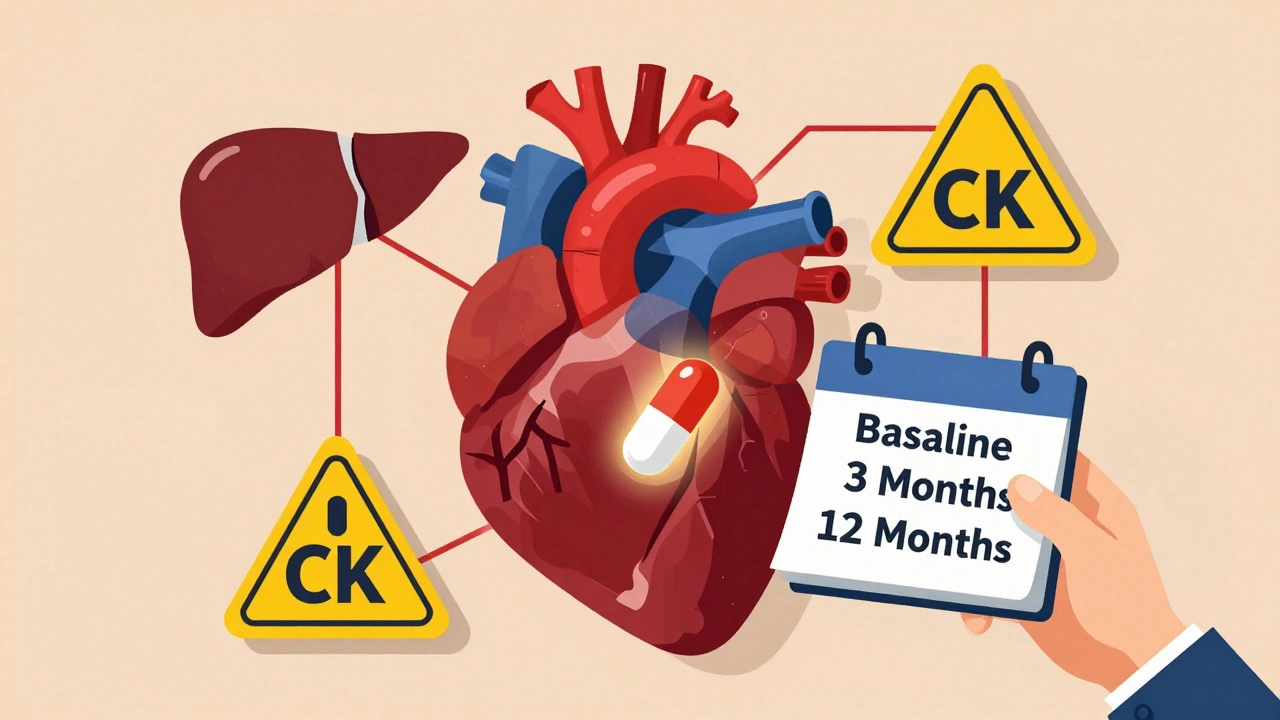
You don’t need a long list of tests every few months. Here’s what you really need - backed by the American College of Cardiology, the American Heart Association, and the National Institute for Health and Care Excellence (NICE):- Baseline test - Before you start your statin, get a lipid panel (total cholesterol, LDL, HDL, triglycerides), ALT/AST (liver enzymes), creatinine (kidney function), and HbA1c (blood sugar). This gives you a starting point.
- 4 to 12 weeks after starting - Repeat the lipid panel. This tells you if the statin is working. Your goal? A 30-50% drop in LDL cholesterol, depending on your risk level. If your LDL didn’t move, your doctor might adjust the dose or switch meds.
- At 12 months - Do the lipid panel again. If everything’s stable, you’re likely good to go.
- Then, once a year - For most people, that’s it. No more routine liver tests. No more monthly blood draws.
What about creatine kinase (CK)? Only test this if you have persistent muscle pain, weakness, or cramps - and only if it’s not from exercise. A single workout can spike CK levels. Testing after the gym is meaningless. If your CK is more than 10 times the upper limit and you have symptoms, stop the statin and call your doctor. Otherwise, ignore it.
What You Don’t Need (And Why)
Many patients still get unnecessary tests because old habits die hard. Here’s what you can safely skip:- Quarterly liver tests - No evidence they prevent harm. The NHS, NICE, and ACC/AHA all say skip them unless you’re symptomatic.
- Monthly cholesterol checks - Lipid levels don’t change that fast. Testing every month gives you noise, not insight.
- Routine HbA1c every 3 months - The American Diabetes Association says monitor this only if you’re already prediabetic (fasting glucose 5.6-6.9 mmol/L, BMI over 30, high triglycerides). For others, statins don’t require regular glucose checks.
- Lipoprotein(a) testing - This is useful for some high-risk patients, but not everyone. It’s not part of standard monitoring unless your doctor suspects inherited high cholesterol.
Why do these tests still happen? Electronic health records often default to quarterly LFTs. Many doctors order them out of habit, not science. Patients are told, “We’re just checking,” but no one explains why. That’s where confusion and anxiety come in.
What to Do If Your Lab Results Look Weird
Don’t panic. Here’s how to respond to common results:- ALT or AST 1-3 times above normal - Don’t stop your statin. Repeat the test in 4-6 weeks. These often return to normal on their own. Only consider stopping if levels stay high and you have symptoms like jaundice, dark urine, or severe fatigue.
- ALT or AST >3 times above normal - Hold the statin and retest in a month. If it’s still high, your doctor might switch you to a different statin or investigate other causes like fatty liver or alcohol use.
- LDL didn’t drop - Talk about adherence. Did you take the pill every day? Was it taken with food (some statins need it)? Could you need a higher dose or a different type? Maybe add ezetimibe or a PCSK9 inhibitor if you’re high risk.
- CK elevated but no symptoms - Ignore it. Don’t stop the statin. Exercise, supplements, or even a long walk can raise CK. Only act if you feel weak or sore for days.

Who Needs More Monitoring?
Not everyone follows the same rules. Some people need closer attention:- People with existing liver disease - Cirrhosis, hepatitis, or fatty liver? Your doctor may monitor LFTs more often.
- Those with kidney problems - Especially if you’re on dialysis or have an eGFR below 30.
- Patients taking other drugs - Fibrates, cyclosporine, certain antibiotics, or grapefruit juice in large amounts can increase statin side effects. More caution needed.
- Older adults over 75 - Higher risk of muscle issues. Watch for weakness, but don’t assume every ache is statin-related.
- People with SLCO1B1 gene variants - A genetic test can now identify those at higher risk for simvastatin muscle damage. If you’ve had unexplained muscle pain on statins before, ask about this test.
Real Stories, Real Confusion
One patient, “HeartWarrior42,” posted on the American Heart Association forum: “My doctor made me test liver enzymes every month for five years. I showed him the FDA guidelines. He said, ‘I still do it my way.’”On Reddit, a cardiologist admitted: “I follow NICE guidelines - baseline, 3 months, 12 months. But 60% of my primary care colleagues still order quarterly LFTs.”
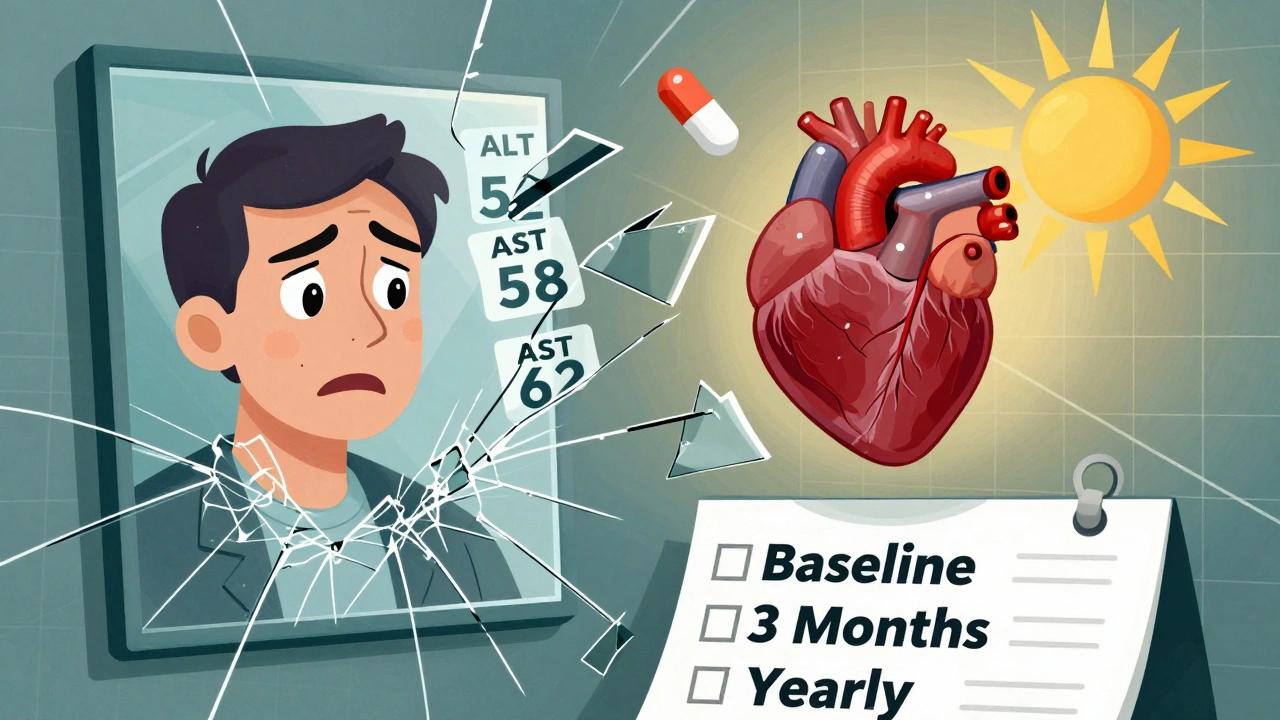
On Healthgrades, 32% of statin users said they were anxious about their labs. One wrote: “My PCP stopped my statin because my ALT was 58. Normal is up to 55. I was furious.”
Meanwhile, others say: “My lipid specialist explained exactly what to test - baseline, 8 weeks, then yearly. No stress. No extra blood draws.”
Why This Matters Beyond the Lab
Every unnecessary blood test costs money - about $1.2 billion a year in the U.S. alone. But the bigger cost is in health outcomes. People who stop statins because of false alarms face higher heart attack risk. Statins prevent more heart events than almost any other drug. If you stop taking them over a harmless lab result, you’re trading safety for a number.Also, too many tests create anxiety. Patients start checking their labs obsessively. They Google every number. They assume the worst. That stress alone can hurt your heart more than a slightly elevated ALT.
What to Ask Your Doctor
If you’re on a statin, ask these questions:- “Do I really need another liver test today?”
- “What’s my target LDL, and how do we know if the statin is working?”
- “When should I come back for a lipid panel?”
- “If my ALT is a little high, should I stop the statin?”
- “Do I need genetic testing for muscle risk?”
Bring up the ACC/AHA 2018 guidelines or NICE CG181. Most doctors will appreciate you being informed. If they insist on monthly tests, ask them to show you the evidence.
The Bottom Line
You’re not being monitored because you’re sick. You’re being monitored because you’re trying to stay healthy. That means smart, not frequent. Three blood tests in the first year - baseline, 4-12 weeks, and 12 months - are enough for most people. After that, yearly lipids are all you need. Skip the routine liver checks unless you have symptoms. Don’t let a lab result scare you off a drug that saves lives. Your heart doesn’t care about your ALT number. It cares that you’re still taking your statin.Do I need to get liver tests every 3 months on statins?
No. Routine liver function tests every 3 months are no longer recommended. The FDA, ACC/AHA, and NICE agree that testing is only needed before starting statins, again after 3 months, and once at 12 months - unless you develop symptoms like yellowing skin, dark urine, or persistent fatigue. Minor, isolated elevations in liver enzymes are common and usually harmless.
Can statins damage my liver?
Severe liver damage from statins is extremely rare - less than one case per million patient-years. Most statin-related liver enzyme changes are mild, temporary, and don’t lead to injury. There’s no evidence that regular monitoring prevents liver damage. The risk of stopping a statin due to a false alarm is far greater than the risk of liver harm from the drug itself.
What if my cholesterol doesn’t drop after 8 weeks?
It doesn’t mean the statin isn’t working. First, check if you’ve been taking it correctly - daily, at the same time, with or without food (depending on the type). If adherence is good and LDL hasn’t dropped by at least 30%, your doctor may increase the dose, switch to a more potent statin, or add ezetimibe. Some people just respond less to statins, and that’s okay - there are other options.
Should I get my creatine kinase (CK) tested regularly?
Only if you have persistent muscle pain, weakness, or cramps that aren’t from exercise or injury. CK levels rise naturally after physical activity, so testing after a workout gives false results. A CK level over 10 times the upper limit with symptoms means stop the statin and call your doctor. Otherwise, ignore it.
Can statins cause diabetes?
Statins can slightly raise blood sugar in some people, especially those already at risk (overweight, prediabetic, high triglycerides). But the benefit of preventing heart attacks and strokes far outweighs this small risk. If you’re at risk for diabetes, your doctor may check HbA1c every 6 months - but not routinely for everyone. Don’t stop your statin over this concern; talk to your doctor about managing both.
Carolyn Ford
December 3, 2025 AT 15:27I’ve been on statins for 8 years, and my PCP still makes me get liver tests every 3 months-like clockwork. I showed him the FDA guidelines. He said, ‘I learned it this way, and I’m not changing.’ So now I just lie and say I ‘forgot’ to schedule it. At this point, I’m more scared of my doctor’s habits than the statin itself.
Heidi Thomas
December 5, 2025 AT 11:35Alex Piddington
December 5, 2025 AT 13:07Thank you for this clear, evidence-based summary. As a healthcare professional, I appreciate when patients come in armed with knowledge from reputable sources like ACC/AHA and NICE. It allows for more meaningful conversations and reduces unnecessary anxiety. I encourage everyone to print this out and bring it to their next appointment.
Karl Barrett
December 6, 2025 AT 01:17What’s fascinating here is the epistemological dissonance between clinical guidelines and clinical practice. The evidence is overwhelmingly robust-statin-induced hepatotoxicity is statistically negligible, yet the reflexive ordering of LFTs persists as a ritualistic safeguard against perceived liability. This isn’t about medicine anymore; it’s about institutional inertia and the psychology of risk aversion. The real cost isn’t monetary-it’s the erosion of patient autonomy through overmedicalization. We’ve turned prevention into surveillance, and in doing so, we’ve weaponized uncertainty. The statin isn’t the threat. The fear of the unknown is.
Jake Deeds
December 7, 2025 AT 22:27Look, I get it. People want to feel like they’re being ‘taken care of.’ But getting blood drawn every 3 months for no reason? That’s not care. That’s performance art. My sister had her statin pulled because her ALT was 58. Normal is 55. FIVE POINTS. She’s now on a 500mg aspirin regimen and her LDL is through the roof. Meanwhile, her doctor’s still billing for those ‘routine labs.’ Someone needs to sue these people. Not for malpractice-for emotional fraud.
George Graham
December 8, 2025 AT 12:33I really appreciate this post. I’m 78 and on simvastatin. My cardiologist only checks my lipids once a year and asked if I’ve had any muscle pain. That’s it. I used to stress over every number, but now I just take my pill, walk every day, and trust the science. It’s such a relief to know I’m not being overtested. I even told my neighbor who’s paranoid about her liver enzymes-she’s now asking her doc for the NICE guidelines. Small wins, right?
John Filby
December 10, 2025 AT 07:29Biggest thing I learned? CK doesn’t mean squat unless you’re hobbling. I did a 10K last weekend and my CK was through the roof. My PCP wanted to stop my statin. I showed him the article and he just said ‘ohhhhh.’ 😅 I’m not mad, just… tired of being treated like a lab rat. Also, yes-grapefruit juice is still evil. Don’t test me.
Elizabeth Crutchfield
December 11, 2025 AT 02:55Ben Choy
December 11, 2025 AT 22:08Love this. I’m in the UK and our NHS follows this exactly. No more quarterly LFTs. My GP even printed me a one-pager to take to my mum’s doctor in the States. She was shocked. I told her, ‘You wouldn’t check your car’s oil every week if it’s running fine.’ She laughed. Then she Googled it and changed her practice. Small ripples, big waves 💪
Emmanuel Peter
December 13, 2025 AT 04:10Let’s be real-this whole post is just a placebo for people who don’t want to face their own bad habits. You think skipping liver tests makes you ‘empowered’? Or are you just avoiding accountability? What if you have undiagnosed NAFLD? What if you’re drinking? What if you’re on 5 other meds? You don’t get to pick and choose which guidelines apply to you. The system’s flawed, sure-but your ignorance is more dangerous than your doctor’s checklist.