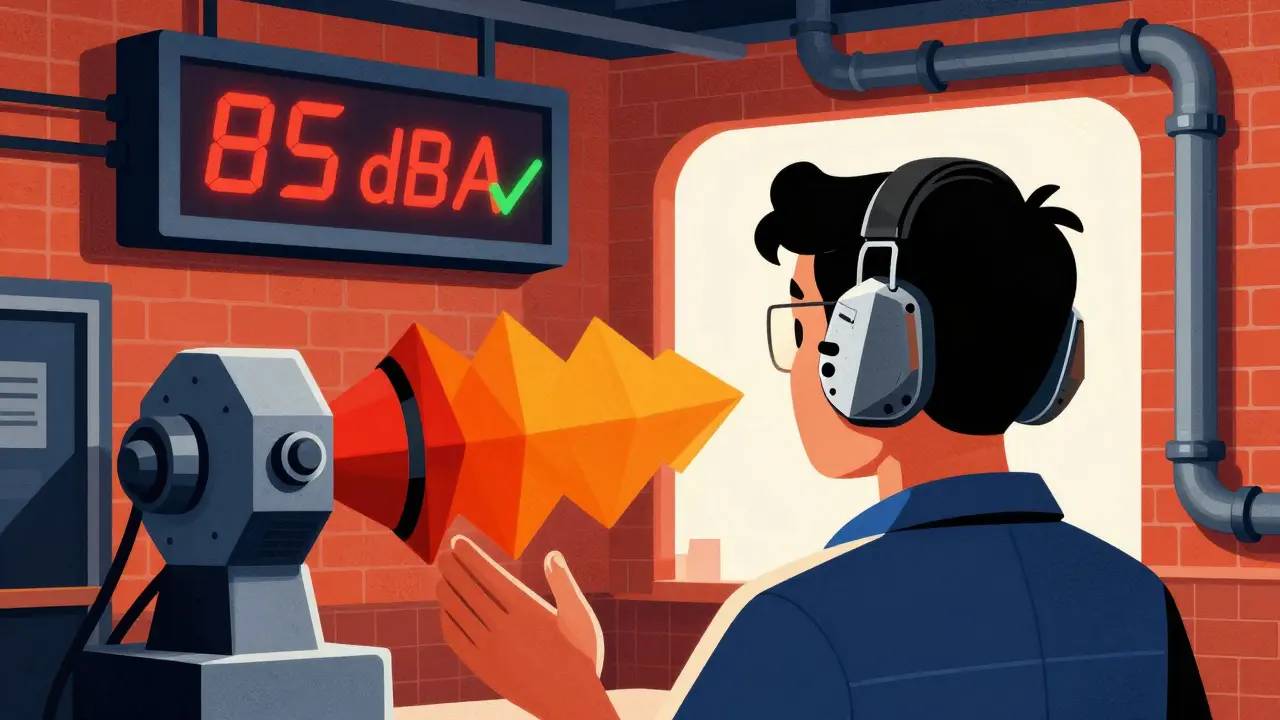
Every day, millions of people are exposed to sounds that can quietly damage their hearing-without them even noticing. At work, the hum of machinery, the clang of metal, or the roar of a jackhammer might seem normal. At concerts, the bass thumps so hard you feel it in your chest. But these sounds aren’t just loud-they’re dangerous. And if you’re not aware of the limits, you could be losing your hearing without ever realizing it until it’s too late.
What Counts as Dangerous Noise?
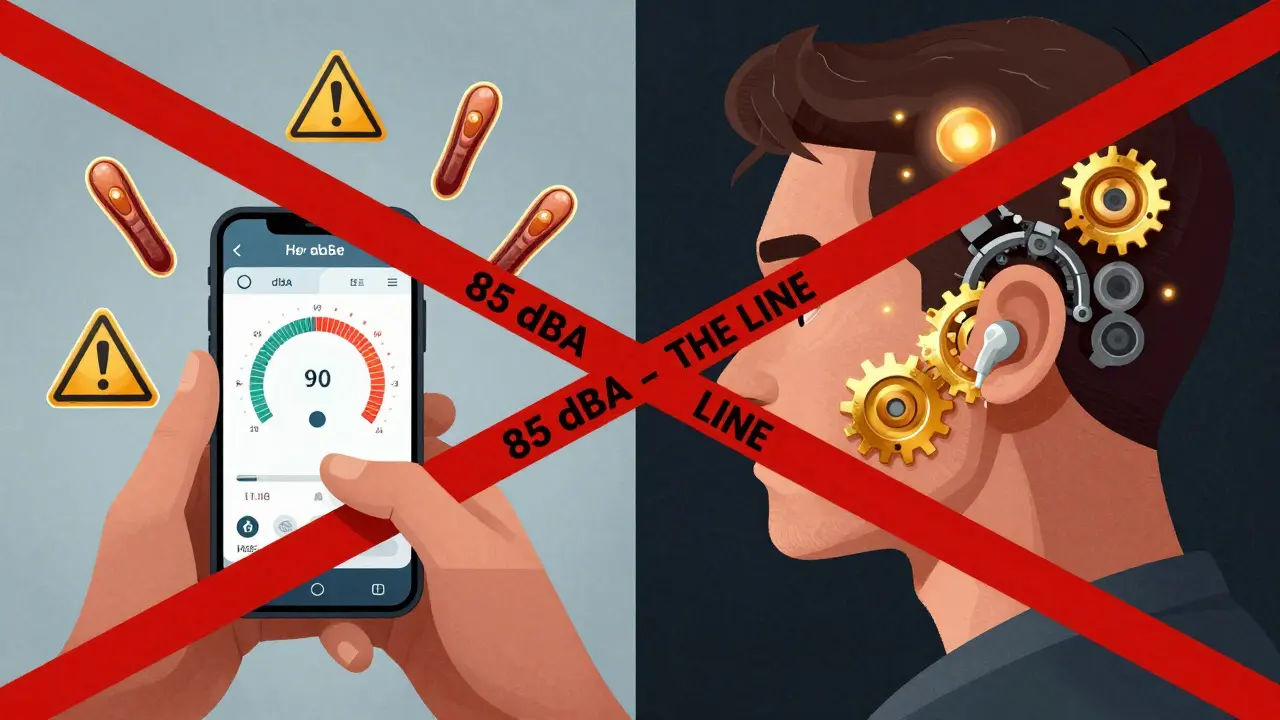
Noise isn’t just about volume. It’s about how long you’re exposed and how often. The noise exposure limit most experts agree on is 85 decibels (dBA) over an 8-hour workday. That’s about the sound of heavy city traffic or a lawnmower. If you’re exposed to that level for 8 hours straight, your risk of permanent hearing loss starts to rise. And it doesn’t take much more to push you over the edge.At 88 dBA, your safe exposure time drops to just 4 hours. At 91 dBA, it’s 2 hours. At 100 dBA-like a power saw or a motorcycle-you’re only safe for 15 minutes before damage can begin. This isn’t theoretical. A 2023 study in JAMA Otolaryngology found that smartphone apps can now measure noise levels with 92% accuracy compared to professional tools. You don’t need fancy gear to know if you’re in danger.
But here’s the catch: not all rules are the same. In the U.S., the Occupational Safety and Health Administration (OSHA) lets employers allow up to 90 dBA for 8 hours. That’s 5 decibels higher than what the National Institute for Occupational Safety and Health (NIOSH) recommends. That difference isn’t just paperwork-it’s the difference between a 25% chance of hearing loss over a lifetime and less than 8%. NIOSH uses a 3-decibel exchange rate: every 3 dB increase cuts your safe time in half. OSHA uses a 5-dB rate, which gives workers more time at high levels-but also more risk.
Why the Rules Are So Different
You might wonder why two federal agencies in the same country have different standards. The answer is simple: OSHA’s rules are legal requirements. NIOSH’s are scientific recommendations. OSHA has to balance worker safety with what industries can practically afford. NIOSH just looks at the science-and the science says 85 dBA is the line where harm starts.Other countries are catching up. The European Union’s rules are stricter than OSHA’s. The UK sets an upper exposure limit of 87 dBA, even when you’re wearing earplugs. Australia and China follow NIOSH’s 85 dBA standard. California already adopted NIOSH’s 3-dB rule in its workplace laws. And the European Commission is moving to extend those protections to concert venues and nightclubs in 2024.
The bottom line? If you’re working in a noisy environment, don’t rely on OSHA’s 90 dBA limit. Treat 85 dBA as your real threshold. Your ears won’t know the difference between the two numbers-but they’ll remember the damage.
How Noise Damages Your Ears
Your inner ear has tiny hair cells that convert sound waves into signals your brain understands. These cells don’t grow back. Once they’re damaged by loud noise, the hearing loss is permanent. That’s why noise-induced hearing loss (NIHL) is completely preventable-but also irreversible.NIHL doesn’t happen overnight. It’s a slow creep. You might not notice it until you’re struggling to hear conversations in noisy rooms, or until your friends keep telling you to turn down the TV. By then, you’ve already lost some of your ability to hear high-pitched sounds-like birds chirping, children’s voices, or the ‘s’ and ‘th’ sounds in speech.
According to the CDC, about 24% of hearing loss in the U.S. is caused by noise exposure. That’s over 30 million people. And it’s not just factory workers. Construction crews, farmers, firefighters, and musicians are all at risk. A 2022 survey by the International Music Managers Forum found that 63% of professional musicians have some degree of hearing loss. Orchestral musicians regularly experience noise levels between 89 and 94 dBA during performances-longer than most factory shifts.
Protecting Yourself at Work
If you work in a noisy environment, you’re not powerless. OSHA requires employers to take action when noise hits 85 dBA. That means:- Providing free hearing protection (earplugs or earmuffs)
- Offering annual hearing tests
- Training you on how to use protection properly
But here’s the problem: most people don’t wear their earplugs right. NIOSH studies show that without hands-on training, only 40% of workers use hearing protection correctly. With training, that jumps to 85%. Proper fit matters. Foam earplugs need to be rolled thin, inserted deep, and held in place until they expand. Earmuffs must seal tightly around the ear-no hair, glasses, or hats breaking the seal.
The best protection isn’t what you put on your ears-it’s what you remove from the environment. Engineering controls like sound-dampening panels, quieter machinery, or enclosures around loud equipment are far more effective than relying on personal gear. Administrative controls-like rotating workers out of noisy areas or limiting shift lengths-also help.
If your employer isn’t doing any of this, ask. You have a right to a safe workplace. And if they ignore you, report it. OSHA takes complaints seriously.
Concerts, Clubs, and Personal Audio
You might think concerts are just fun-until your ears ring for hours afterward. That ringing? It’s a warning. Temporary threshold shift (TTS) means your hearing is already stressed. If it happens often, it becomes permanent.Studies show that 50% of people who leave a concert with ringing ears are at risk of lasting damage. The World Health Organization recommends limiting personal audio device use to 40 hours per week at 80 dBA. That’s about 60% volume on most phones. But most people crank it to 90 dBA or higher-equivalent to a motorcycle riding beside them.
Some venues are starting to act. The Lifehouse Festival in Canada gives out free, high-fidelity earplugs-and 75% of attendees take them. Other festivals have quiet zones where sound levels drop to 70-75 dBA, letting people rest their ears. Real-time sound level displays are popping up too, showing patrons how loud it is right now.
And it’s not just festivals. Apple and Spotify now have built-in “safe listening” alerts. If you’ve been listening at high volume for too long, your phone will nudge you. It’s not perfect-but it’s a start.
What You Can Do Today
You don’t need to wait for your employer or a festival organizer to protect you. Here’s what you can do right now:- Use the 60/60 rule: Keep your personal audio at 60% volume for no more than 60 minutes at a time.
- Carry foam earplugs in your pocket. They cost less than $2 and fit in your wallet.
- At concerts, stand away from speakers. Even 10 feet back can cut noise by 10-15 dBA.
- Give your ears 16 hours of quiet after a loud event. That’s how long it takes to recover from temporary damage.
- Get a free noise app like Decibel X or NIHL Calculator. Measure your environment. You’ll be surprised.
And if you’re a musician, parent, or work in construction, manufacturing, or transportation-don’t wait for symptoms. Get a baseline hearing test now. It’s quick, painless, and often free through workplace programs or community clinics.
The Bigger Picture
Hearing loss isn’t just about missing music or conversations. It’s linked to loneliness, depression, and even dementia. When you can’t hear, you withdraw. The social cost is huge.The good news? We know how to stop it. If every workplace in the U.S. adopted the 85 dBA standard with a 3-dB exchange rate, we could prevent 240,000 cases of hearing loss every year by 2040. That’s not just a number-it’s 240,000 people who won’t have to struggle to hear their grandchildren.
Protecting your hearing isn’t about being overly cautious. It’s about being smart. You wouldn’t skip wearing a seatbelt because you don’t think you’ll crash. Don’t skip ear protection because you don’t think it’ll hurt you yet. Noise doesn’t wait. And neither should you.
What is the safe noise exposure limit for work?
The scientifically recommended safe limit is 85 decibels (dBA) averaged over 8 hours. This is the level set by NIOSH and followed by many countries, including Canada, Australia, and the EU. OSHA’s legal limit is higher at 90 dBA, but that allows for a much greater risk of hearing loss. For maximum protection, treat 85 dBA as your real limit.
Can you really lose your hearing at a concert?
Yes. Concerts often reach 100-110 dBA. At that level, damage can occur in under 15 minutes. Even one loud concert without protection can cause temporary ringing or muffled hearing-signs your ears are already damaged. Repeated exposure leads to permanent hearing loss. Many musicians and concertgoers report hearing issues years later because they never protected their ears early on.
Are earplugs effective at concerts?
Yes-if they’re the right kind. Regular foam earplugs reduce volume but can make music sound muffled. High-fidelity musician’s earplugs use filters to reduce volume evenly across frequencies, so music still sounds clear. They typically reduce sound by 15-20 dBA, bringing dangerous levels into the safe range. Many festivals now offer them for free.
How do I know if my workplace is too loud?
If you have to shout to be heard by someone an arm’s length away, it’s too loud. You can also use a free smartphone app like Decibel X to measure noise levels. If readings consistently hit 85 dBA or higher over an 8-hour shift, your employer is required to provide hearing protection and training under OSHA rules.
Is hearing loss from noise reversible?
No. Once the hair cells in your inner ear are damaged by noise, they don’t regenerate. That’s why noise-induced hearing loss is permanent. What you can reverse is temporary ringing or muffled hearing after exposure-this is called temporary threshold shift. But if it happens often, it becomes permanent. Prevention is the only cure.
What’s the difference between NIOSH and OSHA noise limits?
NIOSH recommends 85 dBA as the safe limit with a 3-dB exchange rate (halving exposure time for every 3 dB increase). OSHA’s legal limit is 90 dBA with a 5-dB exchange rate, meaning workers can be exposed to higher noise levels for longer. NIOSH’s standard prevents 8% lifetime risk of hearing loss. OSHA’s allows up to 25%. NIOSH is based on science. OSHA is based on what’s enforceable.
Can I use headphones safely?
Yes, if you follow the 60/60 rule: keep volume at 60% and limit use to 60 minutes at a time. Avoid using headphones in very noisy places-you’ll naturally turn the volume up to drown out background noise. Use noise-canceling headphones instead. They block outside sound, so you don’t have to crank the music. Apple and Spotify now alert you when you’ve exceeded safe listening levels.
What Comes Next
The future of hearing protection is changing. Real-time noise monitoring in venues, mandatory safe-listening alerts on streaming apps, and stricter enforcement in music industries are on the horizon. But none of it matters if you don’t act now.If you’re reading this, you’re already ahead of most people. You know noise can hurt you. Now, take the next step. Buy a pair of earplugs. Use them at your next concert. Ask your employer about noise levels. Get your hearing checked. Your ears won’t thank you today-but they’ll thank you for the rest of your life.
Amber Lane
January 21, 2026 AT 01:38I used to think earplugs were for nerds until I went to a metal concert and left with ringing for three days. Bought a pair of high-fidelity ones last year-$15, changed my life. Music sounds clearer now, not muffled. My ears thank me.
Ashok Sakra
January 22, 2026 AT 18:21bro why are we even talking about this? loud music is life!!! if your ears bleed then u just not tough enough. i listen to 110db for 5 hours straight and still dance like a maniac. your ears are weak, not the music.
Andrew Rinaldi
January 24, 2026 AT 12:28It’s interesting how we treat hearing like a disposable resource-something we can exhaust and then replace with hearing aids later. But we wouldn’t do that with our eyes or kidneys. Maybe the real issue isn’t the decibels, but the cultural normalization of sensory neglect. We’ve forgotten that our bodies aren’t machines.
Gerard Jordan
January 25, 2026 AT 11:37Just got my first free earplugs at the local festival yesterday 🎧💙. Seriously, if you’re not using them, you’re gambling with your future. My dad lost his high-end hearing in his 50s from years of construction work-never got a test. Don’t be him. Get checked. Get plugs. Be smart. 🙏
michelle Brownsea
January 26, 2026 AT 04:27Let’s be clear: OSHA’s 90-dBA standard is not merely outdated-it is criminally negligent. The science is unequivocal. NIOSH’s 85-dBA threshold is not a suggestion; it is a moral imperative. To tolerate anything higher is to willfully endanger human beings under the guise of “economic feasibility.” And let’s not forget: the workers who suffer are not abstract statistics-they are mothers, fathers, musicians, welders… people who deserve better than corporate indifference.
Roisin Kelly
January 27, 2026 AT 13:18Yeah right, and I’m supposed to believe that Apple’s ‘safe listening’ alert is actually helping? That’s like giving someone a seatbelt while they’re still driving drunk. Corporations don’t care about your ears-they care about your data. They’ll sell you earplugs while quietly lobbying to keep OSHA’s weak rules. Wake up.
lokesh prasanth
January 28, 2026 AT 09:5185db is fine but u forgot one thing-its not the noise its the stress. i work in factory and i dont hear nothing because i just dont care. your brain filters it. so stop worrying so much. also typo in post: ‘dBA’ not ‘dbA’
Malvina Tomja
January 29, 2026 AT 07:57While I appreciate the sentiment, I must point out: the entire premise hinges on an unproven assumption-that noise-induced hearing loss is universally preventable. What about genetic predisposition? What about aging? The data is conflated. And let’s not forget: many musicians deliberately choose to sacrifice hearing for art. That’s not negligence-it’s agency. Your moralizing ignores nuance.