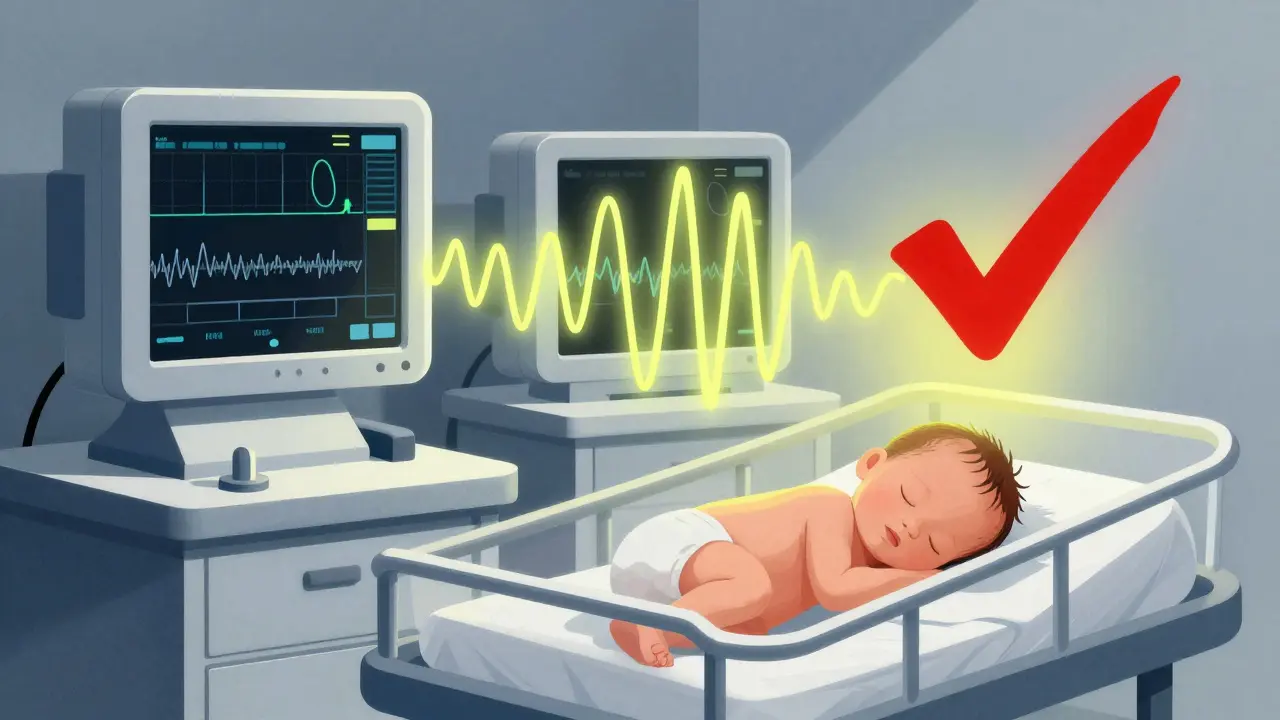
When a baby doesn’t respond to a loud noise or seems to ignore voices, it’s easy to brush it off. Maybe they’re just distracted. Maybe they’re sleepy. But if hearing loss goes undetected, the consequences don’t wait. By age 3, a child with untreated hearing loss may already be months-or years-behind in speech and language development. The good news? We can catch it early. And when we do, most children catch up to their peers.
Why Early Screening Matters More Than You Think
Every year in the U.S., about 3 in 1,000 babies are born with hearing loss. That’s more than 12,000 newborns annually. Most of them look perfectly healthy. No one can tell just by looking. That’s why universal newborn hearing screening became standard practice in the early 2000s. Today, 94% of U.S. newborns get tested before leaving the hospital. Screening isn’t a one-time check. It’s the first step in a system designed to catch problems before they stick. The goal? Identify hearing loss by 3 months and start intervention by 6 months. Why that timeline? Because research shows children who get help before 6 months develop language skills close to normal levels 60-70% of the time. Those identified after 12 months? Only 20-30% reach the same level. The tools are simple. For newborns, it’s usually OAE (otoacoustic emissions) or ABR (auditory brainstem response). Both are painless, quick, and done while the baby sleeps. OAE checks if the inner ear responds to sound. ABR measures how the brain reacts. If the baby doesn’t pass, it doesn’t mean they’re deaf. It could be fluid in the ear, wax, or just movement during the test. But it does mean they need a full diagnostic evaluation-no waiting.What Causes Hearing Loss in Children?
Hearing loss in kids comes from two main places: things they’re born with (congenital) and things that happen after birth (acquired). About half of all cases are genetic. Mutations in the GJB2 gene are the most common, making up half of all inherited hearing loss. If there’s a family history of childhood deafness, that’s a red flag. But genetics isn’t the only culprit. Around 15-20% of congenital cases come from cytomegalovirus (CMV), a virus moms can pass to babies during pregnancy. Many parents don’t even know they had it. That’s why some experts now push for routine CMV testing at birth. Premature babies, especially those who spent time in the NICU, are also at higher risk. Medications used to save their lives-like certain antibiotics-can damage hearing. So can low oxygen or jaundice. After birth, the biggest cause of temporary hearing loss is ear infections. By age 3, 80% of kids have had at least one bout of otitis media. Fluid behind the eardrum muffles sound. It’s not permanent, but if it lasts for months, it can delay speech development. That’s why kids with frequent ear infections need monitoring-even if they passed their newborn screen. Other causes include meningitis (which causes hearing loss in 30% of affected children), head injuries, and loud noise. Yes, noise. Headphones turned up too high, loud toys, or even constant exposure to lawnmowers or concerts can damage a child’s hearing. The CDC says 12.5% of kids aged 6-19 have noise-induced hearing loss. That’s one in eight.Screening Doesn’t End at Birth
Newborn screening catches most cases, but not all. Some hearing loss shows up later. That’s why the American Academy of Pediatrics says kids need check-ups at ages 4, 5, 6, 8, and 10. Then again between 11-14, 15-17, and 18-21. At these visits, screeners use pure-tone audiometry. For kids 3-10, they listen for tones at 500 Hz (25 dB) and 1000, 2000, 4000 Hz (20 dB). For teens, they add 6000 Hz. If a child doesn’t respond, they’re referred for a full hearing test. School nurses and speech therapists often do these screenings. In fact, 87% of school-based speech-language pathologists report handling hearing checks in their districts. But they need training. State rules vary: Minnesota requires screening before kindergarten, Kansas mandates it from birth through age 21. Some states have 99% compliance. Others lag behind. Risk factors matter too. Even if a child passed their newborn test, they should still get checked if they have:- A family history of childhood hearing loss
- Craniofacial abnormalities (like cleft palate)
- Recurrent ear infections
- History of meningitis
- Neonatal ICU stay longer than 5 days
- Use of ototoxic medications
What Happens After a Diagnosis?
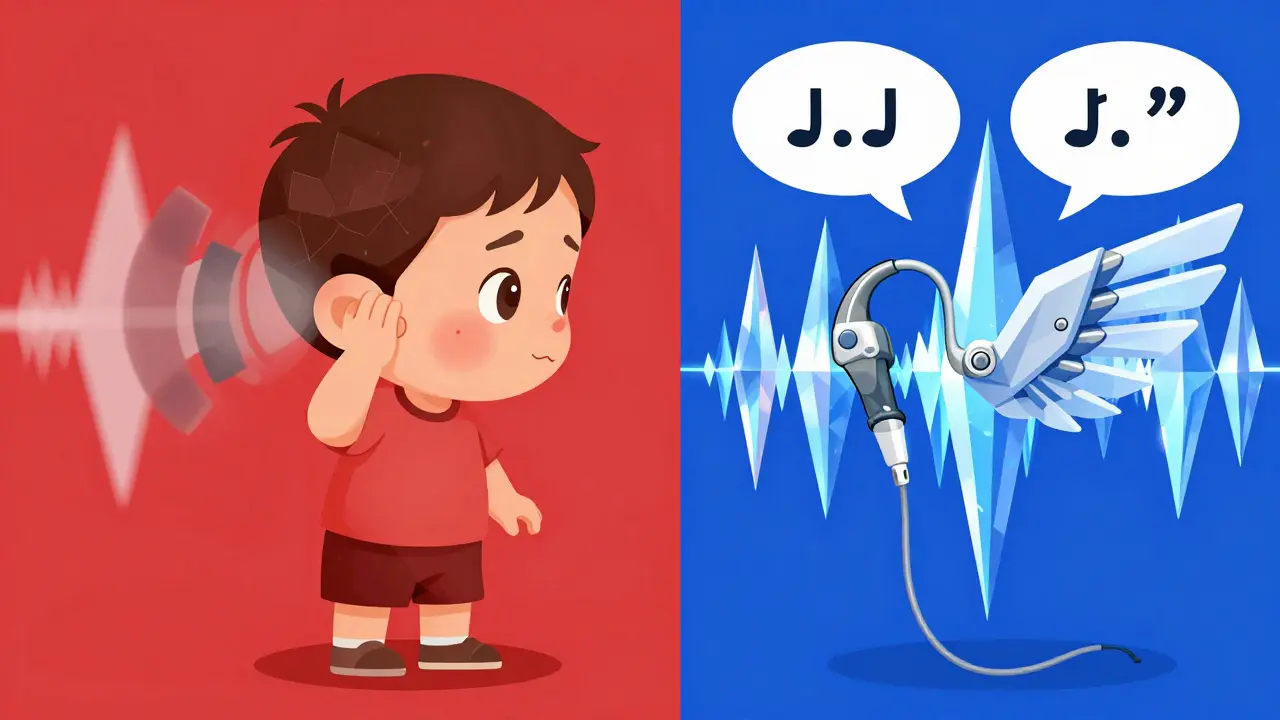
Getting a diagnosis is just the beginning. The real work starts with intervention. And it has to happen fast. For mild to moderate hearing loss, hearing aids are the first step. They improve speech perception in quiet environments by 85%. For profound loss, cochlear implants are often recommended. These devices bypass damaged parts of the ear and directly stimulate the auditory nerve. Around 60-70% of children with implants develop open-set speech recognition-meaning they can understand speech without lip-reading. But devices alone aren’t enough. Therapy is critical. Two main approaches exist:- Listening and Spoken Language (LSL): Focuses on using hearing and speech. Kids with hearing aids or implants who get early LSL therapy reach age-appropriate language skills 78-85% of the time.
- Bilingual-Bicultural (Bi-Bi): Uses American Sign Language (ASL) as a first language, with English taught as a second language. Deaf students in Bi-Bi programs graduate high school at an 80% rate-much higher than the national average for deaf youth.
Where the System Falls Short
The science is clear. The tools exist. The guidelines are solid. But the system still leaks. Nationwide, 37.5% of babies who fail newborn screening never get a full diagnostic test by 3 months. In rural areas, it’s over 50%. Even after diagnosis, only 64.5% of infants get intervention by 6 months. And there’s a racial gap: Black and Hispanic children are 23% less likely to receive timely help than White children. Why? Transportation. Lack of specialists. Insurance delays. Language barriers. Parents who don’t understand the urgency. Or worse-doctors who don’t stress it enough. New tools are helping. Telehealth now allows remote audiologic evaluations with 92% accuracy. Mobile screening units are reaching families who can’t get to clinics. Smartphone-based OAE devices are being tested, with 95% sensitivity in early trials. AI can now interpret audiograms with 98.7% accuracy-matching expert audiologists. But technology won’t fix everything. We still need families who know what to look for. Providers who follow up. Systems that track every child from birth to adulthood.
What Parents Can Do
You don’t need to be a doctor to spot warning signs:- By 6 months: Doesn’t turn toward your voice or react to loud sounds
- By 12 months: Doesn’t say simple words like “mama” or “dada”
- By 2 years: Doesn’t follow simple directions, or speaks very little
- Any age: Frequently says “huh?” or turns up the TV volume
- Any age: Seems to hear some sounds but not others
What Comes Next
The future of pediatric hearing care is bright. Genetic panels at birth could identify 80% of inherited causes before symptoms appear. Expanded CMV screening could prevent thousands of cases. AI tools will make diagnosis faster and more accurate. But progress depends on action today. Every child who gets screened early, diagnosed quickly, and treated right has a chance at full language development, strong academic outcomes, and healthy social connections. Don’t assume hearing loss only affects the obvious cases. It doesn’t always look like silence. Sometimes, it looks like a child who’s quiet in class. Or one who’s frustrated because they can’t follow along. Or one who’s labeled as “not trying.” Hearing loss isn’t a life sentence. With the right support, children can thrive.How common is pediatric hearing loss?
About 3 in every 1,000 babies are born with hearing loss. That’s over 12,000 children each year in the U.S. Many cases are detected at birth, but some develop later due to illness, injury, or noise exposure.
Can hearing loss be reversed in children?
It depends on the cause. Hearing loss from ear infections or fluid buildup often improves with treatment. But sensorineural hearing loss-caused by damage to the inner ear or nerve-is usually permanent. However, hearing aids and cochlear implants can restore access to sound and help children develop spoken language.
What are the signs of hearing loss in toddlers?
Toddlers with hearing loss may not respond when called, speak less than peers, repeat phrases without understanding them, or turn up the TV volume. They might seem to hear some sounds but not others-like loud noises but not whispers. Delayed speech is the most common red flag.
Is hearing screening required by law?
Yes. All 50 states and U.S. territories require newborn hearing screening. Many also require follow-up screenings in preschool and school years. Minnesota, Kansas, and others have specific laws mandating screening at certain ages, with high compliance rates.
What if my child passed the newborn screen but I’m still worried?
Trust your instincts. Some hearing loss develops after birth. If you notice delays in speech, inconsistent responses to sound, or frequent ear infections, ask your pediatrician for a referral to an audiologist. You don’t need a failed screening to get help.
How do I choose between sign language and spoken language therapy?
There’s no single right answer. Some families choose spoken language with hearing aids or implants. Others use sign language as a first language. Many use both. The key is early, consistent exposure to language-whether spoken or signed. Work with a team of specialists to find what fits your child and family best.
Chris Urdilas
January 26, 2026 AT 17:37So let me get this straight - we screen every newborn, but if you live in a rural town, you’re basically expected to huckster your kid across three counties just to get a follow-up? And then insurance takes six weeks to approve a hearing aid? Meanwhile, the kid’s brain is rewiring itself to think silence is normal. We’re not failing kids because we don’t know how - we’re failing them because we’re lazy and cheap.
Also, who wrote the part about ‘trust your gut’? That’s not advice, that’s a cry for help from a parent who’s been gaslit by their pediatrician for six months.
And yes, I’ve been there. My daughter passed the screen. She didn’t say ‘mama’ until she was 21 months. We found out she had progressive hearing loss. The system didn’t catch it. I did. Because I refused to believe ‘she’s just slow.’
Jeffrey Carroll
January 28, 2026 AT 11:21It is imperative to underscore the clinical significance of early auditory intervention in pediatric populations. The neuroplasticity of the developing auditory cortex peaks between 3 and 6 months of age, and subsequent delays in stimulus exposure result in irreversible cortical reorganization. The data presented in this article are consistent with longitudinal studies from the Journal of Pediatric Audiology (2021) and the National Institute on Deafness and Other Communication Disorders (NIDCD).
Furthermore, the integration of teleaudiology protocols has demonstrated non-inferiority to in-person evaluations in controlled trials, with effect sizes exceeding 0.85 for diagnostic accuracy. These findings warrant policy reform to expand reimbursement structures for remote pediatric audiology services, particularly in underserved regions.
Linda O'neil
January 29, 2026 AT 11:47My niece got her cochlear implant at 5 months. She’s 7 now and reading at a 3rd-grade level. No lip-reading. No delays. Just pure, hard work and a team that didn’t give up.
People think ‘hearing loss’ means silence. It doesn’t. It means frustration. It means being left out. It means your kid thinks everyone’s just talking in riddles.
But here’s the thing - with the right support, they don’t just catch up. They soar. I’ve seen it. You can too. Don’t wait for the system to fix itself. Advocate. Push. Ask for the referral. Now.
Jess Bevis
January 29, 2026 AT 17:45My cousin’s kid in Puerto Rico didn’t get screened until 18 months. No one spoke English. No one knew the forms. No one cared. Now he’s in a bilingual program. He signs, he speaks, he’s brilliant. But he lost two years. Don’t let bureaucracy steal that from anyone.
Rose Palmer
January 30, 2026 AT 05:24As a clinical audiologist with over 18 years of experience in pediatric diagnostics, I must emphasize that the 37.5% non-follow-up rate is not merely a statistic - it is a systemic failure of accountability. The Joint Committee on Infant Hearing (JCIH) guidelines are unequivocal: identification by 3 months, intervention by 6. Yet, in many states, the responsibility is delegated to overburdened public health departments with no funding, no tracking, and no consequences for non-compliance.
Moreover, the racial disparity in access is not incidental - it is structural. Medicaid reimbursement rates for pediatric audiology services remain stagnant since 2010, while private insurers impose prior authorization hurdles that delay care by 6–12 weeks. We are not dealing with a medical issue. We are dealing with a policy crisis.
Howard Esakov
January 30, 2026 AT 18:58Wow. So we’re now telling parents that if their kid doesn’t respond to a loud noise, they’re doomed unless they get a $100K implant by age 6? 😏
Let’s be real - most kids develop language at their own pace. My nephew didn’t say a word until he was 2. Turned out he was just a quiet genius. Now he’s at MIT. Meanwhile, the system’s busy pathologizing normal variation because someone got a grant to ‘screen everything.’
Also, AI interpreting audiograms? Next you’ll tell me a robot can tell if your kid is ‘not trying.’ 😒
Lexi Karuzis
February 1, 2026 AT 00:51Did you know that the newborn hearing screen is funded by the same companies that sell hearing aids and cochlear implants? Coincidence? I think not.
And CMV testing? That’s a scam. The CDC admits that 80% of adults have CMV and it’s harmless - except when it’s not, but only if you’re poor and don’t wash your hands. They’re pushing this because they want to sell more tests, more devices, more drugs.
Also, why is no one talking about the fact that 90% of deaf kids are born to hearing parents? Who gave them the right to ‘fix’ their child? Sign language is a full, rich language - why are we pathologizing difference?
And why is the article silent on the fact that 40% of cochlear implants fail within 10 years? Because the manufacturers don’t want you to know. They’re milking the system.
Trust me - if your kid is ‘delayed,’ it’s not because they’re deaf. It’s because you’re being manipulated by a medical-industrial complex that profits from fear.
Amber Daugs
February 1, 2026 AT 13:42Let me just say - if you’re a parent and you’re even *thinking* your child might have hearing issues, you’re already a bad parent. Why? Because you didn’t notice earlier. You didn’t research. You didn’t monitor every single sound they made. You waited for the doctor to tell you. That’s negligence.
My daughter had a mild loss. I caught it because I recorded her babbling and compared it to the CDC milestones on my phone. You think that’s extreme? It’s not. It’s parenting. If you’re too lazy to do that, don’t be surprised when your kid falls behind.
Also, why are we letting schools do screenings? They’re not even medical professionals. And why are we using ‘pure-tone audiometry’ on a 4-year-old who doesn’t know what ‘raise your hand’ means? It’s a joke. The system is broken because parents are lazy and professionals are overworked - and nobody takes responsibility.
And for the love of God, stop letting your kids listen to music on headphones. I swear, if I hear one more kid with earbuds blasting at the mall, I’m calling Child Protective Services. That’s not a preference - that’s child abuse.
Robert Cardoso
February 1, 2026 AT 19:06Let’s deconstruct the underlying assumptions here. The article frames hearing loss as a deficit to be corrected - a pathological deviation from the norm. But what if the real problem is not the child’s auditory system, but the cultural imperative to assimilate into a spoken-language hegemony?
The Bi-Bi model isn’t just an ‘alternative’ - it’s a decolonial practice. Deaf culture isn’t a medical condition to be managed - it’s a linguistic minority with its own epistemology. The 80% high school graduation rate in Bi-Bi programs isn’t a statistic - it’s a rebellion.
And why is no one asking why the state mandates screening but not funding ASL interpreters in preschools? Why is LSL therapy the default? Because capitalism needs compliant, assimilated consumers who can speak in focus groups and answer customer service calls.
The real crisis isn’t hearing loss - it’s the erasure of Deaf identity in the name of ‘intervention.’
Also, AI interpreting audiograms? That’s not progress. That’s automation of bias. The algorithm was trained on data from predominantly white, middle-class children. What about kids with neurodivergent auditory processing? What about bilingual households? The system doesn’t see them. It only sees ‘failures.’
James Dwyer
February 1, 2026 AT 20:25I just want to say - if you’re reading this and you’re worried about your child, you’re not alone. I spent a year thinking I was overreacting. I wasn’t. My son passed the newborn screen. He didn’t respond to his name until he was 18 months. We got him tested. He had moderate loss. We started therapy. He’s in a mainstream classroom now. He loves Minecraft. He talks to his dog. He’s happy.
You don’t need to be perfect. You just need to care enough to ask. One call. One email. One appointment. That’s all it takes to change everything.
Kevin Kennett
February 3, 2026 AT 17:12Look - I get it. You’re tired. You’re overwhelmed. You’ve got three kids, a job, and no childcare. You don’t have time to chase down a specialist.
But here’s the truth: your kid doesn’t care about your schedule. Their brain is building pathways right now. Every day you wait, you’re losing ground.
So here’s what you do: Call your pediatrician. Say, ‘I’m worried about hearing.’ Don’t say ‘maybe.’ Don’t say ‘I think.’ Say ‘I’m worried.’ If they blow you off, go to a different doctor. Go to an audiologist directly - you don’t need a referral in most states.
And if you’re scared? Join a Facebook group. Talk to other parents. You’ll find people who’ve been there. You’ll find hope.
This isn’t about being a perfect parent. It’s about being a persistent one.
Sue Latham
February 4, 2026 AT 04:07Okay but like - why are we still using old-school OAE tests? I saw a TikTok where a mom used her phone’s mic and a $20 app to test her baby’s hearing while he slept. It worked better than the hospital. 🤯
And why are we still pretending this is just about ‘speech’? My nephew got a cochlear implant and now he’s into EDM. He feels the bass. He dances. He doesn’t need to ‘speak normally’ to be whole.
Also, can we stop acting like hearing aids are magic? My cousin’s kid got one and still screamed at the dinner table because he couldn’t hear himself. It’s not just the device - it’s the training. The patience. The love.
And honestly? If your kid’s not talking by 2? Maybe they’re just chill. Or maybe they’re deaf. Either way - don’t panic. Just check.
Chris Urdilas
February 5, 2026 AT 04:23Yeah, I saw that TikTok too. Used it on my daughter when the audiologist canceled for the third time. It flagged a 35dB loss in her right ear. Took me 3 weeks to get a real test. The app was right.
So yeah - maybe the system’s broken. But your phone? It’s not.