
Every year, over a million people in the U.S. end up in the emergency room because of bad reactions to their medications. Many of these cases aren’t caused by taking too much or the wrong pill-they’re caused by how one drug changes the way another drug works inside your body. This is called a pharmacokinetic drug interaction.
What Exactly Is a Pharmacokinetic Drug Interaction?
Think of your body like a delivery system for medicine. When you take a pill, it has to get absorbed, travel through your blood, get broken down, and then leave your body. Pharmacokinetic interactions happen when one drug messes with one or more of those steps.
It’s not about the drugs fighting each other directly-that’s a different kind of interaction. This one is about your body’s process: how drugs are absorbed, distributed, metabolized, and excreted. Doctors and pharmacists call this ADME for short.
Here’s the simple version: if your body can’t handle one drug the way it normally does because another drug is in the way, the result can be too little of the medicine working-or too much, which can be dangerous.
How Drugs Get Absorbed (And When They Don’t)
Some medications need your stomach to be acidic to work. If you take an antacid at the same time, it neutralizes the acid-and suddenly, that antibiotic or antifungal doesn’t get absorbed. Ketoconazole, for example, can become almost useless if taken with heartburn meds.
Then there’s the calcium problem. Tetracycline antibiotics, often used for acne or infections, bind to calcium in milk, yogurt, or calcium supplements. That binding stops the antibiotic from entering your bloodstream. Studies show this can cut absorption by up to half. The fix? Take the antibiotic at least two to three hours before or after dairy or calcium pills.
Even something as common as opioids can slow down how fast other drugs get absorbed. Morphine, for instance, slows your gut movement, which delays how quickly acetaminophen (Tylenol) gets into your system. It’s not always dangerous, but it can mean your pain relief takes longer to kick in.
When Drugs Compete for Space in Your Blood
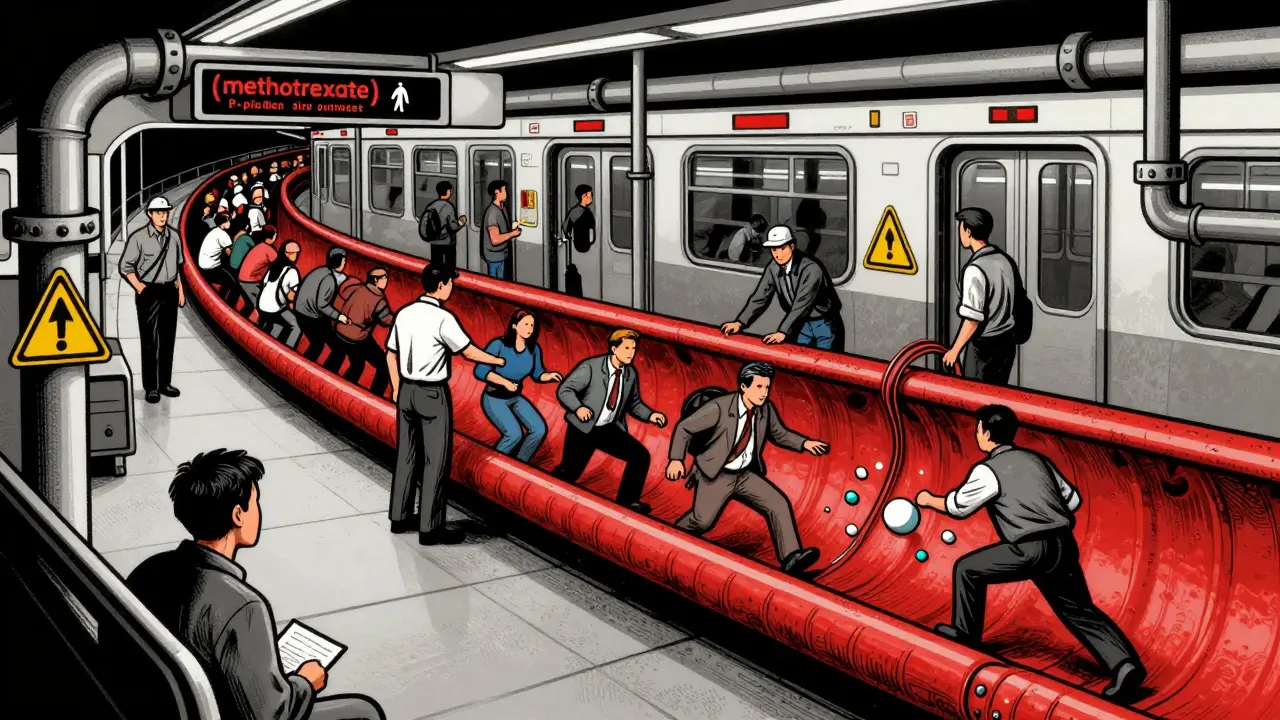
Once a drug gets into your bloodstream, it doesn’t float around alone. Most of it sticks to proteins-mainly albumin-like a hitchhiker on a bus. Only the part that’s not stuck can actually do its job.
Now imagine two drugs trying to ride the same bus. If one gets on first and takes up all the seats, the second one gets pushed off. That’s called protein binding displacement. Warfarin (a blood thinner) and diclofenac (an NSAID painkiller) are a classic example. When taken together, diclofenac can push warfarin off the protein, leaving more free warfarin in your blood. That can raise your risk of bleeding.
But here’s the catch: your body usually notices and starts breaking down the extra free drug faster. So, this kind of interaction only becomes dangerous with drugs that have a very narrow safety window-like warfarin, digoxin, or phenytoin. For most others, the effect is too small to matter.
The Big One: How Your Liver Breaks Down Drugs
This is where things get serious. About 80% of the most dangerous drug interactions happen here, thanks to a family of liver enzymes called cytochrome P450. The most common ones are CYP3A4 and CYP2D6.
These enzymes are like tiny scissors that chop up drugs so your body can get rid of them. But sometimes, another drug comes along and either:
- Shuts the scissors down (inhibition)-so the drug builds up to dangerous levels
- Turns the scissors on full speed (induction)-so the drug gets broken down too fast and stops working
Let’s look at real examples.
Inhibition: Grapefruit juice is famous for this. It blocks CYP3A4. If you’re taking a statin like simvastatin, or a blood pressure pill like amlodipine, grapefruit juice can cause levels of the drug to spike. That’s why you’ll see warnings on the label. Same goes for clarithromycin (an antibiotic) and midazolam (a sedative)-together, they can cause dangerous drowsiness or breathing trouble.
Induction: St. John’s Wort, a popular herbal supplement for mood, is a strong inducer. It can make your birth control, antidepressants, or even heart meds stop working. One patient on warfarin started taking St. John’s Wort and ended up with a blood clot because the warfarin got broken down too fast.
Other common inhibitors: cimetidine (Tagamet), fluoxetine (Prozac), and some antifungals. Common inducers: rifampin (an antibiotic), carbamazepine (for seizures), and even smoking.
And here’s something new: the FDA now requires drug makers to test for CYP interactions. About 60% of all approved drugs affect these enzymes in some way.
How Drugs Leave Your Body (And What Blocks Them)
Your kidneys are the main exit ramp for drugs. But sometimes, two drugs try to use the same exit at the same time.
Probenecid, a drug used for gout, blocks the kidney’s ability to flush out certain antibiotics like cephalosporins. That means the antibiotic stays in your system longer-and higher levels can lead to toxicity.
NSAIDs like ibuprofen or naproxen can do the same to methotrexate, a drug used for arthritis and some cancers. When they’re taken together, methotrexate builds up and can damage your bone marrow or kidneys.
Then there’s P-glycoprotein-a protein that acts like a bouncer, pushing drugs out of your kidney and gut cells. If a drug like itraconazole blocks this bouncer, digoxin (used for heart rhythm) builds up. Too much digoxin can cause life-threatening heart rhythms.
The FDA says about 20% of serious drug interactions involve these transporter proteins. That’s why digoxin, cyclosporine, and some cancer drugs come with strong warnings.
Real Stories: When Interactions Turn Dangerous
An 85-year-old woman was taking venlafaxine (an antidepressant) and propafenone (a heart rhythm drug). Both are processed by CYP2D6 and blocked by P-glycoprotein. Together, they caused venlafaxine levels to soar. She ended up with hallucinations and agitation.
Another patient on lamotrigine (for epilepsy) was started on phenobarbital (a seizure drug). Phenobarbital triggered enzymes that turned lamotrigine into toxic byproducts. She developed low white blood cells and low platelets-dangerous conditions that put her in the hospital.
The Institute for Safe Medication Practices says warfarin, insulin, and digoxin are the top three drugs involved in serious interaction-related ER visits. Together, they account for one-third of all cases.
How to Protect Yourself
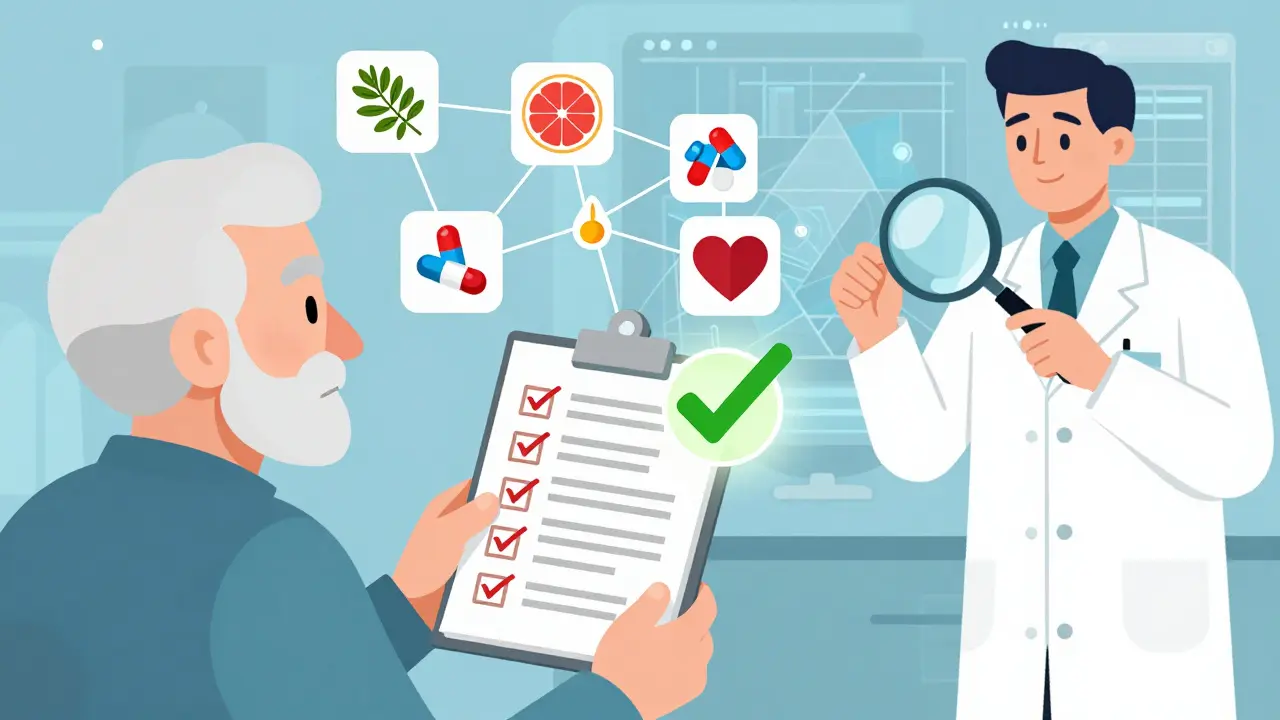
You don’t have to memorize enzyme names or drug classes. But you can take simple, powerful steps:
- Keep a full list of everything you take. That includes prescriptions, over-the-counter meds, vitamins, herbs, and even supplements like magnesium or melatonin. A 2020 study found this cuts interaction risks by 47%.
- Use one pharmacy. All your prescriptions in one place means the pharmacist’s computer can flag problems before you leave the counter. In the U.S., this prevents about 150,000 bad reactions every year.
- Ask these two questions every time you get a new prescription: “Could this interact with any of my other meds?” and “Is there anything I should avoid eating or drinking?” A Mayo Clinic study found asking these questions increases detection of risks by 63%.
- Avoid grapefruit juice. It interacts with 85 prescription drugs. That’s not a myth-it’s on the FDA-approved label for many meds.
- Space out tricky meds. If you take thyroid medicine and calcium, wait at least four hours between them. Same with antibiotics and dairy.
What Your Doctor and Pharmacist Are Doing
Most electronic health records now warn doctors about major interactions-about 85% of them. But here’s the problem: doctors get so many alerts, they start ignoring them. Nearly half of all warnings are overridden.
Pharmacists are stepping in. Medication therapy management programs-where a pharmacist reviews all your drugs-reduce bad reactions by 22% in older adults on Medicare.
Tools like Lexicomp, Micromedex, and Stockley’s Drug Interactions help them make smart calls. In the U.S., pharmacist-led reviews prevent over 1.2 million serious interactions every year.
What’s Next? Personalized Medicine
Genetics play a bigger role than most people realize. Some people are “poor metabolizers” of CYP2C19-meaning they break down certain drugs way too slowly. Others are “ultra-rapid” and clear them too fast.
The FDA now includes pharmacogenomic info in 340 drug labels. That means your genetic profile could one day help your doctor pick the right drug and dose from the start.
By 2025, researchers estimate that using this kind of testing could cut interaction-related hospital stays by 30%. Telehealth platforms are already adding interaction checkers. Most major U.S. health systems now use them.
Age matters too. About 40% of adults over 65 have reduced kidney function. That means drugs stick around longer. The American Geriatrics Society updated its Beers Criteria in 2023 to reflect this-listing drugs to avoid or use with caution in older adults.
Bottom line: drug interactions aren’t rare. They’re common. But they’re also mostly preventable.
You don’t need to be a scientist to stay safe. Just be aware. Keep your list updated. Ask questions. And never assume a pill is harmless just because it’s over-the-counter or natural.
Your body is doing a lot of work just to keep you alive. Don’t let two drugs confuse it.
What’s the difference between pharmacokinetic and pharmacodynamic drug interactions?
Pharmacokinetic interactions are about how your body processes the drug-absorption, metabolism, distribution, or excretion. Pharmacodynamic interactions are about what the drugs do to your body when they’re together. For example, two drugs that both lower blood pressure might cause it to drop too low-that’s pharmacodynamic. One drug slowing down the breakdown of another-that’s pharmacokinetic.
Can herbal supplements cause pharmacokinetic interactions?
Yes. St. John’s Wort is one of the most well-known. It speeds up the breakdown of many drugs, including birth control, antidepressants, and blood thinners. Garlic, ginseng, and echinacea can also interfere with how your liver processes medications. Always tell your doctor or pharmacist about anything you take, even if it’s labeled “natural.”
Is grapefruit juice really that dangerous with medications?
Yes. Grapefruit juice blocks the CYP3A4 enzyme in your gut, which is responsible for breaking down about half of all prescription drugs. Even one glass can affect you for up to 72 hours. Medications like statins, calcium channel blockers, and some anti-anxiety drugs can become dangerously potent. The FDA lists 85 drugs with this warning. Avoid grapefruit juice entirely if you’re on any of them.
Why do some drug interactions only happen in older adults?
As we age, our liver and kidneys don’t work as well. About 40% of adults over 65 have reduced kidney function. That means drugs stick around longer. Older adults also tend to take more medications-sometimes five or more-which increases the chance of overlap. That’s why the American Geriatrics Society has special lists of drugs to avoid in seniors.
Can I trust my pharmacist to catch all interactions?
Pharmacists are trained to spot them, and their systems flag most major ones. But they can only see what’s in your record. If you get a prescription from a different doctor or buy something over the counter, it might not show up. That’s why keeping your own list and sharing it with every provider is so important. Don’t rely on the system alone.
Are over-the-counter painkillers like ibuprofen safe with other meds?
Not always. Ibuprofen and other NSAIDs can increase the levels of methotrexate, warfarin, and some blood pressure drugs. They can also harm your kidneys when taken with diuretics or ACE inhibitors. If you’re on any of these, talk to your pharmacist before using NSAIDs regularly-even if they’re sold without a prescription.
Mike Rengifo
December 19, 2025 AT 02:21So basically your body’s a chaotic subway system and drugs are passengers fighting for seats? Yeah, I get it now. Thanks for the visual.
Dominic Suyo
December 19, 2025 AT 03:22Let’s be real - this article reads like a pharmacology textbook vomit. CYP3A4? P-glycoprotein? Who the hell talks like this outside a med school lecture? If you need a PhD to understand your own meds, the system’s broken. And don’t even get me started on grapefruit juice. I drank it this morning. Guess I’m dying.
Janelle Moore
December 20, 2025 AT 04:39Did you know the government is hiding the truth about drug interactions? Big Pharma doesn’t want you to know that your meds are secretly controlled by aliens through your liver enzymes. I read it on a forum. They use grapefruit juice as a signal. Don’t take anything unless you’ve done a 7-day cleanse first.
mary lizardo
December 21, 2025 AT 08:47While the content presented is largely accurate, the pedagogical approach is lamentably deficient in scholarly rigor. The colloquial metaphors employed-such as ‘hitchhiker on a bus’-are not only imprecise but actively undermine the biochemical veracity of pharmacokinetic principles. One would hope for a more disciplined exposition in a public health context.
Chris Davidson
December 22, 2025 AT 19:20St John’s Wort messes with everything. I took it with my antidepressant and woke up feeling like a zombie. No one warned me. Now I just take Tylenol and hope for the best
Matt Davies
December 23, 2025 AT 03:41Man, I used to think my grandma was just being dramatic when she refused to eat grapefruit. Turns out she was the smartest person in the room. Respect to the elders who figured this out before the FDA even printed the warnings. 🙌
Ashley Bliss
December 24, 2025 AT 19:51This isn’t just about drugs. It’s about how we’ve outsourced our bodies to corporations who treat us like data points. We’re not patients-we’re profit margins wrapped in insurance cards. The real interaction is between capitalism and human biology. And guess who loses? Us. Always us.
Dev Sawner
December 25, 2025 AT 11:31It is imperative to note that the cytochrome P450 enzyme system exhibits significant polymorphic variability across ethnic populations. For instance, the CYP2D6 ultra-rapid metabolizer phenotype is observed in approximately 29% of East African populations, whereas it is present in only 1% of East Asian cohorts. This necessitates culturally tailored pharmacokinetic guidelines, which are currently absent in most public health literature.
Moses Odumbe
December 27, 2025 AT 06:35Bro I just took a melatonin gummy with my blood pressure med and now I’m levitating?? 😵💫 Maybe this article is right. Also grapefruit juice is a trap. Don’t fall for it. 🍊❌
Meenakshi Jaiswal
December 28, 2025 AT 17:51Great breakdown! I’m a pharmacist and I see this every day. The #1 thing patients miss? They think ‘natural’ means safe. I had a woman on warfarin who drank green tea extract daily-no idea it was thinning her blood. Always tell your provider everything-even the ‘harmless’ stuff. You’re not being annoying, you’re saving your life.
holly Sinclair
December 30, 2025 AT 00:22It’s fascinating how our bodies evolved to process natural compounds, but modern pharmacology throws synthetic molecules into this ancient biochemical orchestra without regard for harmony. The liver doesn’t distinguish between a grapefruit and a statin-it just sees molecules. And when we disrupt the rhythm, the whole system stutters. Is this progress? Or are we just teaching our bodies to scream in ways we don’t understand? Maybe the real interaction isn’t between drugs, but between human hubris and biological complexity.
Alana Koerts
December 30, 2025 AT 04:45This article is just fearmongering dressed up as education. Most of these interactions are statistically negligible. People die from falling in the shower more than from drug interactions. Stop scaring folks into thinking every pill is a landmine. Your anxiety is worse than the meds.
pascal pantel
December 31, 2025 AT 01:27You missed the real killer: polypharmacy in the elderly. 70% of seniors take 5+ meds. That’s not a coincidence. It’s negligence. Doctors don’t taper, they just add. Pharmacies don’t audit, they just dispense. And the FDA? They approve drugs based on trials with 25-year-olds. This isn’t science. It’s a slaughterhouse with a white coat.
Gloria Parraz
December 31, 2025 AT 05:32I’ve been on 11 different meds for 8 years. I keep a notebook. I use one pharmacy. I ask the two questions every time. I don’t take grapefruit. I don’t take supplements unless my pharmacist says yes. I’m 72 and I’m still here. Knowledge isn’t power-it’s survival.
Mark Able
December 31, 2025 AT 15:14Wait so if I take my blood pressure med with my coffee and my fish oil and my magnesium and my turmeric and my CBD oil… am I basically playing Russian roulette with my heart? 😅