Every time you pick up a bottle of medicine-whether it’s from the pharmacy counter or the shelf at the grocery store-you’re holding a safety manual. But most people skim it like a receipt. That’s dangerous. A medication label isn’t just paperwork. It’s your lifeline to taking the right dose, at the right time, without hurting yourself.
What’s Actually on the Label?
Prescription and over-the-counter (OTC) labels look different, but they both tell you the same critical things: what’s in the medicine, how much to take, and what could go wrong. The FDA made these formats standard for a reason-because confusion kills.On a prescription label, you’ll see your name, the pharmacy’s info, the doctor’s name, and the drug’s generic and brand names. But the most important part? Section 2: Dosage and Administration. This isn’t just "take one pill." It’s detailed. It tells you:
- How many milligrams or milliliters to take
- How often-every 6 hours? Once a day?
- Whether to take it with food or on an empty stomach
- If you have kidney or liver problems, the dose might be lower
- What other drugs to avoid while taking it
For OTC medicines, the label follows the "Drug Facts" format. It’s broken into seven parts:
- Active Ingredient: The actual medicine. This is what works. If you’re taking two different cold medicines, check this section. You might be doubling up on acetaminophen-dangerous.
- Purpose: Why it’s there. "Pain reliever," "antihistamine," etc.
- Uses: What it treats. Headache? Fever? Allergies?
- Warnings: This is where people skip. It tells you when NOT to take it-like if you’re pregnant, have high blood pressure, or are on another drug.
- Dosage: How much, how often, and for how long. Never exceed this.
- Other Information: Storage tips, like "keep refrigerated" or "protect from light."
- Inactive Ingredients: Fillers, dyes, flavors. Important if you’re allergic to something like gluten or red dye #40.
Dosage Isn’t Always "One Pill"
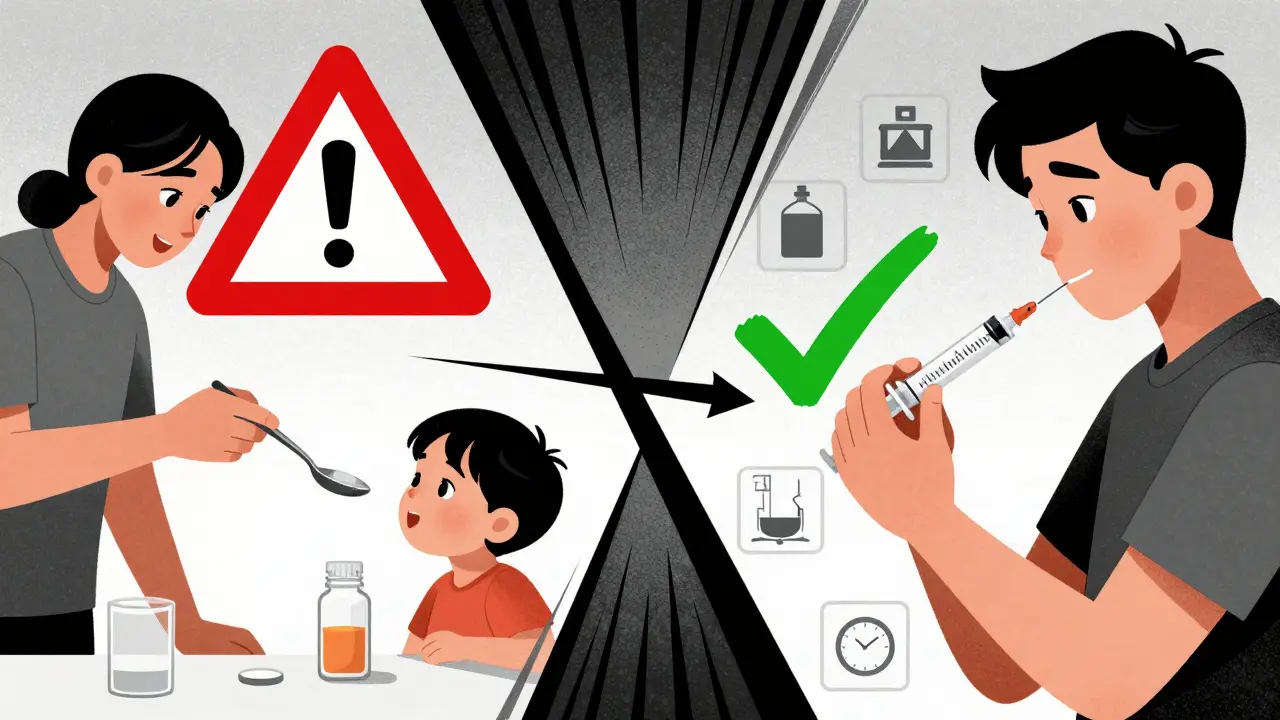
People assume "take one tablet" means one tablet. But what if the tablet is 500mg and your doctor prescribed 1000mg? That’s two tablets. Labels don’t always spell it out like a recipe. You have to read between the lines.For liquids, it gets trickier. A label might say: "350 mg per 5 mL." That means every 5 milliliters contains 350 mg of the drug. If you need 700 mg, you need 10 mL-not two spoonfuls. Household spoons vary wildly. A teaspoon can hold anywhere from 2.5 mL to 7.3 mL. That’s why the American Academy of Pediatrics says: never use kitchen spoons. Use the oral syringe that came with the bottle. Or buy a dosing cup marked in mL. No guessing.
Parents of young kids are especially at risk. A 2022 study found 68% of parents made dosing mistakes with liquid medicines because they didn’t understand concentration. If your child weighs 20 pounds, and the label says "5 mL for 20-25 lbs," you don’t give more because they’re "sick"-you give exactly what’s written. Weight matters more than age for kids’ meds.
Why Warnings Are Non-Negotiable
You might think, "I’ve taken this before, it’s fine." But your body changes. You start a new blood pressure pill. You begin drinking grapefruit juice. You get older. Suddenly, what was safe last year isn’t safe now.The Express Scripts 2021 report showed 47% of people never read the warnings. That’s a problem. Warnings tell you:
- Don’t drink alcohol with this
- Don’t drive-this makes you drowsy
- Stop taking it and call your doctor if you get a rash
- This can interact with your heart medication
One of the most common ER visits from medication errors? People taking multiple OTC cold meds that all contain acetaminophen. They take NyQuil for sleep, then take Tylenol for headache. Boom-overdose. Liver damage. It’s silent. You don’t feel it until it’s too late. The Cleveland Clinic says 27% of medication-related ER visits come from this exact mistake.
The Five Rights of Safe Medication Use
Nurses follow a simple rule called the "Five Rights" to avoid errors. You should too:- Right Patient: Is the name on the bottle yours? Double-check.
- Right Drug: Does the name match what your doctor prescribed? Generic vs. brand can confuse you.
- Right Dose: Is the number on the label what your doctor told you? If it’s different, call the pharmacy.
- Right Route: Is it oral? Topical? Injectable? Don’t swallow a cream.
- Right Time: "Take every 8 hours" means 8 hours apart-not three times a day at breakfast, lunch, and dinner.
It sounds basic. But when you’re tired, stressed, or in pain, you skip steps. That’s when mistakes happen.
What to Do When You’re Confused
If you don’t understand the label, don’t guess. Don’t ask a friend. Don’t Google it. Call your pharmacist. They’re trained for this. They see hundreds of these labels every day. They know the tricks, the pitfalls, the hidden risks.Some meds come with a separate Medication Guide-a booklet the pharmacy gives you. The FDA requires these for high-risk drugs like insulin, blood thinners, opioids, and HIV meds. Read it. It’s not optional. It’s your safety net.
And if you’re on multiple medications? Use a pill organizer. Write down each drug, its dose, and time on a sticky note. Tape it to the bottle. Keep a list in your phone. Don’t rely on memory.
What’s Changing on Labels
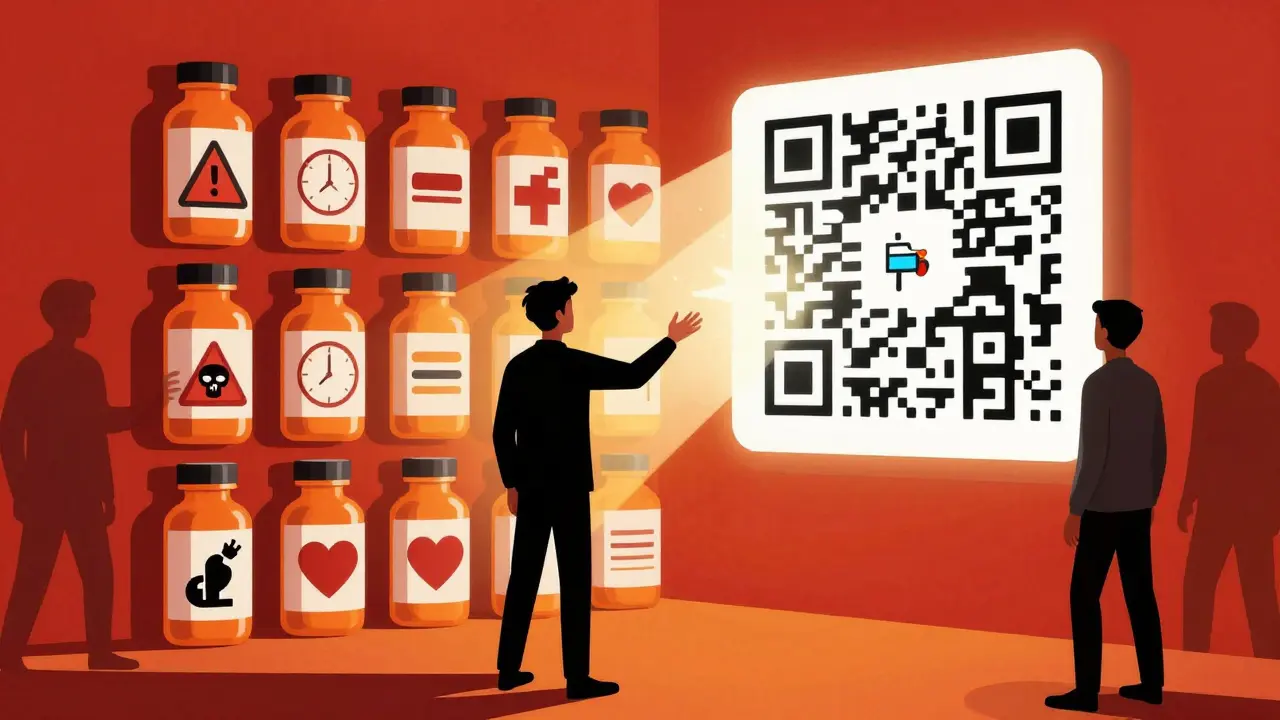
The FDA is pushing for simpler language. By 2024, you’ll start seeing QR codes on some prescription bottles. Scan it, and you’ll get a video showing exactly how to take the drug-no reading required. Some labels will use icons: a skull for danger, a clock for timing, a heart for cardiac risks.Color-coding is coming too. By 2027, high-alert drugs like insulin and anticoagulants will have standardized red or orange caps across all brands. No more guessing which bottle is the dangerous one.
These changes are happening because people keep getting hurt. In the U.S., over 1.5 million preventable drug errors happen every year. Half of them? Because someone didn’t read the label-or misunderstood it.
Your Action Plan
Here’s what to do the next time you get a new prescription or buy OTC medicine:- Stop. Don’t rush to the car.
- Read the label out loud. Say it. Don’t just look.
- Check the active ingredient. If you’re taking two meds, make sure they don’t overlap.
- For liquids: Find the concentration. Calculate the dose. Use a syringe.
- Read the warnings. If anything says "do not use if," ask your pharmacist why.
- Write down the instructions. Put them where you’ll see them-on the fridge, next to your bed.
- Call the pharmacy if anything feels off. Even if it’s "just a question."
Medication labels are designed to protect you. But they only work if you use them. You’re not just a patient. You’re the last line of defense. Read it. Understand it. Question it. Your life depends on it.
Donna Fleetwood
January 31, 2026 AT 08:54Just wanted to say this is one of those posts that makes you pause and actually read the damn label next time. I used to blow past warnings like they were fine print on a warranty, but after my cousin ended up in the ER from mixing NyQuil and Advil, I started reading everything. Now I even check inactive ingredients if I’m sensitive to dyes. Small habits save lives.
Thanks for laying it out so clearly.
Melissa Cogswell
January 31, 2026 AT 13:45As a pharmacy tech, I see this every single day. People grab OTC meds like candy and never check the active ingredients. I had a guy yesterday take three different cold pills because ‘they all help with congestion’ - two of them had 650mg acetaminophen each. He didn’t even know what acetaminophen was. The FDA’s new QR code initiative? Long overdue. A video showing how to use a syringe for a toddler’s dose would’ve saved him hours of panic.
Also - never use kitchen spoons. Ever. A tablespoon is not 15mL unless it’s a measuring spoon. Most are closer to 18mL. It’s insane.
Beth Cooper
February 2, 2026 AT 08:10They’re hiding something. You ever notice how the FDA pushes QR codes and color-coded caps but never mentions the real issue? Big Pharma doesn’t want you to understand your meds because then you’d ask why they’re charging $500 for a bottle of generic ibuprofen. The labels are dumbed down so you’ll keep buying their overpriced versions. The ‘warnings’? They’re there to cover their asses, not protect you. Read between the lines - if it says ‘may cause drowsiness,’ it’s because they know you’ll still drive.
And why do they make the inactive ingredients so obscure? Gluten? Soy? They know people are allergic but they don’t want to admit it. This isn’t safety - it’s control.
Holly Robin
February 2, 2026 AT 20:46THEY KNOW. THEY KNOW YOU’RE NOT READING. THEY COUNT ON IT. I SAW A PHARMACIST LAUGH WHEN I ASKED WHY THE LABEL SAID ‘TAKE WITH FOOD’ BUT THE BOTTLE HAD NO FOOD WARNING ON THE BOX. THEY’RE LYING TO US. THE ‘DRUG FACTS’ ARE A SMOKE SCREEN. I’VE BEEN TRACKING THIS FOR YEARS - THEY USE THE SAME FILLERS IN EVERY BRAND SO YOU DON’T NOTICE YOU’RE TAKING THE SAME STUFF UNDER THREE DIFFERENT NAMES. AND THE ‘FIVE RIGHTS’? THAT’S FOR NURSES. THE SYSTEM IS DESIGNED TO MAKE YOU FAIL. YOU THINK YOU’RE BEING CAREFUL? YOU’RE BEING MANIPULATED.
CALL YOUR PHARMACIST? THEY WORK FOR THE COMPANY. THEY’RE PAID TO SELL, NOT TO SAVE YOU.
KATHRYN JOHNSON
February 4, 2026 AT 13:31Reading medication labels is not optional. It is a civic duty. Failure to do so endangers not only yourself but others - through drug interactions, ER overloads, and increased healthcare costs. If you cannot comprehend a Drug Facts panel, you should not be self-administering pharmaceuticals. This is not a suggestion. It is a baseline expectation of adult responsibility. Your ignorance is not a public service.
Sazzy De
February 5, 2026 AT 11:02My grandma used to keep a little notebook next to her pill organizer. Every med, time, why she took it, what her doc said. She’d even write the pharmacist’s name. I thought it was overkill until I saw her catch a mix-up before it happened. Now I do the same. It’s not hard. Just write it down. Seriously.
Also - yes, use the syringe. Even if it’s gross. I keep mine in a ziplock in my purse. No excuses.
Lily Steele
February 6, 2026 AT 11:27Just read this while waiting for my refill and realized I’ve been taking my blood pressure med wrong for two years. Thought ‘once daily’ meant morning. Turns out it’s supposed to be bedtime. My doctor never said. My pharmacist never corrected. I’m calling them tomorrow. Thanks for the nudge. Small things matter.
April Allen
February 6, 2026 AT 13:02The structural epistemology of pharmaceutical labeling reveals a profound asymmetry in patient agency. The regulatory framework, while ostensibly designed for autonomy, functions as a technocratic apparatus that externalizes cognitive labor onto the layperson - who, by virtue of socioeconomic and educational stratification, is structurally ill-equipped to decode the semiotics of dosage, concentration, and contraindications. The introduction of QR codes and color-coded caps, while ostensibly democratizing access, merely reifies the hegemony of institutional authority by replacing textual literacy with algorithmic compliance. True patient empowerment requires not better labeling, but the dismantling of the pharmacological paternalism that renders the patient a passive recipient rather than an active agent in their own somatic governance.
Also, never use spoons. That’s just common sense.
Sidhanth SY
February 6, 2026 AT 15:52Love how this post breaks it down. I’m from India and here, people just take whatever the shopkeeper says. No labels, no instructions. I showed my cousin how to read a bottle and she was shocked - ‘Why do they write so much?’ I told her, because someone died last week from mixing painkillers. Now she checks everything. Education changes things. Keep spreading this.
Adarsh Uttral
February 8, 2026 AT 10:23lol i just realized i been using a kitchen spoon for my kid’s amoxicillin. like 3 spoons a day. no wonder she was always sleepy. gonna get a syringe tomorrow. thanks for the wake up call. also why is the bottle so small? like 50ml for 10 days? seems like they want us to buy more. conspiracy?
Shubham Dixit
February 9, 2026 AT 02:51Why are we letting foreigners dictate how we take medicine? The FDA is a globalist tool. In India, we know our bodies. We’ve been using turmeric, neem, and home remedies for centuries. Why do we need QR codes and color-coded caps? Because they want us dependent on pills. This is chemical colonization. The label says ‘do not take with grapefruit’ - but in India, we eat grapefruit every day. Our bodies are stronger. We don’t need your Western overcomplicated systems. Read the label? No. Read your roots. Trust your culture. Not your pharmacy.
Bobbi Van Riet
February 11, 2026 AT 01:15I used to be the person who skimmed everything until my mom had a reaction to a new blood pressure med. She didn’t read the warning about grapefruit juice - and she drank it every morning. Turned out the med was metabolized differently in her liver, and the combo caused her BP to crash. She ended up in the hospital for three days. Since then, I’ve become the family label detective. I read every single line. I check for interactions. I even Google the inactive ingredients if someone’s allergic to something weird like carmine or lactose. I know it sounds obsessive, but I’d rather be annoying than bury someone because I didn’t ask a question.
And yeah - the pharmacist is your best friend. They don’t get paid enough. But they know more than your doctor sometimes. Don’t be shy. Ask them to explain it like you’re five. They won’t judge. They’ve seen it all.