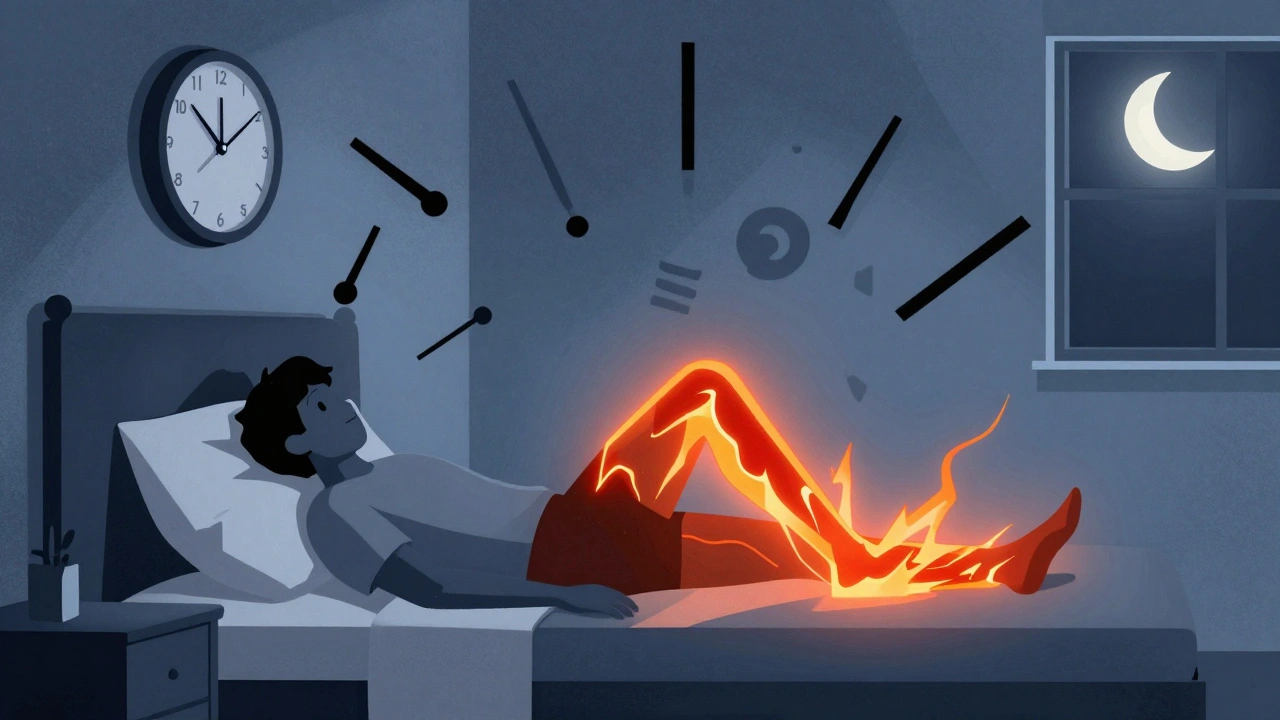
Restless Legs Syndrome isn’t just an itch you can’t scratch. It’s a relentless, crawling, aching urge in your legs that hits like clockwork every evening-right when you’re trying to relax, watch TV, or fall asleep. If you’ve ever tossed and turned for hours, only to feel like your legs are alive with electric ants, you’re not alone. About 10% of adults in the U.S. live with this condition, known medically as Willis-Ekbom disease. And for many, the real enemy isn’t the sensation itself-it’s the sleep it steals.
Why Your Legs Won’t Stay Still at Night
Restless Legs Syndrome (RLS) doesn’t show up on X-rays or blood tests. It’s diagnosed by what you feel and when you feel it. The International Restless Legs Syndrome Study Group laid out five clear rules: an urge to move your legs, symptoms that start or get worse when you’re resting, relief when you move, symptoms that spike in the evening or night, and no other medical condition explaining it. That’s it. No lab work needed. Just your story. The sensations vary. Some describe tingling, others a deep pull or burning. But the timing is always the same. Between 8 p.m. and midnight, symptoms can jump 300-400% in intensity. That’s not coincidence. It’s biology. RLS follows a strict circadian rhythm tied to dopamine levels in your brain. Dopamine, the neurotransmitter that helps control movement and reward, dips naturally at night. In people with RLS, that dip is sharper-and it triggers a signal in the spinal cord that makes your legs feel like they’re on fire. Brain scans show RLS patients have 20-30% fewer dopamine transporters in the striatum compared to people without it. That’s not a small difference. It’s a broken circuit. And it’s not just your legs. About 80-90% of RLS patients also have Periodic Limb Movement Disorder (PLMD), where their limbs jerk involuntarily every 20-40 seconds during sleep. These movements can happen 15 to 100 times an hour, shattering deep sleep. The result? You might spend 8 hours in bed, but only get 4-5 hours of real rest.The Sleep Thief: What RLS Does to Your Nights
Think you’re just a light sleeper? Think again. Polysomnography studies show RLS patients take 45-60 minutes just to fall asleep-double the time of someone without it. They wake up 6-10 times a night, compared to 2-3 for healthy sleepers. Sleep efficiency-the percentage of time actually spent sleeping while in bed-drops to 70-80%. Normal is 85-90%. That’s not just tiredness. That’s chronic sleep deprivation. The fallout isn’t just grogginess. People with RLS score 12-14 on the Epworth Sleepiness Scale-where 10+ means excessive daytime sleepiness. Their attention and working memory drop by 20-30%. One study found they’re 2.3 times more likely to be in a car accident. That’s higher than the risk from texting while driving. And it’s not just physical. The constant fatigue leads to irritability, anxiety, and depression. Many patients say they’ve lost jobs, relationships, or hobbies because they’re too exhausted to show up. One woman on Reddit wrote: “I canceled my daughter’s birthday party because I couldn’t get out of bed. I didn’t even have the energy to cry.”Dopaminergic Therapy: Fast Relief, Slow Consequences
For decades, the go-to fix for RLS has been dopamine-boosting drugs. Three are FDA-approved: ropinirole (Requip), pramipexole (Mirapex), and rotigotine (Neupro patch). They work fast-often within an hour. Patients report sleeping through the night for the first time in years. That’s life-changing. But here’s the catch: these drugs don’t cure RLS. They mask it. And over time, they can make it worse. Augmentation is the biggest risk. That’s when symptoms start earlier in the day, spread to your arms or torso, or get stronger even with the same dose. In clinical trials, 20-70% of patients develop augmentation after one year. Pramipexole has the highest rate-66% after three years. Rotigotine, the patch, is better at 26%. That’s why doctors now warn against using the highest doses. The maximum for ropinirole is 4 mg daily. For pramipexole, it’s 0.5 mg. Go higher, and you’re not helping-you’re accelerating the problem. Another hidden danger: impulse control disorders. About 6-17% of users develop compulsive behaviors-gambling, shopping, binge eating, even hypersexuality. One patient on Healthgrades reported racking up $20,000 in credit card debt from online shopping after starting pramipexole. The FDA added black box warnings for these risks in 2016. They’re not rare. They’re common enough that every patient should be screened before starting treatment.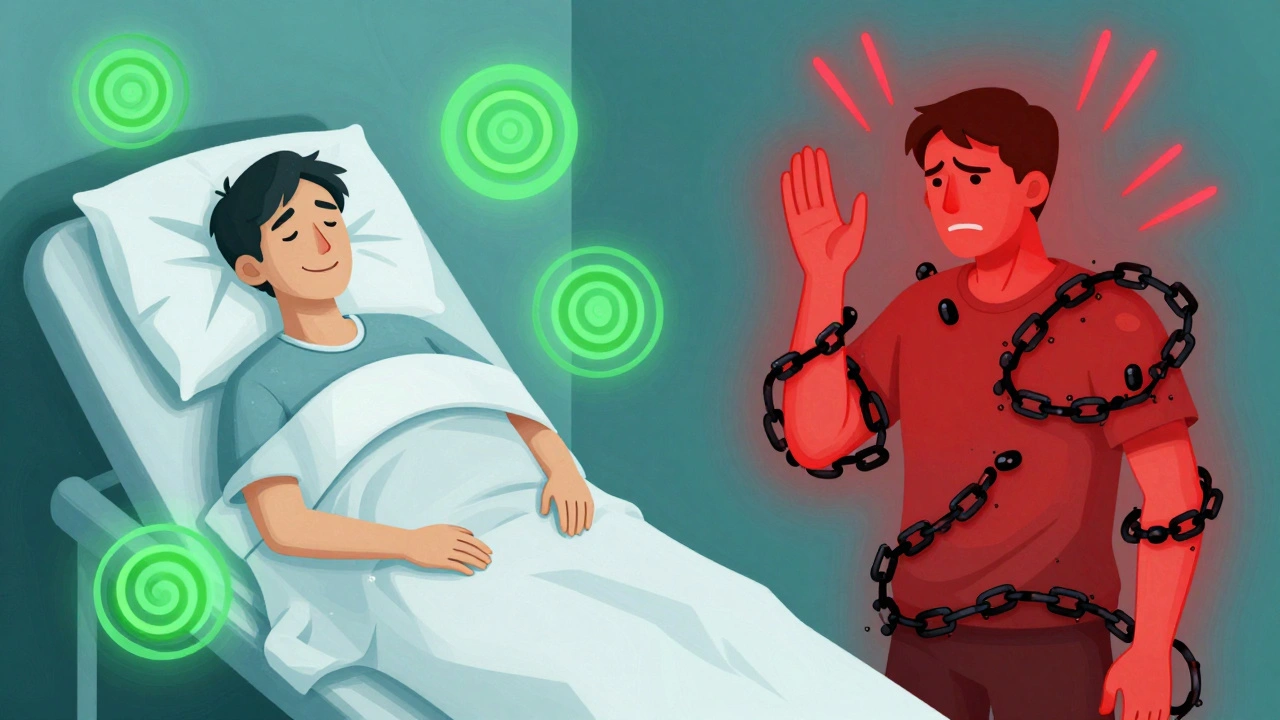
Alternatives That Actually Work (Without Making Things Worse)
There’s another path. Alpha-2-delta ligands-gabapentin enacarbil and pregabalin-are now recommended as first-line treatment for chronic RLS. They don’t boost dopamine. Instead, they calm overactive nerves. They take 2-4 weeks to kick in, but they don’t cause augmentation. In a 2021 head-to-head trial, pregabalin matched pramipexole in symptom relief but had only 8% augmentation versus 32% at six months. Iron therapy is another option-if you’re deficient. About 30% of RLS patients have low iron in the brain, even if their blood iron looks normal. A single IV infusion of ferric carboxymaltose can improve symptoms by 30-40% in those with ferritin below 75 ng/mL. But it takes 3-6 months to see results. It’s slow, but it’s safe and long-lasting. Lifestyle changes matter too. Regular moderate exercise, avoiding caffeine after noon, and keeping a consistent sleep schedule can cut symptoms by 30-50%. One study found that patients who tracked their symptoms in a daily journal were 83% more likely to catch augmentation early.Who Gets What-and Why
Not everyone needs drugs. If your symptoms are mild or only happen a few nights a week, skip the pills. Try iron testing first. If your ferritin is below 75, get an IV. If it’s normal, focus on sleep hygiene and exercise. For moderate to severe cases, doctors now prefer alpha-2-delta ligands over dopamine agonists. Why? Because augmentation is irreversible. Once your symptoms start creeping into the afternoon, you can’t just stop the drug and go back to how you were. The brain adapts. The damage sticks. Dopamine agonists are still used-but only for short-term relief or when other treatments fail. A 2022 survey of sleep specialists found 63% would reduce dopamine use if better options existed. But 89% still say they’re essential for severe, treatment-resistant cases.The Future: Personalized Treatment and New Hope
The next wave of RLS treatment is personalization. Researchers have found that two genes-BTBD9 and MEIS1-predict who’s likely to respond to pramipexole and who’s at high risk for augmentation. In a 2022 study, genetic testing predicted treatment success with 72% accuracy. That’s not perfect, but it’s a start. New drugs are coming. Fipamezole, an alpha-2 adrenergic antagonist, showed 35% lower augmentation rates than pramipexole in early trials. Intranasal apomorphine is being tested for rapid, short-term relief without the systemic side effects of pills or patches. And in 2023, a new extended-release version of ropinirole (Requip XL) hit the market. It delivers steady drug levels over 24 hours, cutting augmentation risk from 31% to 18% in one year. It’s not a cure, but it’s progress.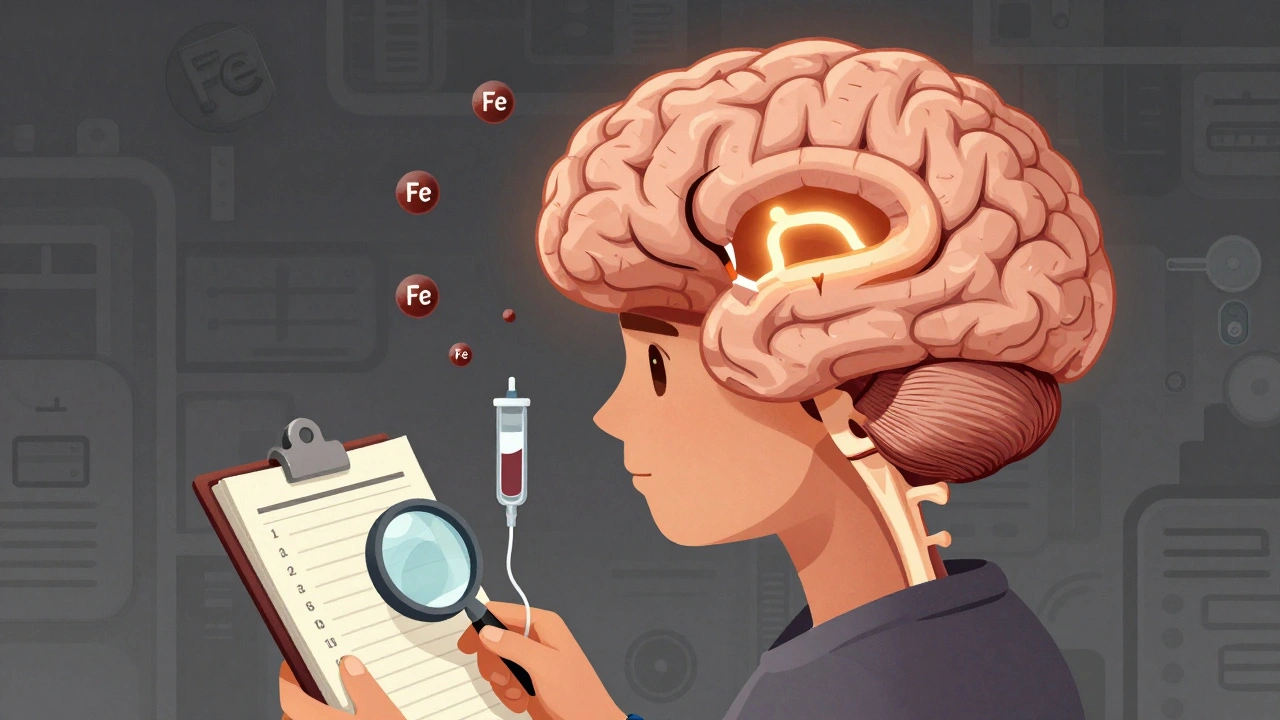
What to Do If You Think You Have RLS
If you’re losing sleep to leg sensations, start here:- Track your symptoms for two weeks. Note when they start, how bad they are (0-10 scale), and if they spread.
- Get your serum ferritin checked. If it’s under 75 ng/mL, ask about IV iron.
- Eliminate caffeine after noon. Avoid alcohol and nicotine at night.
- Try walking or stretching for 15 minutes before bed.
- If symptoms persist, see a sleep specialist-not just your GP. RLS requires expertise.
Real Stories, Real Choices
One man, 58, switched from pramipexole to pregabalin after two years of augmentation. “I started getting restless at 3 p.m. I was terrified I’d never sleep again. The switch wasn’t easy-my legs were awful for two weeks. But now? I sleep. I’m back to gardening. I didn’t know I’d forgotten what rest felt like.” Another woman, 42, stayed on ropinirole for five years. “I was scared to stop. But when I did, I found out my symptoms were worse than I remembered. I had to go back. But now I use the lowest dose possible and take breaks every few months. I’m not cured. But I’m not drowning either.”Bottom Line
Restless Legs Syndrome isn’t a nuisance. It’s a neurological condition that steals sleep, health, and quality of life. Dopaminergic therapy gives fast relief-but it’s a temporary fix with serious long-term risks. The best approach is layered: test for iron, optimize sleep habits, and use non-dopamine drugs first. Reserve dopamine agonists for when nothing else works-and monitor closely. There’s no magic pill. But there is a smarter way to live with it.Can RLS go away on its own?
Rarely. Primary RLS-meaning it’s not caused by another condition like kidney disease or pregnancy-is usually lifelong. Symptoms can improve temporarily, especially during pregnancy or with lifestyle changes, but they almost always return. There’s no cure, but with the right management, most people can live well with it.
Is RLS genetic?
Yes. About 60-70% of people with RLS have a family member with it. Two genes, BTBD9 and MEIS1, are strongly linked to the condition. If a parent has RLS, you’re 50% more likely to develop it. Genetics don’t guarantee it, but they raise your risk significantly.
Can iron supplements help?
Only if you’re deficient. Oral iron often doesn’t raise brain iron levels enough. A blood test for serum ferritin is key. If your level is below 75 ng/mL, IV iron (ferric carboxymaltose) is more effective than pills. It can reduce symptoms by 30-40%, but it takes months to work. Don’t take iron without testing-too much can be harmful.
Why do dopamine drugs make RLS worse over time?
Dopamine agonists overstimulate brain receptors, causing them to become less sensitive. The brain tries to compensate by reducing its own dopamine activity and increasing receptor sensitivity to movement triggers. This leads to augmentation-symptoms start earlier, spread, and intensify. It’s like turning up the volume on a broken speaker until it distorts. Higher doses make it worse, not better.
How do I know if I’m experiencing augmentation?
Look for these signs: symptoms starting earlier in the day (like mid-afternoon instead of bedtime), spreading to your arms or torso, needing higher doses for the same relief, or feeling symptoms even when you’re active. If you notice any of these, talk to your doctor. Early detection can prevent full-blown augmentation.
Are there any natural remedies that work?
Some help, but they’re not replacements for medical treatment. Magnesium and folate supplements may ease mild symptoms. Compression socks, leg massages, warm baths, and regular exercise can reduce intensity. Avoiding sugar, alcohol, and caffeine after noon is one of the most effective non-drug strategies. But if symptoms are moderate to severe, you’ll likely need prescription treatment to get real relief.
Can RLS affect children?
Yes. Children with RLS often describe it as “creepy crawlies” or say their legs feel “tired.” They might be labeled as fidgety, restless, or have trouble concentrating in school. Many are misdiagnosed with ADHD. If a child has persistent leg discomfort at night and an urge to move, it’s worth discussing with a pediatric neurologist. Iron deficiency is common in kids with RLS and should be checked.
iswarya bala
December 8, 2025 AT 20:59omg i had no idea rls was this complex!! i thought it was just ‘bad sleep hygiene’ lol. my mom’s had it for 20 years and she swears by magnesium gummies. turns out she’s probably iron deficient?? going to get her tested tomorrow 🙏
Simran Chettiar
December 10, 2025 AT 13:38It is, indeed, a profound neurological phenomenon, one that transcends mere physical discomfort and enters the realm of existential sleep deprivation. The dopamine system, as a modulator of both motor control and reward anticipation, becomes not merely dysregulated but catastrophically inverted in its feedback mechanisms. One must ask: is the brain’s attempt to compensate not a form of self-sabotage? The augmentation phenomenon is not a side effect-it is the disease revealing its true, recursive nature.
Noah Raines
December 10, 2025 AT 14:22bro i was on mirapex for 3 years. started getting restless at 2pm. thought i was just stressed. turned out i was having ‘augmentation’ like a glitchy robot. switched to gabapentin and now i sleep like a baby. no more 3am leg wars. 🙌
Katie Harrison
December 10, 2025 AT 22:39It is, however, worth noting that the reliance on pharmacological intervention, particularly dopamine agonists, reflects a broader societal tendency to pathologize natural circadian variation. The body’s rhythms are not failures to be corrected, but signals to be understood. Iron deficiency, sleep hygiene, and movement-these are not ‘alternatives.’ They are foundational. Why are they so often treated as afterthoughts?
Guylaine Lapointe
December 12, 2025 AT 15:55Wow. So you’re telling me people are literally gambling away their savings because of a sleep pill? That’s not just a side effect-that’s a medical scandal. The FDA should have banned these drugs years ago. And now they’re pushing ‘extended-release’ versions like it’s an upgrade? It’s not. It’s just a slower poison.
Jennifer Blandford
December 13, 2025 AT 07:18My cousin was misdiagnosed with ADHD as a kid because she kept fidgeting in class. Turns out? RLS. She didn’t get tested for iron until she was 28. Now she gets IV iron every 6 months and finally sleeps. I’m crying. This needs to be taught in med school. Like, yesterday.
Ruth Witte
December 13, 2025 AT 22:30YESSSSSSSSSSS TO IV IRON!!! 🙏 I was so tired I thought I was depressed. Got my ferritin checked-was at 12. One IV infusion and I could finally read a book at night without my legs screaming. No drugs. No side effects. Just… peace. 💖
Courtney Black
December 15, 2025 AT 01:24Everything is dopamine. Everything. RLS, addiction, depression, even your craving for carbs after 8pm. We’ve turned our brains into vending machines. You press the dopamine button, you get relief. But the machine? It starts eating itself. The real question isn’t how to treat RLS-it’s how we stopped seeing the body as a system, and started seeing it as a remote control.
Christian Landry
December 15, 2025 AT 05:47so i’ve been on ropinirole for 4 years. just found out i have augmentation. my arms are twitching now at work. i’m scared to stop. any tips? i’m trying yoga and cutting caffeine. still feel like a zombie.
Anna Roh
December 15, 2025 AT 08:08Why is everyone so obsessed with dopamine? What about GABA? Serotonin? Maybe it’s not the dopamine that’s broken-it’s the whole damn system. And why is IV iron so expensive? Because Big Pharma doesn’t profit from iron. That’s the real story.
Mona Schmidt
December 17, 2025 AT 03:17Thank you for writing this with such precision. As a neurology nurse, I’ve seen too many patients suffer from augmentation because their doctors didn’t warn them. The 20-70% statistic isn’t just a number-it’s a generation of people who lost their sleep, their dignity, and sometimes their marriages. We need mandatory patient education before prescribing dopamine agonists. Not a suggestion. A requirement.
Shubham Mathur
December 18, 2025 AT 19:17Iron deficiency is the silent epidemic no one talks about. My sister had RLS since she was 16. She tried everything. Pills, yoga, massage. Nothing worked. Then we found out her ferritin was 8. IV iron. Two weeks later she slept through the night. No drugs. No side effects. Just iron. Why isn’t this standard care?
Asset Finance Komrade
December 19, 2025 AT 18:27Interesting. But let’s not romanticize ‘natural remedies.’ The human body is not a yoga mat. It’s a biochemical factory with faulty wiring. If dopamine agonists cause augmentation, then so do certain SSRIs. The problem isn’t the drug-it’s the reductionist model of neurology that treats symptoms as isolated events. RLS is not a leg problem. It’s a brain problem. And we’re still using band-aids.
Darcie Streeter-Oxland
December 21, 2025 AT 09:03It is, indeed, a matter of considerable concern that pharmacological interventions, while efficacious in the short term, have been permitted to dominate clinical practice to the exclusion of foundational, non-pharmacological modalities. The persistence of dopamine agonists as first-line treatment, despite well-documented augmentation rates, reflects a systemic failure in medical governance. A more rigorous, evidence-based, and ethically accountable approach is not merely desirable-it is imperative.