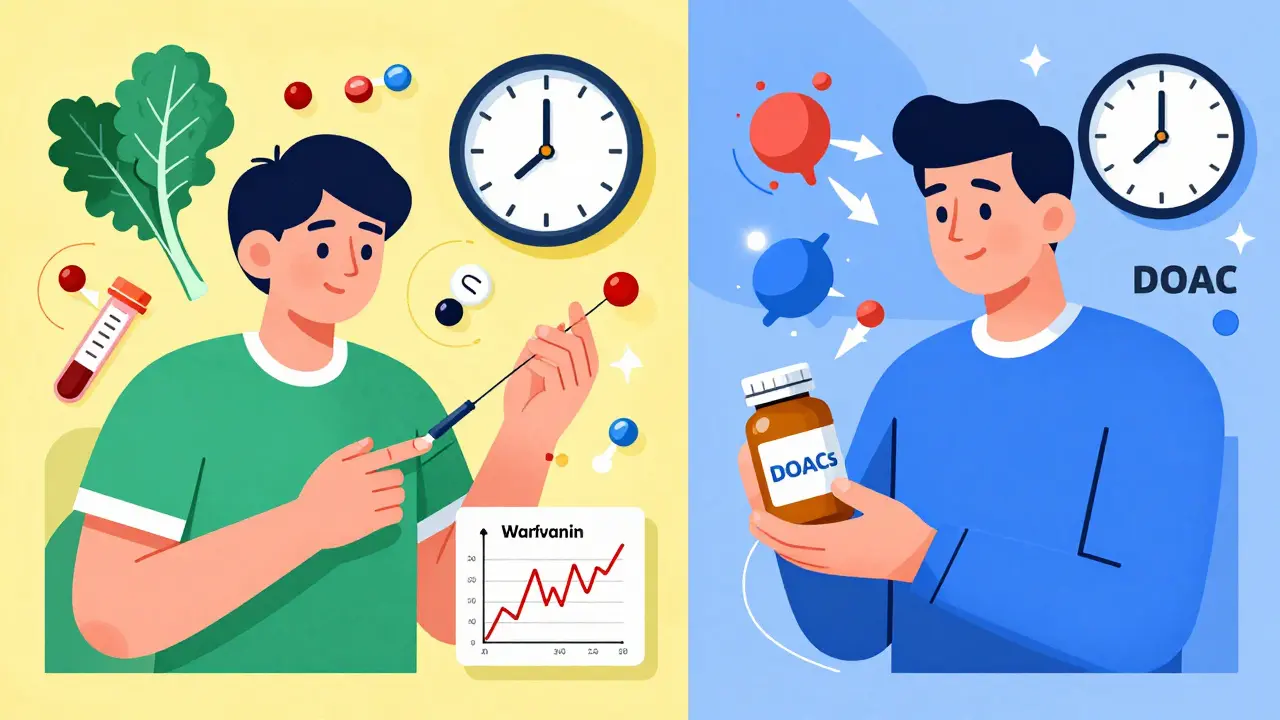
When your blood clots too easily, it can lead to strokes, pulmonary embolisms, or deep vein thrombosis. That’s why doctors prescribe anticoagulants-medications that slow down clotting. But not all blood thinners are the same. For over 70 years, Warfarin was the go-to choice. Today, it’s being replaced by a newer group called DOACs-direct oral anticoagulants. And when things go wrong, knowing how to reverse them can save lives.
What Warfarin Does and Why It’s Still Used
Warfarin, first approved in 1954, works by blocking vitamin K, which your body needs to make clotting factors. It’s cheap-often under $30 a month with insurance-and it’s been used in millions of patients. But it’s finicky. Too little, and you’re at risk for clots. Too much, and you could bleed internally.
To keep it safe, you need regular blood tests. The INR (International Normalized Ratio) measures how long your blood takes to clot. The target is usually between 2.0 and 3.0. If you’re on a mechanical heart valve, it might be higher. That means 15 to 20 blood draws a year, on average. Miss a test, eat a big serving of kale or spinach (high in vitamin K), start a new antibiotic, or skip a dose-and your INR can swing out of range.
It’s not just food and drugs. Alcohol, fever, even stress can throw off your numbers. That’s why Warfarin is still used in only a few cases today: people with mechanical heart valves, those with severe kidney failure (eGFR under 15), or patients with antiphospholipid syndrome. For everyone else, DOACs are now preferred.
DOACs: The New Standard in Blood Thinners
DOACs-dabigatran, rivaroxaban, apixaban, and edoxaban-work differently. Instead of messing with vitamin K, they directly block specific clotting proteins. Dabigatran hits thrombin. The others block factor Xa. They start working in 1 to 4 hours, and their effects wear off faster than Warfarin’s.
Here’s the big win: no routine blood tests. No dietary restrictions. Fewer drug interactions. Warfarin has over 300 known interactions. DOACs? Around 40. That’s why, in 2023, 85% of new anticoagulant prescriptions in the U.S. were for DOACs.
Studies show DOACs are better at preventing strokes and clots. A 2023 JAMA study of nearly 18,500 people with blood clots found those on DOACs had a 34% lower chance of another clot than those on Warfarin. They also caused 17% fewer major bleeds overall. Apixaban, in particular, stood out-cutting stroke risk by 25% and major bleeding by 35%.
They’re not perfect. DOACs are expensive-$300 to $500 a month without insurance. Warfarin costs pennies. Some patients skip doses because of the price. And while DOACs are safer for most, they’re risky if your kidneys are failing. Most are cleared through the kidneys. If your eGFR drops below 30, they can build up. But even here, newer data shows apixaban may still be safer than Warfarin, even in dialysis patients.
Reversal Agents: What Happens When Things Go Wrong?
Every anticoagulant carries a bleeding risk. When someone has a major bleed-brain, stomach, or after trauma-you need to reverse it fast.
For Warfarin, you have options. Vitamin K reverses it slowly, over hours. Fresh frozen plasma (FFP) gives clotting factors but takes time to prepare. Prothrombin complex concentrate (PCC) works in minutes. It’s the go-to in emergencies. Hospitals keep it stocked. It’s reliable. And it’s cheap.
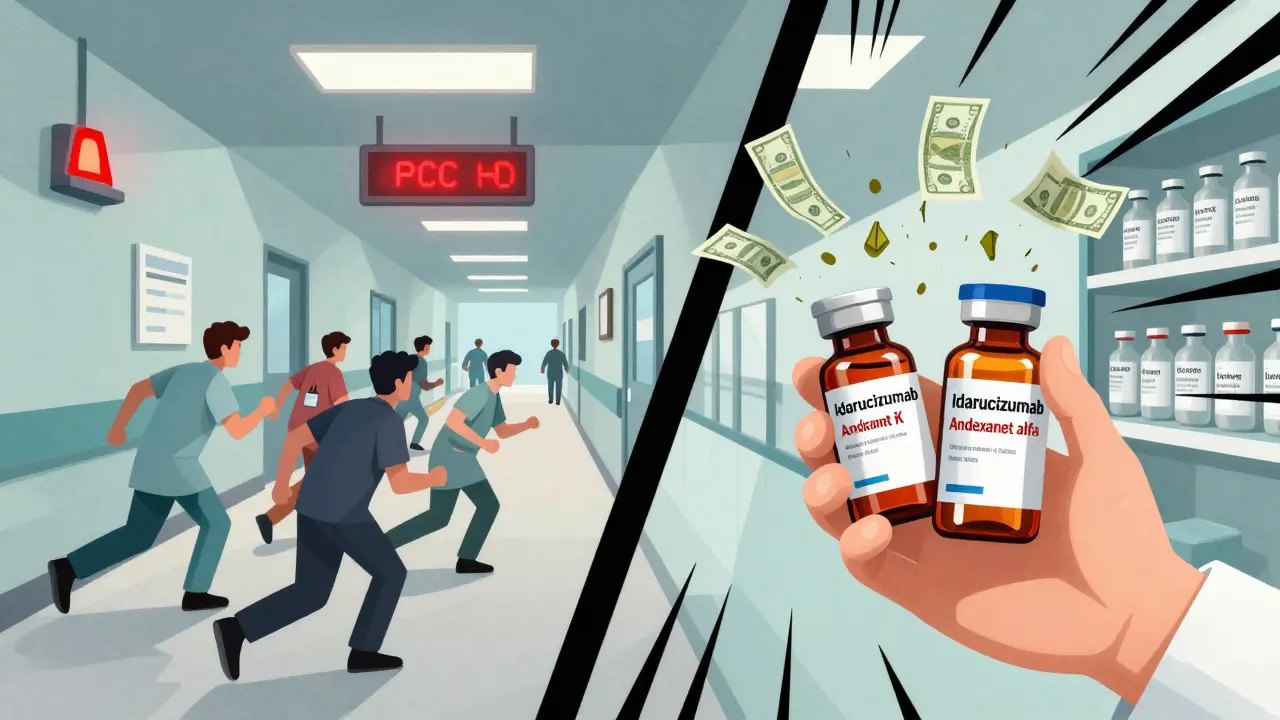
For DOACs, it’s more complicated. You need a specific antidote. Idarucizumab (Praxbind) reverses dabigatran. Andexanet alfa (Andexxa) reverses rivaroxaban, apixaban, and edoxaban. Both are monoclonal antibodies or modified proteins that bind tightly to the drug and neutralize it.
Idarucizumab works in seconds. In the RE-VERSE AD trial, 98.7% of patients with major bleeding saw their anticoagulant effect reversed within minutes. But each 5g vial costs $3,400. Andexanet? Around $17,000 per treatment. That’s why only 62% of U.S. hospitals stock these drugs. Rural hospitals often don’t have them. And if you don’t know which DOAC the patient is on, you’re stuck.
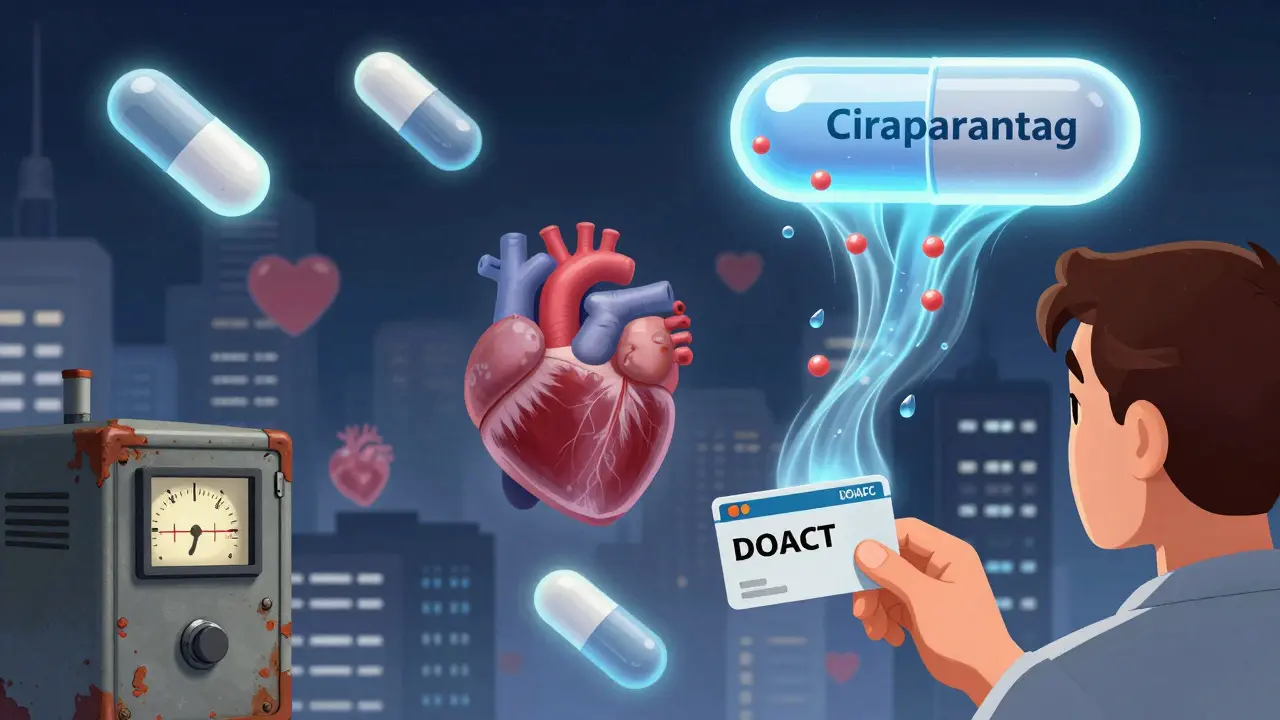
For factor Xa inhibitors without Andexanet, doctors use 4-factor PCC. It’s not as good-it only works about half the time. But it’s better than nothing. There’s also an experimental drug called ciraparantag in Phase III trials. It’s designed to reverse all DOACs and even heparin. If it gets approved, it could change everything.
Who Should Take What? The Real-World Rules
Doctors don’t just pick based on studies. They look at the person.
- For most people with atrial fibrillation: DOACs, no question. Especially if you’re under 75, have low body weight, or live far from a lab. Apixaban is often first choice-it’s the safest.
- For people with mechanical heart valves: Warfarin only. DOACs don’t work here. Period.
- For kidney patients: If your eGFR is above 30, DOACs are fine. If it’s below 15, stick with Warfarin. But new data suggests apixaban might be okay even in dialysis patients-ask your nephrologist.
- For cancer patients: DOACs (apixaban or rivaroxaban) are now recommended over injections like Lovenox. They’re easier, just as effective, and cause fewer clots.
- For elderly or frail patients: DOACs reduce intracranial bleeding by 45% compared to Warfarin. That’s huge. Brain bleeds are often fatal.
There are exceptions. If you’ve had a clot while on a DOAC before, Warfarin might be safer. If you can’t afford the drug, Warfarin is still effective-if you can stick to the monitoring. And if you’re under 50 kg or over 120 kg, data is limited. Some doctors still prefer Warfarin in these cases.
The Cost vs. Benefit Debate
DOACs cost more upfront. But they save money long-term. A 2022 study found they save $1,200 to $2,800 per patient per year in quality-adjusted life years (QALYs). Why? Fewer hospital visits. Fewer bleeds. Fewer INR tests. Fewer emergency room trips.
But cost still matters. In 2023, 34% of Medicare patients skipped their DOAC doses because of price. Only 12% skipped Warfarin. That’s a real problem. A drug that prevents strokes is useless if you can’t afford to take it.
Some insurers require step therapy-try Warfarin first. That’s outdated. But it’s still common. If you’re denied a DOAC, ask for a prior authorization. Cite the 2023 ACC/AHA guidelines. They say DOACs should be first-line.
What’s Next? The Future of Blood Thinners
The field is moving fast. New DOACs are being tested. Milvexian, a factor XIa inhibitor, showed 46% less bleeding than apixaban in a 2023 trial. It might be the next big thing-effective but safer.
Lower doses are also gaining ground. Rivaroxaban 10mg once daily works just as well as 20mg for long-term clot prevention-with 33% less bleeding. Apixaban 2.5mg twice daily is now approved for older, lighter, or kidney-impaired patients.
Universal reversal agents like ciraparantag could eliminate the biggest weakness of DOACs. If approved by 2026, they’ll make DOACs even safer and more widely adopted.
By 2028, DOACs will make up 82% of the anticoagulant market. Warfarin will be a backup-used only when DOACs can’t be given. The future is simpler, safer, and more predictable. But only if we can make it affordable.
Key Takeaways
- DOACs are now the first choice for most people needing anticoagulation-especially for atrial fibrillation or blood clots.
- Warfarin is still needed for mechanical heart valves, severe kidney failure, or antiphospholipid syndrome.
- DOACs don’t need blood tests, have fewer interactions, and cause fewer brain bleeds.
- Reversal agents exist for DOACs but are expensive and not always available.
- Cost is a real barrier-34% of Medicare patients skip DOACs because of price.
- Future drugs like milvexian and ciraparantag could make anticoagulation even safer.
Are DOACs safer than Warfarin?
Yes, for most people. DOACs reduce the risk of stroke and major bleeding by 17-35% compared to Warfarin, especially dangerous brain bleeds. They also don’t require frequent blood tests or dietary changes. But they’re not safer for everyone-people with mechanical heart valves or severe kidney failure still need Warfarin.
Can I switch from Warfarin to a DOAC?
Many people can. If you’re on Warfarin for atrial fibrillation or a blood clot (and don’t have a mechanical valve), switching to a DOAC is often recommended. Your doctor will check your kidney function, weight, and other meds first. The switch is done carefully-usually by stopping Warfarin and starting the DOAC when your INR drops below 2.0.
What if I have a major bleed while on a DOAC?
Call 911 immediately. Tell emergency staff what DOAC you’re taking. If you’re on dabigatran, they’ll use idarucizumab. If you’re on rivaroxaban or apixaban, they’ll use andexanet alfa-if it’s available. If not, they’ll use 4-factor PCC. Don’t wait. Time matters.
Do I need to stop my DOAC before surgery?
Usually, yes-but not always. For minor procedures, you might not need to stop. For major surgery, you typically stop 1 to 3 days before, depending on the drug and your kidney function. Always talk to your surgeon and cardiologist together. Never stop on your own.
Why do some doctors still prescribe Warfarin?
Three main reasons: cost, contraindications, and habit. Warfarin is cheaper and works for mechanical valves. Some doctors, especially in rural areas, aren’t trained on DOAC reversal. Others still believe INR monitoring is safer-even though studies show DOACs are more consistent and predictable.
Is there a blood test for DOACs?
Not routinely. But if there’s an emergency-like a major bleed or overdose-doctors can use special tests. Anti-Xa assays measure factor Xa inhibitors. Diluted thrombin time checks dabigatran. These aren’t used for regular monitoring, only in urgent cases.
What to Do Next
If you’re on Warfarin and wondering if you should switch, ask your doctor about your INR history. Have you been in range most of the time? Do you miss appointments? Are you on other meds that interact? If you’re on a DOAC, make sure you know which one you’re taking and what to do in an emergency. Keep a card in your wallet with your drug name and dose.
Cost is a problem. If your insurance denies your DOAC, ask for a prior authorization. Use patient assistance programs-many drugmakers offer them. Don’t skip doses just because it’s expensive. A stroke can cost you everything.
The era of Warfarin is ending. But the transition isn’t perfect. The goal is simple: keep you safe, prevent clots, and avoid bleeding. With the right drug, the right support, and the right knowledge-you can do that without constant blood tests or dietary stress.
ANA MARIE VALENZUELA
December 27, 2025 AT 21:29Let’s be real-DOACs are just fancy placebo pills for people who can’t handle a little discipline. Warfarin’s been around since Nixon was president, and it works if you actually care enough to monitor your INR. But nope, everyone wants a magic bullet that doesn’t require effort. You skip your blood test, eat kale, then blame the drug when you bleed out. Classic.
Bradly Draper
December 28, 2025 AT 22:07I’m just glad my grandma’s on apixaban now. She used to get so stressed about her weekly blood draws. Now she just takes her pill and forgets about it. No more counting spinach. I wish all meds were this easy.
Nicole Beasley
December 30, 2025 AT 13:23DOACs = life changing 🙌 I used to hate my INR visits-like, why does my blood have to be a math problem? Now I just take my pill, drink my coffee, and go. And yes, I cried when I found out there’s a reversal agent. I didn’t know that existed. 😭
Vu L
December 30, 2025 AT 23:25LOL 85% of docs prescribe DOACs? That’s because they’re lazy. Warfarin’s cheaper, proven, and if you’re smart you don’t need ‘em to babysit you. Also-did you know the FDA approved these drugs after one study where the placebo group had more heart attacks? Just saying.
James Hilton
December 31, 2025 AT 16:15USA: 85% on DOACs. Nigeria: Still using aspirin and prayer. 🇳🇬😂
Mimi Bos
December 31, 2025 AT 18:49i just started on rivaroxaban and honestly i had no idea there was a reversal drug?? like i thought you just waited it out?? and now im scared i might die if i fall and no one knows what i take 😅
oluwarotimi w alaka
January 2, 2026 AT 09:07DOACs are a big pharma scam to make you dependent on expensive drugs. Warfarin is from nature-vitamin K is from green plants. But they want you to pay $500 a month for a synthetic protein that only rich people can afford. And now they’re hiding the truth about reversal agents-because if you knew how expensive they are, you’d revolt. The system is rigged.
Debra Cagwin
January 2, 2026 AT 19:12If you’re on a DOAC, please keep a little card in your wallet with the name and dose. I’ve seen too many ER visits where no one knew what the patient was taking. You don’t need to be a doctor to save your own life-just a little prep. You’ve got this 💪
Hakim Bachiri
January 3, 2026 AT 21:00Let’s be honest: DOACs are a marketing gimmick wrapped in a JAMA study and sold to gullible patients who think ‘no blood tests’ means ‘no responsibility.’ Meanwhile, the reversal agents cost more than a used Prius. And yet, somehow, we’re supposed to be impressed? This isn’t progress-it’s financial engineering disguised as medicine.
Celia McTighe
January 5, 2026 AT 14:40My dad’s on apixaban and he’s 82. He used to have 3 INR trips a month-now he just takes his pill with breakfast. I cried when I saw how much less anxious he is. 🤍 And yes, the cost is a problem-but patient assistance programs exist. Call the pharma company. They’ll help. Don’t skip doses. You’re worth it.
Ryan Touhill
January 7, 2026 AT 12:37It’s fascinating how the medical establishment has embraced DOACs with such uncritical enthusiasm, despite the fact that their long-term safety profile remains incompletely characterized. The absence of routine monitoring is not a feature-it’s a liability. And while reversal agents exist, their accessibility is grossly inequitable, particularly in rural and under-resourced settings. One must ask: is this innovation-or institutionalized neglect disguised as convenience?