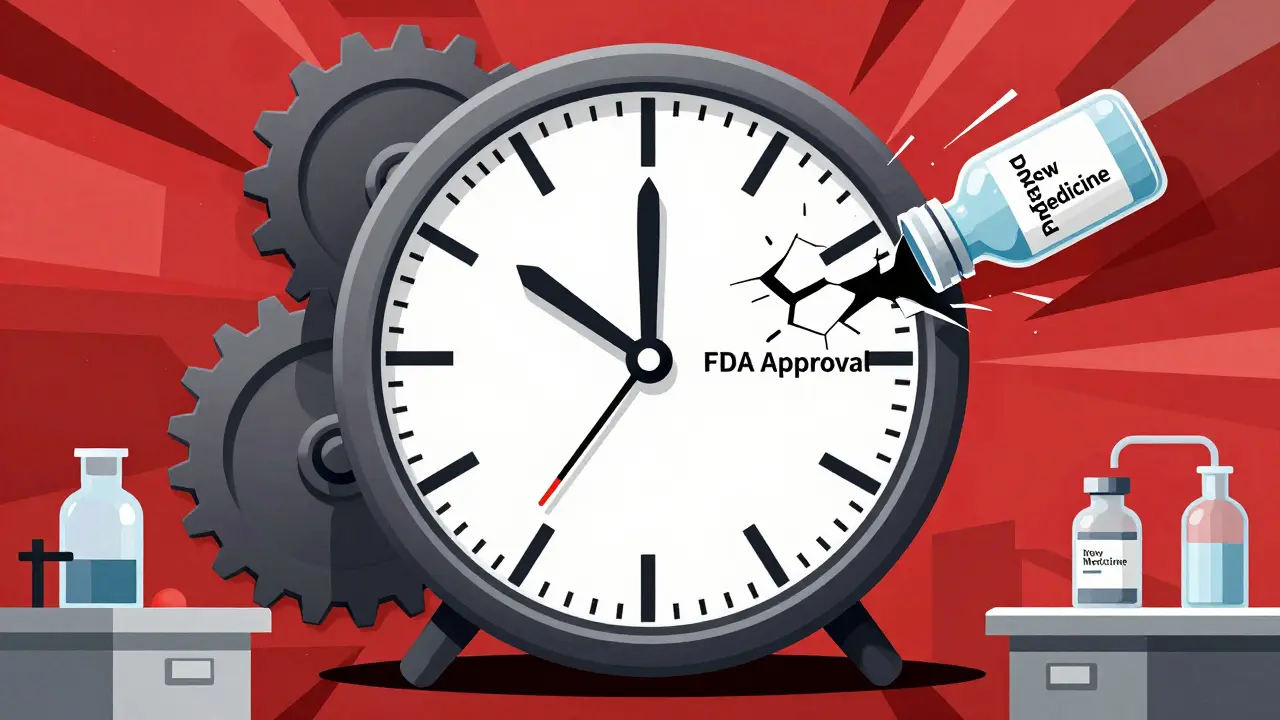
Most people think a drug patent lasts 20 years - and that’s technically true. But if you’re waiting for a brand-name drug to go generic because the patent clock hit 20 years, you’re going to be disappointed. In reality, most drugs lose patent protection after just 7 to 12 years on the market. Why? Because the 20-year countdown starts the day the patent is filed - not when the drug hits shelves. By the time a drug gets FDA approval, half the patent term is already gone.
How the 20-Year Clock Actually Works
The U.S. patent system follows a rule set in 1994: all patents, including drug patents, last 20 years from the earliest filing date. That sounds straightforward. But here’s the catch: drug development takes forever. On average, it takes 10 to 12 years just to get a new drug from lab to pharmacy. That means the clock is ticking while the company is still running clinical trials, paying for safety tests, and waiting for regulators to review data. By the time the drug is approved and sold, the patent might have only 8 or 9 years left. That’s not enough time to recoup the $2.3 billion average cost of bringing a drug to market.
This is why the Patent Term Extension (PTE) exists. Thanks to the Hatch-Waxman Act of 1984, drugmakers can apply for up to 5 extra years of protection to make up for time lost during FDA review. But there’s a hard cap: the total time from FDA approval to patent expiration can’t exceed 14 years. So even with extension, you’re rarely looking at more than 14 years of market exclusivity.
What Else Can Extend a Drug’s Patent Life?
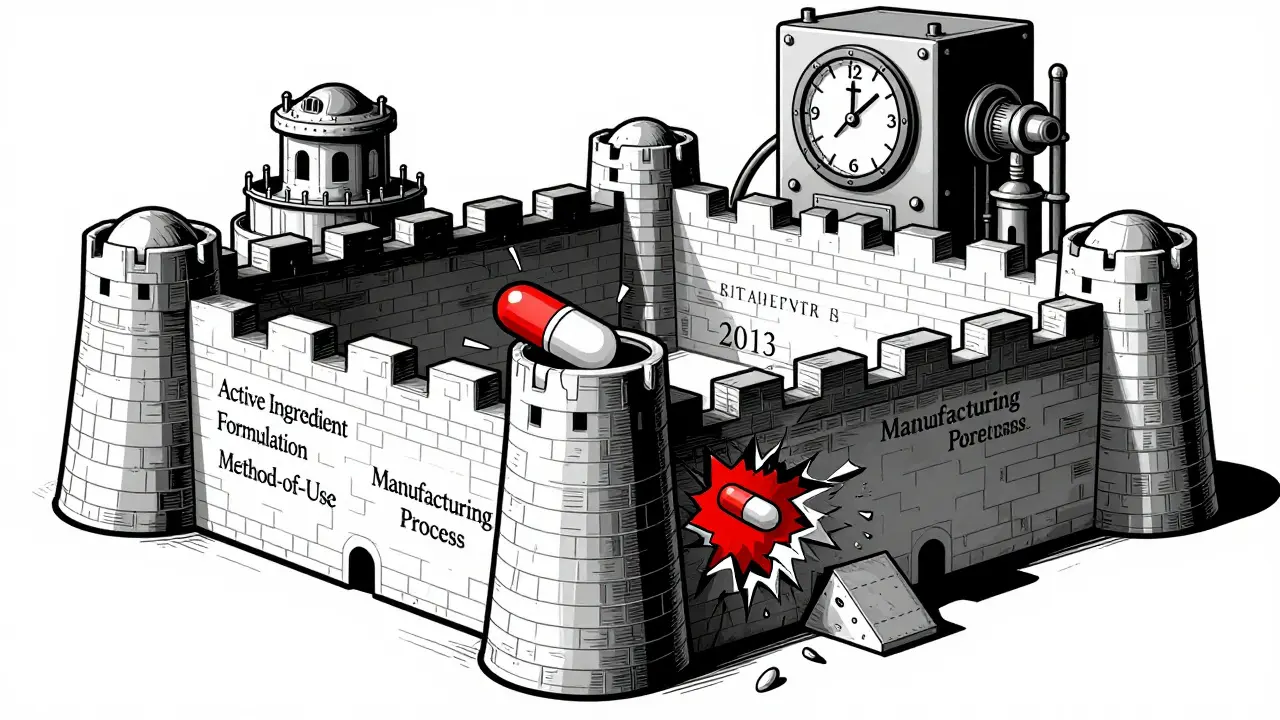
It’s not just about extending the original patent. Pharmaceutical companies rarely rely on one patent. They build a whole wall of protection around a single drug. Think of it like a fortress with multiple layers.
- Active ingredient patents - the core chemical that makes the drug work. This is the first line of defense.
- Formulation patents - cover how the drug is made: pill, liquid, patch, extended-release. A company might file a new patent on a slow-release version to delay generics.
- Method-of-use patents - protect new ways to use the drug. For example, if a heart drug originally approved for high blood pressure later gets approved for heart failure, a new patent can be filed.
- Manufacturing process patents - protect how the drug is produced. Even if the chemical is public, the exact method to make it can be patented.
Take Spinraza (nusinersen), a drug for spinal muscular atrophy. Its original patent was filed in 2013, but because of multiple layered patents, its protection stretches all the way to 2030. That’s 17 years of exclusivity - not because the original patent was extended, but because new patents were filed on different aspects of the drug.
This strategy is called evergreening. Critics say it’s a way to delay competition. The Federal Trade Commission found that some companies file secondary patents on minor changes - like a new pill coating or a different injection device - to push back generic entry by 2 to 3 years.
Regulatory Exclusivity: The Secret Weapon
Even if a patent expires, a drug might still be protected by something called regulatory exclusivity. These are separate from patents and granted by the FDA. They’re not about invention - they’re about data.
- New Chemical Entity (NCE) exclusivity - 5 years. During this time, the FDA can’t even look at a generic application. This is automatic for brand-new drugs.
- Orphan Drug exclusivity - 7 years. For drugs treating rare diseases (fewer than 200,000 U.S. patients). This is a powerful incentive for companies to develop treatments for small patient groups.
- New Clinical Investigation exclusivity - 3 years. For new uses, doses, or delivery methods that require new clinical trials.
- Pediatric exclusivity - 6 months added to existing patents or exclusivity periods. Companies get this bonus if they study how the drug affects children.
These exclusivities can stack. A drug might have 5 years of NCE exclusivity, then 6 months of pediatric exclusivity on top - meaning no generics can enter for 5.5 years, even if the patent expired earlier.
Why Generics Don’t Show Up Right Away
Even after patents and exclusivity expire, generics don’t flood the market overnight. Why? Because of legal battles.
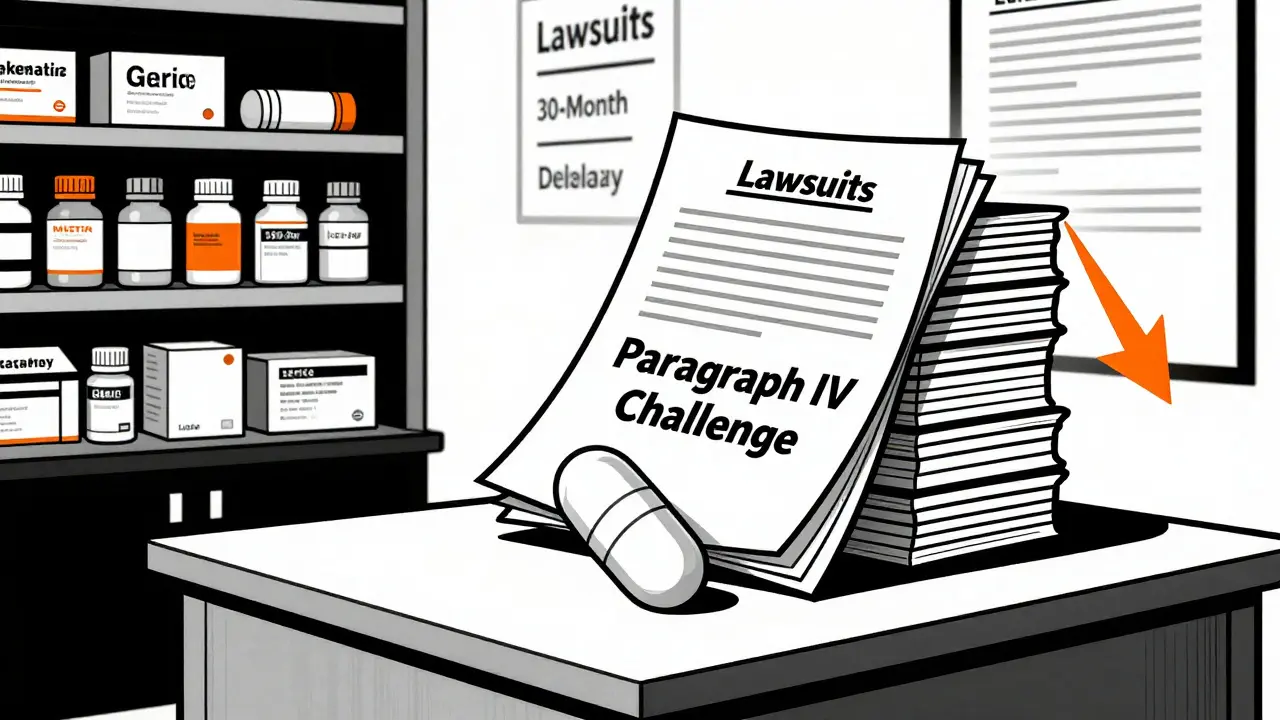
Under the Hatch-Waxman Act, generic companies can file a Paragraph IV certification - basically saying, “We believe your patent is invalid or won’t be infringed.” This triggers a lawsuit. If the brand-name company sues within 45 days, the FDA is forced to delay approval of the generic for 30 months. That’s a legal timeout.
Here’s what that means in real numbers: if a patent expires in January 2026, but a generic company files a Paragraph IV challenge in October 2025, and the brand sues, the generic won’t be approved until at least July 2028 - even if the patent is later thrown out.
And here’s another twist: the first generic company to challenge a patent gets 180 days of exclusive sales rights. That’s a huge financial incentive. So sometimes, you’ll see one generic hit the market, then no others for half a year - even though the patent is gone.
What Happens When the Patent Finally Expires?
When a drug finally opens up to generics, the price drops hard - and fast.
Take Eliquis (apixaban). Its patent expired in December 2022. Within six months, generics made up 35% of sales. By the end of the first year, prices fell 62%. Two years later, generics held over 90% of the market.
Biologics - like Humira or Enbrel - are trickier. They’re complex molecules made from living cells. Generics for these are called biosimilars, and they’re harder to make. So even after patents expire, biosimilars take longer to gain traction. They usually capture 40-60% of the market after 2 years.
But here’s the kicker: insurance companies don’t always switch you to the cheapest option. Some plans still charge a $200 copay for a generic if the brand-name drug had a $50 copay during its patent life. Patients have reported being hit with surprise bills during these transitions.
What’s Changing in 2026?
There’s growing pressure to shorten patent terms. The World Health Organization recommends cutting pharmaceutical patents to 15 years to improve global access. Meanwhile, the U.S. Patent and Trademark Office is rolling out automated systems to streamline patent term adjustments - which could make it harder to game the system.
Also, in February 2024, Congress introduced a bill called the Restoring the America Invents Act that could remove some patent term adjustments. If passed, it could cut average exclusivity by 6 to 9 months. That means more drugs could go generic sooner.
And the numbers are staggering. In 2025 alone, the pharmaceutical industry is expected to lose $62 billion in revenue due to patent expirations. By 2028, cumulative losses will hit $268 billion. That’s why companies are betting big on combo drugs - like Tagrisso (osimertinib), which combines multiple active ingredients to stretch protection until 2033.
What You Should Know
- Don’t assume a drug goes generic exactly 20 years after it’s invented. The real clock starts ticking long before the drug is even approved.
- Multiple patents, exclusivity periods, and lawsuits can delay generics for years - even after the main patent expires.
- Generics don’t always mean cheaper out-of-pocket costs. Check your insurance plan’s formulary.
- Biologics take longer to have biosimilars enter the market. Be patient - and ask your pharmacist.
- If you’re on a high-cost drug, start planning ahead. Around 18 months before a patent expires, generic versions usually start appearing.
Understanding drug patents isn’t just for lawyers or CEOs. It’s for anyone paying for prescriptions. Knowing how long a drug stays protected helps you anticipate when prices might drop - and when you might need to switch plans, providers, or even medications.
Do all countries have the same drug patent rules?
No. The U.S. uses a 20-year term from the filing date, but other countries adjust differently. Japan, for example, calculates patent expiration based on the later of five years after filing or three years after requesting examination. The EU generally follows the 20-year rule but allows for a Supplementary Protection Certificate (SPC) that can add up to 5 years. In developing countries, patent rules are often more flexible - especially for public health emergencies. The World Trade Organization’s TRIPS Agreement sets a global minimum, but countries can use compulsory licensing to allow generics during health crises.
Can a patent expire before 20 years?
Yes. If the patent holder fails to pay maintenance fees - which are required at 3.5, 7.5, and 11.5 years after grant - the patent can be abandoned. This is rare for blockbuster drugs because the financial stakes are too high. But for smaller or less profitable drugs, companies sometimes let patents lapse if they don’t see enough future revenue. In those cases, generics can enter earlier than expected.
How do I find out when a specific drug’s patent expires?
The best public source is the FDA’s Orange Book, which lists all patents and exclusivity periods for approved drugs. You can search it online at fda.gov/orangebook. It includes patent numbers, expiration dates, and whether the patent is for the drug substance, formulation, or use. For more detail, services like DrugPatentWatch offer subscription-based tools with real-time tracking and litigation alerts.
Why do some generics cost more than others?
It’s not about quality - it’s about timing. The first generic to enter the market often gets a 180-day exclusivity period. During that time, they’re the only option, so prices stay higher. After that, competition kicks in and prices crash. Also, some generics are made with different inactive ingredients or delivery systems, which can affect how they’re covered by insurance. Always check with your pharmacy or insurer to see which version is covered under your plan.
What happens if a patent lawsuit takes longer than 30 months?
The FDA can approve the generic before the lawsuit ends - but only if the court hasn’t ruled in favor of the brand-name company. If the lawsuit is still ongoing after 30 months, the FDA may still approve the generic, but it can’t be marketed until the court resolves the dispute. This is why some generics sit on shelves for months after approval - waiting for legal clearance. The FTC reports that 78% of patent lawsuits over generics are resolved within 3 years, but the delay still affects patient access.